Remarks of UN Special Rapporteur on Torture and Other Cruel, Inhuman or Degrading Treatment or Punishment, Alice Jill Edwards
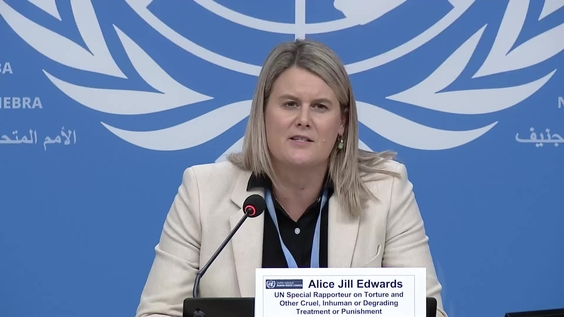
By Alice Jill Edwards
At the Consultation on Custodial Torture in India, organised by the People’s Union for Civil Liberties in Delhi on 09.05.2026.
Madam Kavita Srivastava and Dr. V. Suresh,
Ladies and gentlemen,
Thank you to the People’s Union for Civil Liberties for convening this important discussion and the kind invitation to speak on police accountability and the prevention of torture and ill-treatment.
India is a country with strong constitutional traditions, a vibrant civil society, an independent legal profession, and a judiciary that has historically played an important role in safeguarding fundamental rights. These are important foundations for confronting serious human rights challenges and strengthening the rule of law.
At the same time, there are also common allegations of normalised and frequent use of torture and other violence in custody, coercive interrogation practices, and a high number of unexplained deaths in police custody.
These allegations suggest not merely isolated misconduct, but deeper structural problems requiring urgent and deep-rooted institutional reform.
Particularly troubling are recent reports indicating that between 1 January and 15 March 2026 — the first 74 days of this year — more than 170 custodial deaths were reportedly recorded across India. Henri Tiphagne at People’s Watch has documented 20,000 deaths India-wide – which are truly shocking.
Such figures, if confirmed, underscore the scale and seriousness of custodial violence and reinforce longstanding concerns expressed by human rights mechanisms, civil society, and India’s own institutions regarding torture, excessive force, and impunity.
Allow me to highlight several issues of particular concern.
First, there are persistent reports of unlawful killings and excessive use of force by police and security forces, including incidents described as “encounters” and “half-encounters.”
While such incidents are often presented as spontaneous armed confrontations between police and suspects, credible allegations suggest that some may involve staged events, unlawful use of lethal force, or punitive violence outside judicial oversight.
The terminology itself risks normalising abuse. References to “half-encounters” — involving shootings intended to maim or permanently disable suspects or knee-capping — reflect a troubling dehumanisation of victims and a dangerous blurring of the line between law enforcement and extrajudicial punishment.
Reports indicate that these practices have occurred repeatedly in several states, including Uttar Pradesh and Assam, and that marginalised communities — including religious minorities, Dalits, Adivasis, and economically vulnerable groups — are often disproportionately affected.
As special rapporteur, I have sent a communication on these issues to the Government, and held an in person follow up but regrettably no formal response has been received.
Second, there are widespread allegations of torture and ill-treatment in police custody.
Information received describes beatings, stress positions, electric shocks, sleep deprivation, threats against family members, psychological humiliation, denial of medical treatment, and sexual violence.
Particularly alarming are reports of torture used to extract confessions, intelligence, or incriminating statements — what is commonly described as “confessional torture.”
In many criminal justice systems, an over-reliance on confessions as the primary form of evidence can create what has been described as a “confession culture.” Such systems may inadvertently incentivise coercive interrogation practices where institutional pressure, public expectations, or career advancement become linked to confession or conviction rates. And those confessions can be extracted by any means!
Where confessions become the central measure of investigative success, the risk of torture rises sharply.
This is incompatible with international human rights law and fundamentally corrosive to justice.
International law is clear that statements obtained through torture or coercion must never be invoked as evidence in judicial proceedings, except against perpetrators of torture themselves.
Moreover, evidence from psychology and neuroscience demonstrates that coercive interrogation techniques impair cognition, memory recall, and decision-making, thereby increasing the risk of false confessions and wrongful convictions.
By contrast, rapport-based and evidence-based interviewing methods — including those reflected in the Mendez Principles on Effective Interviewing, named after my predecessor in this role as Special Rapporteur on torture — are both more effective in establishing the truth and reliable in court, and more consistent with human rights standards.
Professional policing cannot be built on fear and violence. It must be grounded in legality, professionalism, forensic evidence, accountability, and respect for human dignity.
Third, recent allegations concerning the illegal abduction, detention, and torture of eleven students and young activists by members of the Special Cell of the Delhi Police between 12 and 14 March 2026 are particularly disturbing.
If verified, such allegations would constitute grave violations of international human rights law and raise profound concerns regarding accountability, oversight, and safeguards against abuse.
The recurrence of allegations involving some of the same young persons reportedly detained previously in July 2025 further heightens concerns regarding reprisals, recurring abuse, and institutional impunity.
More broadly, concerns regarding torture and excessive use of force continue to be raised in several regions, including Kashmir, Manipur, and Chhattisgarh, particularly in contexts involving prolonged security operations and exceptional legal regimes.
These cases also highlight the need for re-education of all actors – including medical personnel.
Excellencies,
One of the most significant obstacles to prevention remains the lack of a legal framework compatible with international standards and persistence of impunity.
India signed the Convention against Torture in 1997 but has yet to ratify it.
Although constitutional protections and judicial jurisprudence prohibit torture and other cruel, inhuman and degrading treatment, the absence of comprehensive anti-torture legislation is a major block. Despite multiple attempts to put such legislation to Parliament, of which I was also consulted upon in a prior position I held, this continues to create significant legal and practical gaps in prevention, investigation, and accountability.
Existing safeguards also appear inconsistently implemented.
Concerns persist regarding:
- delayed access to legal counsel following arrest;
- inadequate medical examinations;
- lack of audiovisual recording of interrogations;
- insufficient implementation of CCTV monitoring in police stations;
- weak forensic documentation of injuries; and
- limited independent oversight of detention facilities.
Some of these safeguards have been laid down by Supreme Court rulings, yet they remain unimplemented.
In many cases, allegations of abuse continue to be investigated by agencies lacking full operational independence, while prosecutions and convictions of officials accused of torture remain exceptionally rare. Is the National Human Rights Commission properly equipped to deal with these complaints?
The absence of such safeguards – and India’s failure to ratify the Convention – have also impacted diplomatic relations – and their ability to have returned wanted individuals. I am aware of two individuals wanted by India remain in two different countries because it has been assessed that they cannot be returned under threat of torture.
At the same time, the recent conviction of nine police personnel in the Sathankulam custodial deaths case in Tamil Nadu represents an important and welcome moment of accountability.
The convictions demonstrate that accountability is possible when investigations are independent, evidence is preserved, and prosecutions are pursued diligently – and courts properly oversee the process.
Yet the rarity of such outcomes also underscores the broader structural challenge: too often, custodial torture cases do not result in effective investigation or prosecution, contributing to a wider perception of impunity.
Excellencies,
There are many good reasons for India to clean up its act.
Preventing torture and police misconduct is the only thing capable of producing effective law enforcement.
Accountability and professionalism strengthen public trust and improve the effectiveness of criminal justice institutions. But such accountability and professionalism need a readiness to receive constructive criticism and to reform accordingly – including through revision of police academic curricula, recruitment, pay and promotions systems, codes of conduct, and police oversight bodies.
The present situation is a blight on India’s standing internationally. India has regularly cited their human rights record – or even promised ratification of UNCAT – in order to obtain seats, for example, on the Human Rights Council or the Security Council. Torture is regularly mentioned during the Universal Periodic Reviews.
Yet getting India – and all the relevant state authorities – to see the need to change their ways – and that there are great benefits to doing so, does not seem to be working.
Allow me therefore to conclude with several recommendations.
First, we need to urge the Government of India to take cognizance of the serious and recurring nature of custodial torture and deaths reported across the country and to recognise these incidents not as isolated abuses, but as indicators of deeper structural problems requiring comprehensive reform – and to see that proposed reforms will lead to a more modern police force with greater justice outcomes and ultimately greater respect and cooperation with the police.
Second, India should ratify the Convention against Torture without delay and enact comprehensive anti-torture legislation that explicitly criminalises torture in line with international standards.
Third, authorities should ensure prompt, independent, impartial, and transparent investigations into all allegations of torture, custodial deaths, enforced disappearances, sexual violence in detention, and police shootings. Such investigations should be conducted in accordance with the Istanbul Protocol and the Minnesota Protocol. And provide witness and victim protection – and measures against retaliation and reprisals.
Fourth, improved training of investigators, prosecutors and courts on professional investigative methods grounded in forensic evidence and effective interviewing practices consistent with the Mendez Principles; and related changes to any legislative or operational instruments must follow.
Finally, accountability mechanisms must be strengthened so that victims, lawyers, journalists, witnesses, and civil society organisations can seek justice free from intimidation or reprisals. India’s fragmented ways of handling complaints against the police and subsequent investigations may also need a wholesale review.
Ultimately, we need to find new ways to encourage and entice the Government to see addressing these issues as in the national interest. It appears insufficient to continue to recite that preventing torture is a legal obligation under international law and under your Constitution. It is also fundamental to protecting human dignity, strengthening democratic governance, reinforcing public confidence in the rule of law, and sound international relations.
While my remarks are at a certain level of generality, and conscious that many of you have pursued important breakthroughs over many years, I hope nonetheless that these reminders of what is needed can contribute to meaningful progress toward these goals.
I would like to offer my assistance in the future to assist with this process – such as through conducting a study visit with a program of discussions with relevant actors and authorities in the near future to further our shared goals. I offer my availability.
So pleased that you are aware of the new Survivors’ Charter – it will be groundbreaking – finally norms are being written by survivors rather than only about them.
Thank you for your attention.
Dr. Alice Jill Edwards (Australia) is the seventh – and first woman – UN Special Rapporteur on Torture and Other Cruel, Inhuman or Degrading Treatment or Punishment appointed by the UN Human Rights Council.