Letter to Gujarat CM: Unconscionable violations of the liberty of thought, conscience and expression in the brutal attack on those reading books by Malala and Anne Frank
By PUCL National, PUCL Gujarat
To,
Shri Bhupendra Patel,
Chief Minister of Gujarat,
3rd floor, Swarnim Sankul – 1,
New Sachivalay, Sector 10,
Gandhinagar, Gujarat
Date: 22nd September, 2026
Subject: Unconscionable violations of the liberty of thought, conscience and expression in the brutal attack on those reading books by Malala and Anne Frank
People’s Union for Civil Liberties (PUCL), is a civil liberties and human rights body formed in 1976 by Sh. Jayaprakash Narayan, Acharya Kriplani, Krishna Kant and others. Justice V.M. Tarkunde, Justice Rajindar Sachar, Rajni Kothari, K.G. Kannabiran and others were associated with PUCL as its President. The organization has branches across India and has been raising awareness about human rights, civil liberties and also fighting for their protection. PUCL has conducted many fact-finding enquiries and has compiled several reports on human rights violations in India.
We would like to bring to your attention an egregious violation of the basic freedom of thought, conscience and expression, on a group reading peacefully in a park in Ahmedabad by right wing vigilante elements. This marks a new low in how the state has abdicated its responsibility to protect these freedoms in the state of Gujarat. We believe that while the attack may have occurred in one city, its implications are far wider in terms of what it means for the future of the constitutional freedoms we hold dear and what it means for the future of democracy in India.
On the evening of 27 August 2026, an armed mob of 45 to 50 men attacked a peaceful, silent reading assembly of approximately 50 students, citizens, and youth at AUDA Garden in Vastrapur, Ahmedabad. The group were gathered to read books by Malala, Anne Frank as well as by Gandhi, Bhagat Singh and Ambedkar. The vigilante elements who attacked from the Bajrang Dal were seen asking about Malala’s opinion on Kashmir and implying that such an anti-national person should not be read.
This was not a minor scuffle; it was sustained, blunt-force violence to vulnerable parts of the body that could easily have resulted in death.
- Jai Kumar Thakkar was dragged out of the garden and beaten with sticks, a baseball bat, fists, and kicks to the head, stomach, back, legs, and left elbow.
- Sneh Bhavsar was struck with the same weapons on the head, left hand, both legs, elbow, and back.
- Shashi Kumar was beaten repeatedly with a stick on the forehead, eyes, jaw, and back while being forced into a police vehicle
- A police officer’s hand was also struck during this assault.
- Savan Zalariya was slapped hard enough to break his glasses, then beaten with sticks and a bat on the head, waist, and left ankle. Repeated blows with blunt weapons to the head carry an inherent risk of grievous, permanently disabling, or fatal injury.
- Women in the group were actively targeted. Swati Goswami’s arm was forcibly grabbed, and her hair was violently pulled in a manner the complaint describes as a violation of her modesty and dignity.
- Maitreyi Chhaya was repeatedly slapped on the back by several mob members.
- Aadhya Chhatrola, who was recording the attack on her phone, was surrounded and threatened.
The details of the incident as well as the analysis of the failure of the police to treat this with seriousness as mandated by law is fully documented in the statement issued by the PUCL- Gujarat. (See Annexure A for the statement issued by the PUCL- Gujarat)
The attack followed a dispute at Anand Niketan School in Shilaj, Ahmedabad which centered around a protest by parents and members of the Bajrang Dal and Vishwa Hindu Parishad (VHP) against two books that were recommended to be part of the students’ reading list: I Am Malala and The Diary of a Young Girl (The Diary of Anne Frank). Following notices from District Administrative Officer Rohit Chaudhary, the school not only dropped the two books from its mandatory reading list but also terminated the services of its consultant, Munazza Shums.
The origin point of the dispute is really the choice of these two books by Anand Niketan School based on the recommendation of its consultant Munaza Shums. We at PUCL believe that the choice of these two books as recommended reading for young people was constitutionally appropriate and are deeply troubled at the intimidatory atmosphere in Gujarat when books are withdrawn based not on reason but as a result of hooliganism. This kind of atmosphere of intolerance for books reminds one of a totalitarian regime’s fear of books.
Especially when it comes to the two books in question, the PUCL would like to congratulate the consultant Munazza Shums and the school for an excellent choice of books and express our disquiet at the volte face by the Anand Niketan School resulting in the termination of the contract of someone who was truly constitutional minded and clearly had the interests of children at heart in the thoughtful choice of books.
The use of books, which are not part of the syllabus, also takes forward the farsighted ideas of visionary Gujarati educationist, Gijubhai Badheka as outlined in his book, Divaswapna. Gijubhai Badkeka’s philosophy of education, which has been so influential in Gujarat, stressed the importance of going beyond the textbook and encouraging learning through the extensive use of library books.
Further, both books are age appropriate and do not fall foul of any NCERT guidelines. In fact both books have been recommended by NCERT as suitable texts in high school. A Chapter from Anne Frank’s diary has been included in the class 10 NCERT English textbook and Malala’s Nobel acceptance speech has been included as a part of the beehive / supplementary material, to teach them about human rights, global peace and values in education. Both texts are really exemplary in how they help students to cultivate a ‘constitutional morality’ based on the core values of equality and fraternity.
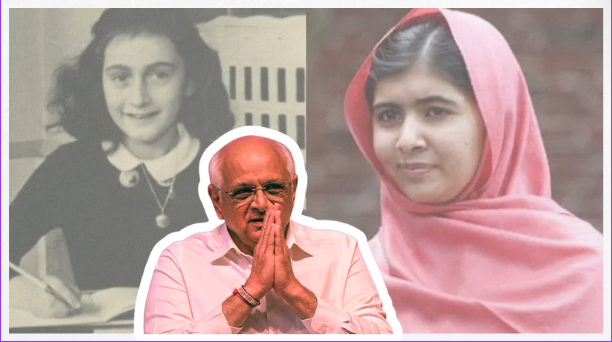
‘I am Malala’, is a book about a childhood in which the biggest concerns of Malala are not about ‘being hassled by a boy’ but rather about the struggle against armed men who will not hesitate to blow up your school and even kill you if you continue to assert your right to go to school as a girl student. The protagonist, Malala documents her struggle against the Pakistani Taliban to ensure that girls can continue to study. The book is a profile in courage, as Malala in spite of threats by the Taliban and in spite of being shot in the head and grievously injured, does not turn her back on her dream and continues to be a fierce advocate for girl’s education. The author is a Nobel Prize winner and her book is being read widely around the world.
The Diary of Anne Frank is the moving document of Jewish life under Nazi rule during the II World War told through the words of a young Jewish girl. Anne Frank is a young girl whose family is driven by Nazi persecution to hide in a building and they remain hidden for a little over two years. Anne writes a diary of everyday life in the ‘Annexe’ which traverses her feelings of being Jewish, reflections on her relationships to her family as well as what it means to fall in love. However just a little over two years since when the family went into hiding, they are discovered by the police and sent to concentration camps where Anne Frank, her sister Margot and her mother perish. Anne’s diary is a poignant account of a girl who is able to contextualise her difficulties and say that, ‘I feel wicked sleeping in a warm bed’, when ‘close friends have been delivered into the hands of the crudest brutes that walk the earth’. This dairy is one of the iconic memoirs of childhood, lived under incredibly difficult circumstances. Anne’s diary has been translated into more than 70 languages and is now read all over the world.
Both these books are really about the struggles of girl children which though so different from the context in India have a resonance. They are very important from the point of view of the pedagogy of education as they stimulate critical reflection and thinking. Both books broaden the idea of the world we live in and help students to reflect upon growing up under incredibly difficult circumstances. Malala has to face death threats, blowing up of schools and finally an assassination attempt. As she ruefully notes, ‘ I really wished, being hassled by a boy was my biggest problem’. For Anne Frank, the challenge is how, ‘inspite of everything’ she can ‘continue to believe that people are still good at heart’.
Thus both books are at heart about taking forward the values of the Constitution as well as the mandate of the right to education in Article 13 of the International Covenant on Economic, Social and Cultural rights which is to ‘promote understanding, tolerance and friendship among all nations and all racial, ethnic or religious groups, and further the activities of the United Nations for the maintenance of peace.’ When around the globe fundamentalists seek to narrow and constrict our imagination, and when the Taliban has prohibited girls from going to school in neighbouring Afghanistan these books are even more precious.
The fact that these two books are really about the struggles by girls should resonate deeply with a government which has made Beti Padhao, Beti Bachao its motto. We are deeply concerned as to whether the VHP and Bajrang Dal by their strictures on what can be read are taking us down a road which is not very different from the road taken by the Nazi party and the Taliban. Is it deeply concerning that while the Taliban bombs girls schools, the Bajrang Dal attacks those who read literature it decides is anti-national ! It is ominous that if the Nazi’s put restrictions on the social life of the Jews, the Bajrang Dal would do something similar to the life of Muslims.
The PUCL has been deeply concerned about protecting the sanctity of the freedom of speech and expression. Right from our condemnation of the banning of Salman Rushdie’s Satanic verses to the support we extended to Tamil writer Perumal Murugan when he was threatened as his book, `Madhorubagan was allegedly defamatory to a caste group, we have stood with the principle of the freedom of speech and expression. More recently in August of 2025, we condemned the blanket order by the Jammu and Kashmir government banning 25 books as a form of ‘drastic censorship’ which showed a ‘cavalier disregard for the freedom of speech and expression.’
This is because the PUCL is convinced that the fundamental right of speech and expression under Art. 19(1) (a) is one of the key underpinnings of democracy and rule of law. As has been held by the Hon’ble Supreme Court and different High Courts, the right of free speech and expression is a crucial right, in such a diverse and complex country such as ours with numerous language, religious, caste, regional and other identity diversities; any attempt, by the State (government) or non-state players, to deny free speech and expression ultimately weakens democracy.
This action of violently preventing the reading of books and thereby seeking to control thought is also fundamentally antithetical to the values of the Constitution. The Bajrang Dal and the VHP by their violent attack on the peaceful exercise of these core Preambular commitments continue to undermine the values of the Constitution. They have in fact committed a constitutional crime. The violations of the criminal law are not just violations of provisions meant to protect law and order, but fundamentally the violations are about the violations of the core promise of the Constitution to all its citizens.
The constitutional rights to thought in Article 21, the right to conscience in Article 25 and the right to freedom of expression in Article 19(1)(a) stand imperilled by these violent actions and the complicity of the state Government.
The Chief Minister is duty bound to take account of this and act in accordance with his constitutional oath to ‘bear true faith and allegiance to the Constitution of India’. The Chief Minister must therefore act in compliance with his oath and ensure that the machinery of the state functions in accordance with the Constitution.
Accordingly, we ask the Vastrapur police and the Ahmedabad Police Commissionerate to:
- Amend the FIR to reflect the complaint’s full account, including the communal sloganeering, the demand to forcibly verify religion, and the national anthem episode.
- Treat Hiren Rabari and Jimit Rabari as main culprits.
- Apply the correct legal charges, specifically examining the evidence on record against Sections 118, 117, 121, 74, and 78 of the BNS, rather than confining the case to Sections 115(2) and 351(2).
- Immediately secure CCTV footage from AUDA Garden, the Kasa Vyoma building, and the nearby Amul parlour before the data is overwritten.
- Send the surrendered weapons for forensic and fingerprint examination without delay, as requested by the complainants.
- Provide police protection to Aadhya Chhatrola and the other complainants, given the specific and credible threats made against them.
- Complete the investigation within a fixed, publicly stated timeframe, given the size of the mob and the risk of repeat incidents at future gatherings.
We also urge the Gujarat State Human Rights Commission and the Director General of Police, Gujarat, to call for a status report on this FIR, given the glaring gap between what was reported by victims and what was officially registered.
The Anand Niketan School management must apologise to consultant Munazza Shums for terminating her contract for doing her job.
Finally it is upto the Chief Minister to act to protect the constitutional values of dignity as well as liberty of thought, conscience and expression.
Yours faithfully,
Kavita Srivastava (President – PUCL)
V. Suresh (General Secretary – PUCL)
Anand Yagnik (President – PUCL Gujarat)
Mujahid Nafees (General Secretary – PUCL Gujarat)