The right to assemble peacefully is the heart of Indian democracy
By PUCL Bulletin Editorial Board
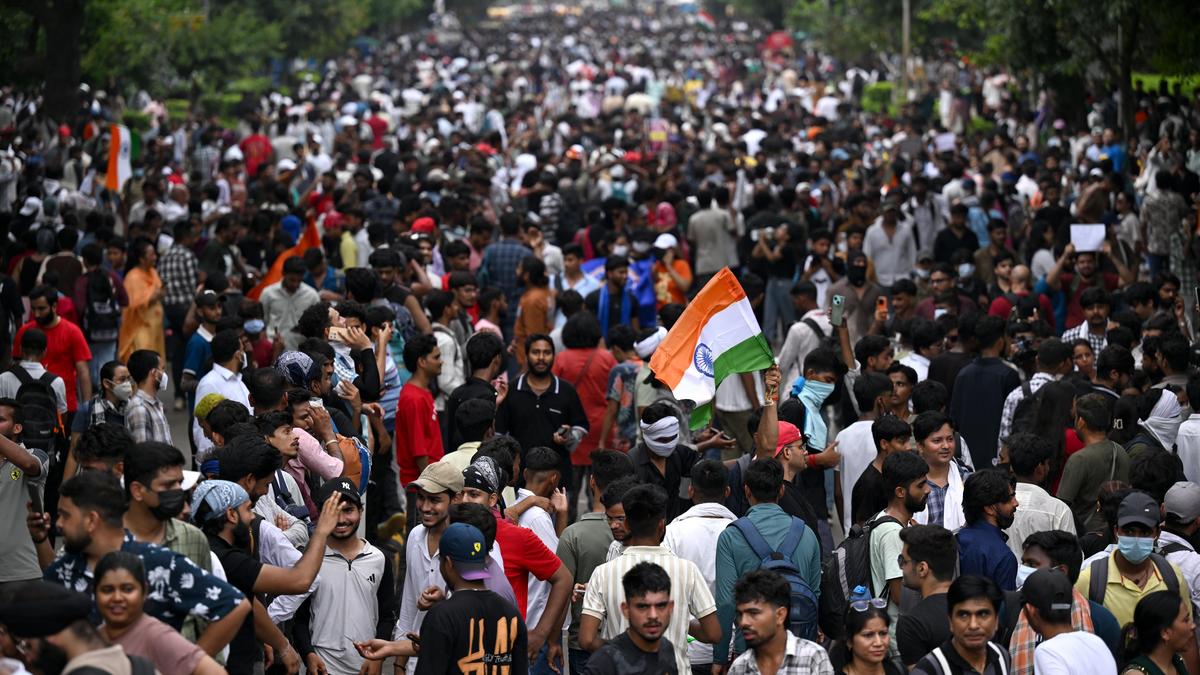
The shocking deletion of 130 million voters from the electoral rolls has resulted in sustained protests fronted by the Cockroach Janata Party, left parties and the Congress. The protests which began on October 2, 2026 and have continued through October has been described as Jantar Mantar 2.0. The protests have seen the coming together of the organized left parties, the Congress and the Cockroach Janata Party all demanding the scrapping of the SIR and the resignation of Gyanesh Kumar. The protests have been met by a brutal crackdown, exposing the democratic pretensions of the Narendra Modi government.
In a heavy handed response to the call for the protests on October 10, the government resorted to internet shut downs, the stopping of trains and the closure of 47 metro stations to prevent protesters from gathering. This unconstitutional response by the Union Government was legitimized by an equivocal order of the Supreme Court which in effect allowed for the unprecedented restrictions on the rights of movement and assembly.
The CJP leaders, Saurav Das, Ashutosh Ranka and Abhijeet Dipke were detained in the airport, with the police arresting them from the airplane itself. Other leaders of the protest such as Neha Bora were also preventively detained. Leaders of the political opposition from Mamta Banerjee to Arvind Kejriwal were also detained. Reports indicate that there were over 3000 detentions all over Delhi.
The detentions were accompanied by brutal violence both by the police as well as goons who beat up protesters in full view of the police. There were plainclothes men shouting slogans in favour of the Narendra Modi government chasing young men and women, dragging them and beating them up mercilessly with sticks. They brazenly described their victims as ‘anti-national elements’ who ‘deserve to be thrashed.’ The public anger triggered by one video of such vigilante violence forced the police to eventually detain four men — Raman Saini, Vivekanand alias Vivek, Kapil Kumar, and Ravinder Singh alias Govind Hindu belonging to the Hindu Raksha Dal.
The use of goons point to an expansion of the state, which now included both uniformed as well as personnel in plain clothes. It is shocking that inspite of the Supreme Court judgment in DK Basu v. State of West Bengal in 1996 that police carrying out arrest must bear ‘accurate, clear and visible name tags’, the police personnel brazenly violating the law laid down by the Supreme Court. Delhi was converted into a garrisoned city, with the Delhi police force being supplemented by 200 paramilitary companies with a force of 20,000.
The violence by the forces on unarmed protesters was brutal. Videos and photographs have shown male police officers brutally assaulting women. In one video, a police officer is seen pressing himself against a woman protester against a bus. A young woman journalist has alleged that an ACP-ranked police officer grabbed her breasts. When she attempted to file a complaint, she herself was detained and an FIR was filed against her and others. Trans women and trans men have reported many instances of women and men police officers attacking them sexually, hitting them on the genitals and brutalising them. Similar reports of sexualised attacks on male protestors have also surfaced. The violence was also sexual in nature and targeted both women as well as queer people who did not conform to the norms of gender and sexuality.
While Jantar Mantar 2.0 did not witness the use of pellet guns and lathis, due to the enormous backlash to its use in July, this time around the forces introduced mobile vans which functioned as de facto detention centres. The mobile vans (where there were no CCTV cameras) were the sites of beatings and torture of young protestors. Protesters were also taken to detention centers where they were also subjected to beatings. In a further show of illegality, mobile phones were confiscated during the protests with police deleting photos and videos on phones and refusing to give the phones back.
What is sorely lacking is any transparency around the Standard Operating Procedure (SOP) with regard to how the police deal with public agitations using non lethal measures. While there is a SOP dated 2011 on dealing with public agitations through non lethal measures all attempts at finding out the latest SOP by RTI activists has been met by stonewalling by the state. It is vital that the Union government share the SOP on dealing with public agitations as this document will indicate to what extent the mobile detention centers, the use of newly designated detention centers are legal as well as the protocol for the confiscation of phones.
In a further attempt at silencing dissent, on October 13, the government decided to denotify Jantar Mantar as a protest site and notifying two other more sites in Ramlila Maidan and Burari Ground. By this move, the Union Government has reiterated its resolve to not permit the meaningful exercise of the constitutional right to ‘assemble freely and without arms’. The purpose of the right under Article 19(1)(b) is that the voice of the protesters can be heard by those in power. By banishing the protesters to spaces outside central Delhi, the Union Government is rendering the constitutional right meaningless. This denotification also violates the recognition of the right to protest and be heard by the Supreme Court in MKSS v Union of India.
It is in this context that the act of Ashutosh Ranka and Saurav Das in breaking the tight security cordon and going on to hold the national flag in Jantar Mantar should be seen. For this act of civil disobedience, both the young men were detained on October 13. They were detained for nine days before being finally released on the execution of a peace bond. The symbolism of holding the flag at Jantar Mantar is the forceful assertion that protest is the heartbeat of democracy and should not be curtailed. Without this right being safeguarded, the question of change becomes impossible.
The use of the peace bond to curtail protest is another strategy being used by the Government to strangulate protest through law. The petition by Neha Bora challenging the peace bond being imposed upon her, is an example of an attempt to expose its illegitimacy. The notice issued to Neha Bora by the Special Executive Magistrate stated that, Neha Bora had ‘instigated people to participate in unauthorized demonstration at Central Park, Connaught Place which is not a designated protest site and also hoist the national flag without obtaining valid permission. There is every likelihood of apprehension of breach of public peace and tranquility within the jurisdiction of this court.’ Based on this apprehension she was asked to executive a peace bond, which she refused to do and instead challenged the notice in the Delhi High Court on the basis that ‘staging a peaceful protest cannot lead to breach of peace.’ However the Delhi High refused to stay the notice of the SEM. The use of the peace bond has become another means to stifle dissent and civil liberties groups need to note this development.
The BJP’s narrative is that the protests are illegitimate as they are nothing other than an attempt at regime change. However it should be noted that all other ways of bringing attention to the illegitimacy of the SIR process have been blocked. The impeachment motion moved against the Chief Election Commissioner, Gyanesh Kumar in the Rajya Sabha is pending since March 2026, indicating a failure of parliament to act.
All other institutions meant to safeguard Indian democracy have failed. The most egregious failure has been that of the Supreme Court which has greenlit the SIR process by upholding the constitutionality of the SIR process in Bihar and thereby opening the door to its application in the rest of the country. If today 130 million voters stand disenfranchised, no small share of the blame vests with the Supreme Court. The Supreme Court has not been unequivocal in defending the right of protest, ensuring that police violence is not used to break up protests and protecting Jantar Mantar as the site in central Delhi for the expression of a people’s voice.
Equally egregious is the stunning silence of the NHRC to the scenes of torture, sexual violence and the strangulation of the right to protest in the national capital in October. Just as these violations were taking place on the streets of Delhi, the NHRC was celebrating its foundation Day on 12th October, 2026 with its chief guest being Chief Justice Suryakant. In a galling spectacle, Chief Justice, Suryakant, with no sense of irony stated that the words in the Preamble of ‘dignity, equality, liberty and justice’ were among the ‘finest ever written and they must be observed day after day in the field, in the lockup, in the hospital ward and in the village at the end of the road.’ This was even as protesters were being beaten up on the streets of Delhi.
It was finally left to international institutions to do what institutions in India should have done. UN Human Rights Spokesperson Thameen Al-Kheetan, expressed concern at ‘reports of mass detentions in India of demonstrators, protest leaders, members of civil society organisations, lawyers and journalists’ on 10th October 2026. The UN called on ‘the authorities to ensure that the right to peaceful assembly is fully respected and fulfilled’ and to ensure that restrictions on peaceful protests must meet strict tests of necessity and proportionality.’
While the Modi government refused to engage with protesters internally, it did respond to the UN statement noting that, ‘Our law enforcement authorities act strictly in accordance with the law, and our courts remain available to all for the redressal of any grievances’. The External Affairs Ministry also attacked the OHCHR for ‘an unacceptable interference in the internal affairs of India’ and characterized the OHCHR statement as an ‘approach of extreme selectivity’ as ‘violent responses to protests in our neighbourhood have gone uncommented.’
This characterisation is unwarranted as the mandate of the OHCHR flows from the human rights obligations undertaken by India. India by ratifying the International Covenant on Civil and Political Rights is legally obliged to protect the right to peaceful assembly. The OHCHR by drawing attention to the violation of the right to peaceful assembly is only reminding the Indian government of its obligation which is mandated by its ratification of the ICCPR.
In a further move, on 20th October, 24 UN experts called upon India to ‘immediately cease the use of excessive force, rescind blanket assembly bans, and refrain from the misuse of digital surveillance, including through biometrics, and internet disruptions.’
The silence of the NHRC in the wake of the responses by the United Nations human rights mechanisms is even more glaring and speaks to a complete institutional failure. The mandate of the NHRC as per the Protection of Human Rights Act, 1993 is for the ‘better protection of human rights’ , with human rights being defined as, ‘the rights relating to life, liberty, equality and dignity of the individual guaranteed by the Constitution or embodied in the International Covenants and enforceable by courts in India;
The NHRC in its better moments has indeed functioned as an institution which ‘better protects human rights.’ One has only to recall former Chief Justice J.S. Verma taking suo motu cognizance into the violence which erupted in Gujarat post the Godhra incident of 2002. The NHRC Chair, severely indicted the Gujarat government for not responding promptly and noted that investigations in these cases were being “influenced” by extraneous considerations. The NHRC under his leadership went on to recommend CBI probe into five cases — Godhra carnage, Gulberg Society, Naroda Patiya, Best Bakery and Sardarpura.
One hopes against hope that the current Chairperson of the NHRC, Justice V. Ramasubramanian, takes inspiration from former Chief Justice Verma and begins to work to fulfil the mandate of ‘better protecting human rights’. The NHRC must not remain silent and take suo motu cognizance of the situation in the national capital. Till such time as institutions such as the NHRC begin to function and address core issues of democracy, all protesters will be left with is the street. They will have no choice but to brave the oppression of the state even as they seek to exercise their constitutional right to assemble peacefully and without arms.
In this bleak scenario of institutional failure, what gives hope is the actions of ordinary people. Ordinary people in Delhi have displayed a sense of humanity and fraternity by refusing to be intimidated and continuing to provide food and transport to the protesters. Lawyers have risen to the occasion and have provided much needed legal help to the protesters both in terms of bail and in terms of ensuring that the police are accountable for their actions. Institutions must now imbue the same constitutional morality which suffuses the ordinary citizen who has kept alive the spirit of Indian democracy.