Take action against the Public Parading of accused by Gujarat police officers
By PUCL Bulletin Editorial Board
Anand Yagnik, on behalf of his client, Mujahid Nafees, who is the General Secretary of the PUCL- Gujarat, issued a legal notice for initiating suitable action against the Illegal and Unconstitutional Custodial Violence, Torture and Public Parading of accused by Nilambaug Police Station Inspector D.P. Undadkat and other Police officers involved in such inhumane actions to the DGP, Chief Secretary and other police authorities in Gujarat.
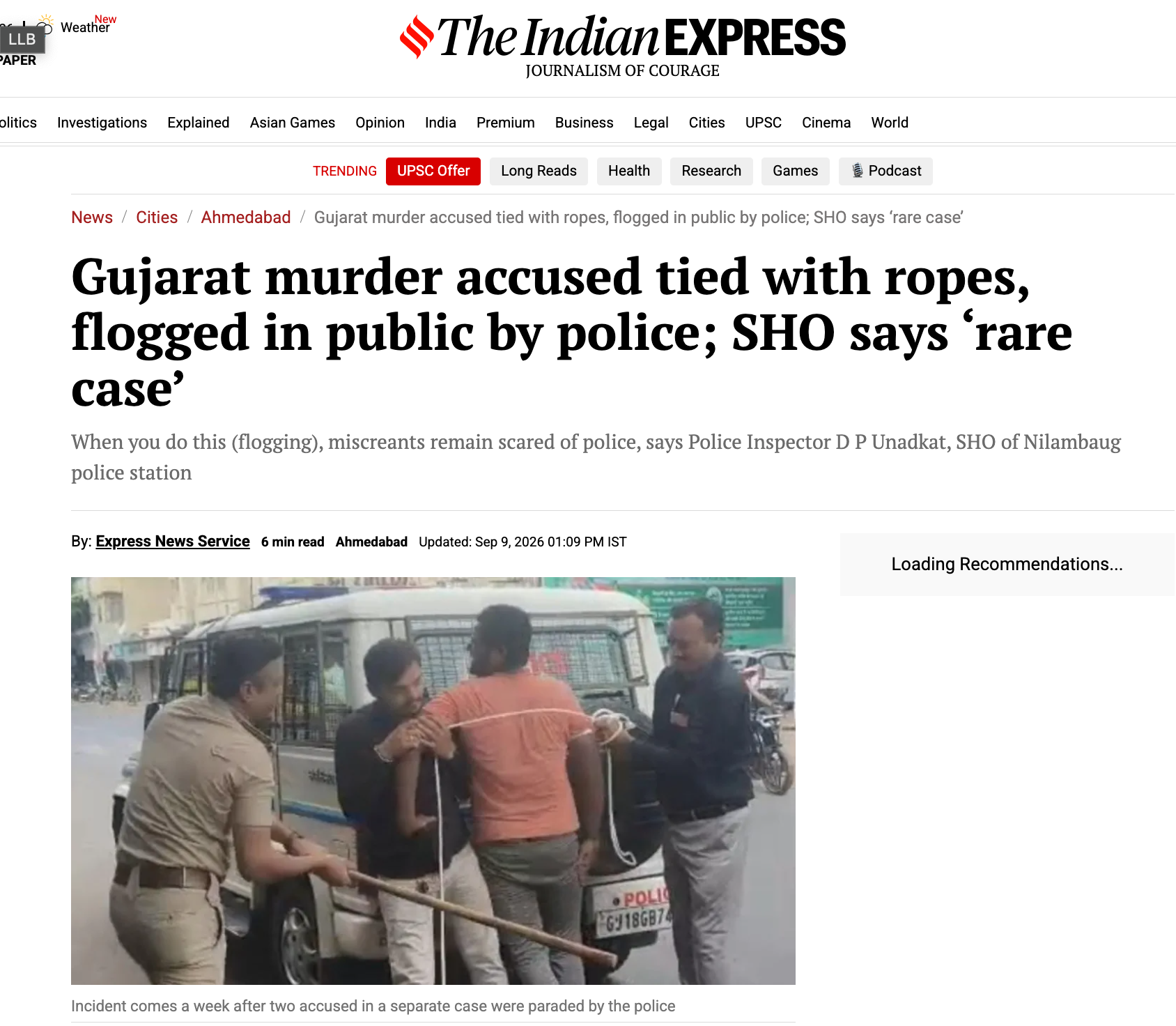
As per the legal notice, Faisal who was under investigation for a alleged crime was on September 5th in full view of the public tied the accused with ropes and brutally and ruthlessly struck him more than a 100 times with sticks, with more than 40 blows falling in the first 4 minutes of this act of barbaric and unconstitutional violence by the Bhavnagar Police. The accused was bent over a pillar and beaten until he fell, he was also laid down on a bench and attacked, A stick was placed between his legs and he was then further beaten and then made to crawl on his knees while being tied up with ropes and dragged. He was beaten until his clothes tore and he fell to the floor and yet the merciless assault continued, and he was held up with ropes to be beaten further.
This is ‘illegal and unconstitutional’ as ‘the Police personnel are flouting the law, as it exists in the Penal Codes, flagrantly violating all protections given to the accused deriving from the Constitution of India is a cause for shame and immediate action.’
The notice made the point that, officers working under the authority of the state have completely lost sight of the law and were in ‘contempt of the judgment of the Hon’ble apex court passed in D.K.Basu Vs. State of West Bengal.’
It was noted that, ‘No section in any police manual or Indian penal code that allows police to indiscriminately assault citizens. Further these actions are also in brazen violations of D. K. Basu Vs. State of West Bengal and other subsequent decisions of the Hon’ble Apex Court touching Article 21 of the Constitution of India with regard to the maltreatment and protection of the dignity of the Accused. These also fell against Order passed by the Hon’ble High Court of Gujarat in Public Interest litigation being WP(PIL) No. 153 of 2018 calling for intervention, or the sensitization of Police personnel of every rank. And, further the Director General of Police on 12.05.2026, issued a circular/office order to all the high-ranking officers of all the districts to initiate strict disciplinary action against the erring officers in cases of reported human rights violations. However, the implementation of all of these rightful and applicable guidelines and Orders has been soundly ignored.’
It was further noted that ‘police excesses manifest themselves in two broad forms. First is when police play an active role in violence, which in the present case, the perpetrators have done. And the second is when the police in not an active participant but stands as a mute spectator and acts a facilitator of the violence, which in the present case is done’ by the officers of the state.
It was prayed that the state authorities must, ‘initiate any and all appropriate and suitable action, departmental, disciplinary, punitive and criminal, against the erring police officials forthwith who have openly violated all rights of the victims by way of public parading and custodial atrocities and also acting in contempt of the judgment of the apex court in the case of D.K. Basu v. State of West Bengal, failing which, my client shall be constrained to initiate any and all suitable legal action as may be advised, in accordance with law, against the erring police officials of having flogged and beaten the alleged accused in violation of all norms in public view, and against your good selves for being mute spectators to the flagrant violation of all rights of the alleged accused who belong to the minority and are as equal citizens of India, of which your good self may take note of.’