Re-Reading K. Balagopal
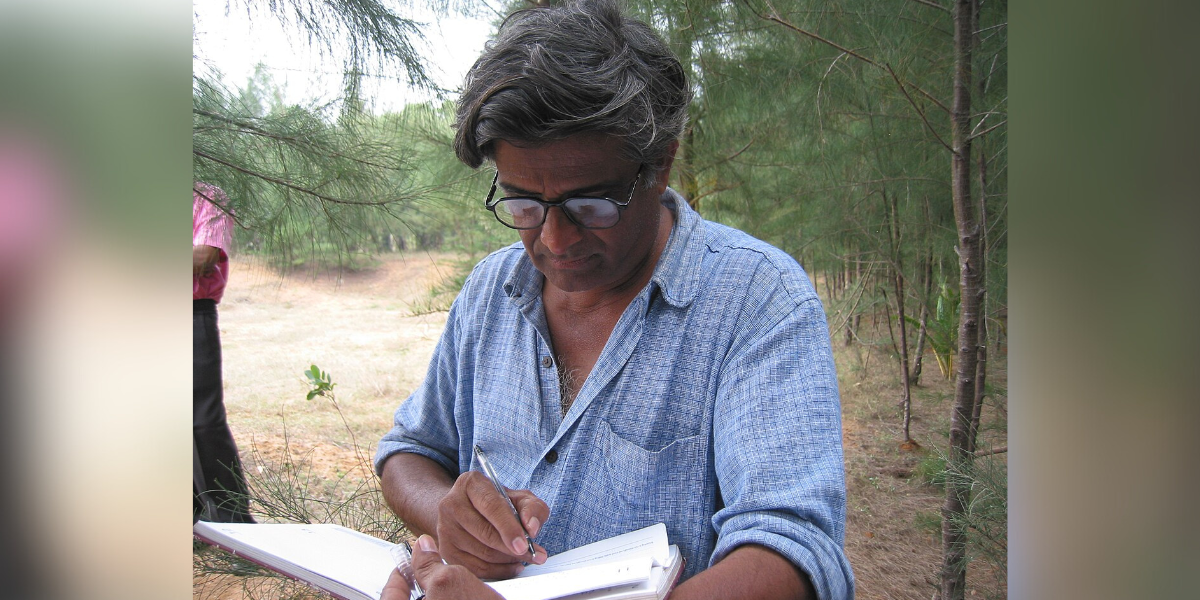
By Anand Teltumbde
Originally published in The Wire
Human Rights Forum, which the late K. Balagopal (1952-2009) helped found after ending his long association with the Andhra Pradesh Civil Liberties Committee (APCLC), has recently reissued the book being reviewed in this article – Ear to the Ground: Writings on Class and Caste by K. Balagopal – expanding the earlier edition published by Navayana in 2011 with additional papers. The volume is organised into seven sections and contains forty-four essays, written over three decades (1980s to 2000s), largely engaging questions of caste, class, the Left movement, and contemporary populist politics.
They are ably introduced by V. Geetha, a distinguished scholar of these issues in her own right. Most of these writings originally appeared in Economic and Political Weekly and some in other periodicals. Together they weave granular field observation, political economy, and radical democratic imagination into a critique of Indian society that refuses the abstractions of both naïve class analysis and caste denialism. Taken together, they constitute a substantial volume of 536 pages – an apt tribute to Balagopal’s intellectual range, political integrity, and analytical brilliance.
The book is a rare intellectual artefact – a lived testament of a Mathematician turned civil rights activist who became an incisive political theorist. Balagopal maps Indian society with unflinching clarity, showing caste and class not as discrete variables but as interwoven infrastructures of power. What he offers is not consolation but analytical precision: an account of how inequality is produced, reproduced, and politically weaponised at the very core of India’s so-called democratic institutions. Each essay in the book bears the mark of his distinctive intellectual capacity to pierce the surface of events and theorise their underlying logic, transforming empirical immediacy into enduring political insights. This review just offers a glimpse to them.
A model of a scholar-activist
The unique insights arise from a dialectical unity of theory and practice, sustained by an uncompromising commitment to the vision of a just society. I had a good fortune to know Balagopal over the years as a fellow traveller in a fraternal organisation. As general secretary of the Andhra Pradesh Civil Liberties Committee, Balagopal embodied an ethic of relentless presence: He would rush with his shoulder bag by any available means, walking long distances to sites of police violence, sustaining himself on cups of tea, and copiously documenting encounters, custodial killings, mass arrests, and torture. In this near-ascetic commitment, he functioned as a one-man army, forcing the realities of counter-insurgency in Andhra Pradesh into national consciousness and exposing the state and society that normalised coercion in the name of order. These were years of near-permanent emergency, marked by the resurgence of the Naxalite movement in Andhra Pradesh and constant threats to his life; Balagopal was repeatedly arrested and assaulted.
Yet, repression neither pushed him into dogma nor partisan silence. Over time, he grew increasingly critical of Naxalite violence, insisting that a civil liberties platform must retain autonomy from armed politics and condemn violence irrespective of its source – a position that drew criticism from those, who argued that state violence and people’s violence in defence could not be judged on the same scale. Balagopal understood this asymmetry better than most: he recognised that insurgent violence was rooted in the state’s brutality and denial of democratic redress, and that its scale was incomparably smaller. But he also saw how the rhetoric of armed revolution alienated potential allies and foreclosed wider democratic support. His distinction was precise: the state, as a constitutional entity, bears a qualitatively different responsibility, and its systematic violations constitute structural domination rather than error; yet this does not exempt insurgent violence from ethical scrutiny.
What set Balagopal apart was this refusal of both false equivalence and false exemption. Civil liberties, for him, were a non-negotiable democratic principle, tested most severely in moments of conflict – a balance that unsettled both the state and its armed opponents, and gives his work its enduring credibility.
Framing the post-colonial state
In the first section of the book – Balagopal offers a structural reading of the postcolonial Indian state in which nation-building appears not as a neutral or moral project but as a necessary by-product of ruling-class enrichment. After Independence, he argues, the Indian ruling classes confronted a dual task: securing mass loyalty and constructing the industrial and infrastructural base for accumulation. Both were accomplished through an etatist state that functioned as the chief mobiliser and distributor of surplus. In industry, the state absorbed risks, undertook unprofitable investments, shielded private capital from imperial competition, and financed it without ceding control; in agriculture, it protected and reconstituted landlord classes, diluted land ceilings, invested in irrigation and electrification, supplied Green Revolution technology, and deployed coercive force against rural resistance, while leaving relations of domination intact.
The result was a paradoxical formation in which the state became the single largest capitalist, while private capital remained structurally dependent on it – what Balagopal identifies as bureaucratic capital. This material restructuring was accompanied by a powerful ideological consensus – socialism, self-reliance, secularism, liberal democracy, and anti-imperialism – which, though not merely cynical, enabled real achievements: industrial growth, infrastructural expansion, agricultural increase, relative political stability, and mass loyalty through limited patronage and selective coercion.
Yet this apparent stability concealed deep contradictions. By the mid-1960s the structure had exhausted its possibilities: growth slowed, investment declined, the rupee weakened, drought and recession set in, and ideological cohesion frayed. Rejecting apocalyptic or linear accounts of collapse, Balagopal argues that social systems encounter their limits through development itself, producing not a single terminal crisis but a sequence of “crises within the crisis.” The Green Revolution exemplified this dialectic, unleashing productive forces that collided with existing social relations and intensified class conflict.
While the working masses perceived this as a crisis of the system itself and rebelled against exploitation, the propertied classes misread it as a problem of structural misalignment and demanded reconfiguration in their favour – a divergence that marked the first major manifestation of the principal contradiction of Indian political economy and shaped the subsequent trajectory of Indian politics.
Caste and class – Classical confusion
Balagopal’s work remains crucial to any serious understanding of contemporary India because of his refusal to treat caste and class as analytically separate domains. Against liberal frameworks that relegate caste to cultural identity or electoral arithmetic, and against orthodox Marxist approaches that reduce it to a residual or dissolving contradiction, Balagopal insists that caste is constitutive of class formation, political mobilisation, and state power.
Caste, in his analysis, is not an epiphenomenon of economic relations but one of the primary social mechanisms through which those relations are organised, stabilised, and reproduced. This intervention decisively dismantles the false opposition between “class politics” and “caste politics” that has long distorted both theory and strategy on the Indian Left.
He grounds this argument in a material history of production and domination. Dominant castes, Balagopal shows, did not emerge as mere cultural elites but through the historical transformation of tribal and peasant groupings into hierarchically ranked social formations integrated into agrarian production and political control. These caste formations functioned as productive social structures, shaping access to land, labour, capital, education, and political authority. His essays on reservation politics – especially in Andhra Pradesh during the 1980s – expose how anti-reservation agitations were not principled defences of merit or efficiency but organised efforts by forward castes to defend inherited material privileges, including control over universities, state employment, licit capital, and patronage networks.
The moral outrage surrounding reservations, he demonstrates, was carefully manufactured, revealing caste as a key mechanism for the reproduction of ruling-class advantage.
Balagopal is equally unsparing in his critique of class reductionism. By the early 1990s, he recognised that appeals to abstract class unity were unlikely to resonate with savarna lower-middle and middle-class groups who had already consolidated caste identity into emerging provincial bourgeois formations. For these groups, caste was not an obstacle to class formation but its very medium, deployed as a resource for political mobilisation and economic advancement. His insistence that caste and class struggles are coterminous is therefore not a concession to identity politics but an analytical recognition that class solidarities in India are continually fractured and reorganised through caste hierarchies, which operate as decisive vectors of political allegiance and conflict.
This integrated understanding of caste and class informs Balagopal’s conception of the Indian state. Rejecting both the liberal image of the state as a neutral guarantor of rights and the crude Marxist view of it as a mere instrument of repression, he shows how the state is structurally embedded in caste – class relations, reproducing inequality through routine administrative practices – policing, selective legality, bureaucratic impunity, and the systematic denial of civil rights.
Rights, in this framework, are not benevolent concessions but contested outcomes of social struggle. By foregrounding the everyday operations of governance rather than constitutional ideals, Balagopal dismantles the illusion that legality protects the weak or that democratic institutions automatically mediate inequality.
Although his engagement with fascism becomes more explicit in later writings, the trajectory is already visible in Ear to the Ground. Balagopal anticipates how right-wing politics in India transforms caste from a social hierarchy into a political technology, mobilising the anxieties of aspirational savarna classes to construct majoritarian authority. Populist politics, in his account, draws on caste’s multiple social functions: stabilising upper-caste privilege, offering compensatory cultural entitlements to strata unsettled by neoliberal restructuring, and legitimising grievance and hatred as political resources under the rubric of Hindu identity. Fascistic tendencies thus emerge not from abstract ideology alone but from the concrete alignment of caste-based class interests with state power.
Central to Balagopal’s legacy is his insistence that caste violence – and its routine social and institutional justification –constitutes a crime against democracy itself. His analyses of atrocities such as Chundur exposed the inseparability of caste and patriarchy and the social consent that normalises humiliation and degradation. Drawing on Ambedkar, he rejected liberal and Left tendencies to treat fascism as an external aberration, locating its social conditions within the Hindu social order and arguing that democracy must be assessed not only electorally or constitutionally, but through administrative practices, social relations, and economic structures.
Balagopal leaves behind neither a closed theory nor a political blueprint, but a method of radical democratic realism. His work confronts state violence without euphemism, rejects unreflective utopianism, and insists that democracy cannot be inherited but must be continuously produced through struggle. In an era marked by neoliberal accumulation, majoritarian rule, surveillance, and shrinking democratic space, his writings function less as a legacy to be celebrated than as an indictment to be reckoned with; a beacon to struggle.
Constricted communist imagination
In “Popular Struggles: Some Questions for Communist Theory and Practice,” Balagopal interrogates the long-standing communist assumption that popular struggles acquire revolutionary significance only when subsumed under communist leadership and strategy. While he recognises the need for coordination among struggles confronting a coherent structure of oppression, he insists that such coordination cannot take the form of absorption into a centralised party unless it is accompanied by genuine reciprocity – openness to theoretical renewal, organisational innovation, and responsiveness to popular aspirations as they emerge.
Drawing on the Andhra Pradesh experience after the mid-1980s, Balagopal shows that many mass movements – Dalit, women’s, environmental, and rights-based – arose outside the communist fold despite being substantively anti-landlord and anti-capitalist. This estrangement, he argues, reflected not ideological hostility but deep disaffection with communist practice, rooted in the rigidity of the Bolshevik organisational model, which privileged discipline and militancy over creativity and inhibited the continual renewal of theory. Communist responses – ranging from doctrinaire criticism and unsolicited theoretical instruction to warnings about co-optation – often widened this distance, even as communists claimed historical credit for legitimising radical politics.
This general critique acquires concrete sharpness in Balagopal’s analysis of the anti-arrack and Dalit movements in Andhra Pradesh, where he exposes the gendered and caste-bound blind spots of Left politics. In the case of the anti-arrack struggle, he shows that while Left parties correctly identified the nexus between liquor, corruption, and state power, they fundamentally misrecognised the primary victim of the arrack economy as the male worker whose wages were drained by drink. This framing ignored the reality that women and children bore the heaviest burden through deprivation and domestic violence.
The error stemmed from a deeper theoretical reduction: identifying the working class with male wage labour outside the home and treating the family as a homogeneous unit rather than a site of internal conflict. This led to politically disastrous demands – such as lowering arrack prices – that intensified women’s suffering, and later to support for prohibition without reckoning with the underlying conceptual failure. The success of the anti-arrack movement, Balagopal argues, lay precisely in rural women’s autonomous reframing of the struggle around violence, dignity, and everyday survival. A parallel failure marked communist engagement with the Dalit movement, which, despite being rooted among rural landless labourers – the Left’s presumed social base – developed largely outside the communist stream because caste-based self-respect and dignity were treated as secondary or “superstructural,” especially in regions where feudal domination was limited but caste humiliation sharply constrained social mobility.
Balagopal situates these failures within a deeper theoretical problem in Marxist class analysis itself. Reworking the distinction between class-in-itself and class-for-itself, he insists that emancipation requires not only objective location within relations of production but subjective self-discovery – of dignity, worth, and collective agency. In the Indian context, this self-discovery occurs not primarily through abstract class identity but through caste, tribal, and gendered experiences of oppression. Communist practice, however, remained fixated on preserving the objective unity of the working class, treating identity-based self-assertion as divisive rather than as a necessary moment in the formation of political subjectivity – a blindness reinforced by the savarna social origins of much of its leadership.
Balagopal contends that such assertions are not regressions but transformative advances, a point he illustrates through the Madiga movement for categorisation within Scheduled Caste reservations, where sectional assertion proved indispensable for dignity and agency even as it disrupted the illusion of a unified oppressed bloc. Extending this argument, he challenges Leninist vanguardism and argues for localised, self-directed struggles that federate into broader movements rather than being subsumed under a centralised party oriented toward capturing state power.
His discussion of the independent tribal land struggle in West Godavari reinforces this view: while communist-led struggles raised consciousness, autonomous mobilisation produced greater tenacity, leadership from within, and a deeper sense of collective self-worth. Together, these arguments call for a radical rethinking of class, organisation, and political strategy in India, grounded in the lived processes through which oppressed groups become historical subjects.
While I largely share Balagopal’s concern about the failure of communist parties to engage adequately with identity-based struggles – a failure rooted in the Leninist model of a vanguard party claiming exclusive revolutionary authority – the alternative cannot lie simply in a loose federation of autonomous struggles. Such movements, if they are to transcend fragmentation and achieve transformative outcomes, inevitably require a unifying principle. That unifying logic, however, need not be organisational centralism; it may emerge more coherently from a fundamental rethinking of class itself.
Class should not be treated as a narrowly economic category but as an abstraction encompassing the full range of exploitative and oppressive processes operative in any society. Under such a reconceptualisation, struggles against caste, gender, and other forms of domination would not stand alongside class struggle but would constitute it. This perspective, however, demands a thorough reworking of key Marxian categories and conceptual frameworks. And of course, creative practice to realise it.
Anand Teltumbde is former CEO of PIL, professor of IIT Kharagpur, and GIM, Goa. He is also a writer and civil rights activist.