PUCL Complaint to the NHRC on Torture of eleven youth activists
By PUCL National
To,
Chairperson, NHRC and Other Members,
Manav Adhikar Bhawan,
Block-C, GPO Complex,
INA, New Delhi – 110023.
Sub: Complaint regarding illegal detention and brutal torture and sexual violence against 11 youth activists in Delhi between 12th to 14th March, 2026.
Ref.: Our Complaint to NHRC, Case No. 4621/30/8/2025 dtd 31.07.2025
Dear Sir,
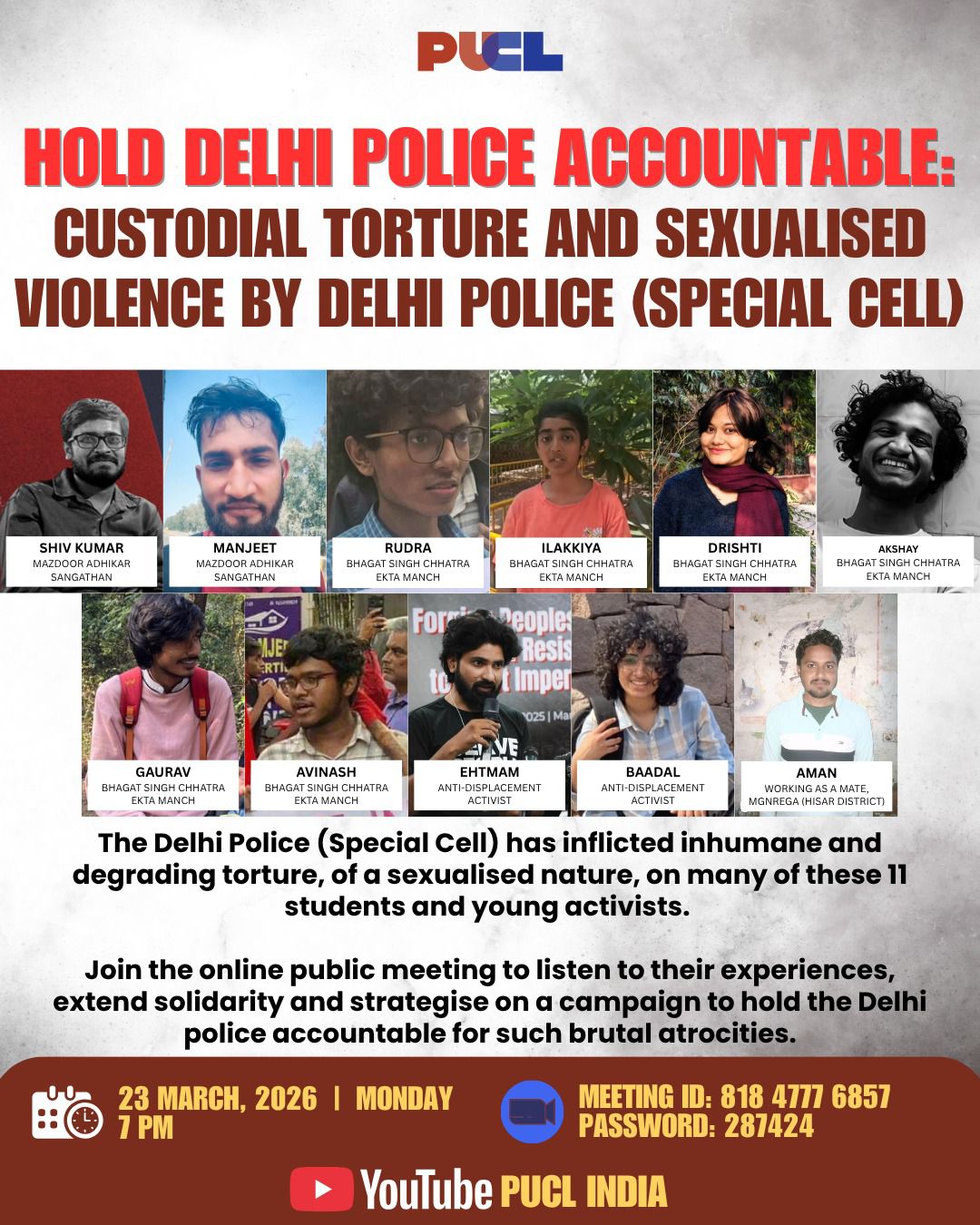
We are writing to you from the PUCL to express our shock and grave concern regarding the incident of illegal abduction, detention and torture of eleven students by the Special Cell of Delhi Police from the 12th to 14th March, 2026. The students have testified to the fact that the police have inflicted brutal torture of a sexualised nature and severe psychological violence on the students. (See Annexure 2 to 11 for affidavits filed by the students in petitions before the Delhi High Court.) Most of the students have also participated in a public online programme organised by the PUCL in which they have shared testimonies of these grave violations. The recording is available in this link.
What is particularly disturbing about this entire episode of illegal detention is the deeply sexualised nature of the torture inflicted on the young students which included beatings on the private parts, stripping them naked, threats of rape, photographing the students naked as well as the shocking attempts to get some of the students to perform oral sex on each other. The fact that this form of shocking illegalities are being perpetrated in the capital of India, by the Delhi Police should be a matter of grave concern to all of us. The fact that the Delhi Police are targeting young students aged between 20 to 25, indicates a level of brazen and callous contempt both for the Constitution as well as any norms of decency which should govern the functioning of a constitutional authority.
It is even more disturbing that this is the second such incident within a year, as the Special Cell of the Delhi Police and the Anti-Terrorism Squad had made such illegal detentions of eight students and youth in July 2025. Four of the eight students who were subjected to such torture last year are among the eleven detainees in this case.
We wish to remind you that PUCL had filed a complaint with the NHRC (See Annexure 12, registered as Case No. 4621/30/8/2025) and had also written to the Commissioner of Police, Delhi. Despite both these communications being acknowledged by authorities, there has been no action taken against the police officials who tortured the students last year.
Brief facts of the case:
- 12th March, 2026: Shiv Kumar and Ilakkiya were abducted around 1:30 PM and Manjeet was abducted around 7 – 8 PM and taken to the Special Cell Office of the Delhi Police in New Friends Colony.
- 13th March, 2026: Seven students and youth activists had gathered in the Bhagat Singh Chhatra Ekta Manch office in Vijay Nagar. Around 7:30 PM, Delhi Police officials barged in to the room, threatening, verbally abusing and beating some of the youth activists. Gaurav, Akshay, Ehtmam, Rudra and Avinash were abducted from Vijay Nagar around 10 PM and taken to the Special Office, and Drishti and Baadal were illegally confined to the room, with four police officials present.
- 14th March, 2026: Drishti and Baadal were taken to the Special Cell Office in New Friends Colony at 5 AM. Aman, a friend of Manjeet’s, who had accompanied Manjeet’s mother to Delhi to file the habeas corpus petition, was abducted near his village in Haryana and also brought to the Special Cell Office in New Friends Colony, New Delhi.
- On 14th March, 2026, around 9 PM or 9:30 PM, the police made all detained activists sign notices indicating that they were called for investigation and that they came of their own accord. Thereafter, between 11:45 PM and 12:30 AM, while 10 of the activists were released, Rudrabikram alone, was released only by late afternoon on 15th March after the matter came up at the special hearing constituted by the Delhi High Court.
Methods of torture inflicted on many of the activists:
- Brutally slapped, kicked and beaten with rubber batons, lathis and metal chains
- Stripping them naked and taking photographs of them
- Forcing them to touch each other’s private parts and photographing them
- Beating them on their private parts with belts and metal chains
- Pulling their hair and banging their head against the wall
- Forcing them to perform oral sex on each other
- Forcing them to slap each other
- Verbally threatening to file false UAPA cases against them and encountering them
- One of them was forced to stare at a brightly lit wall for a prolonged period of time
- One of them was made to sit with a foul-smelling soaked towel around her face for hours together
- Verbally threatening to rape them and make them rape each other
- Denial of food and water, and denial of privacy even while using the bathroom
- Casteist remarks, atrocities and torture was inflicted on an activist from the SC community:
- Forced to strip naked and clean 3 rooms using his own clothes, while being photographed by police officials
- Made to rub his nose on the floor
- Forced under the threat of beatings, to lie about information and sign documents with false information that might be used to implicate them in cases
- Remarks that referred to their gender identity, sexual orientation and religion were constantly made to humiliate them.
- Repeated warnings were given by the officials to the activists to leave Delhi and never return, if they want to live
All of these shocking violations of law are testified to by the students in the affidavits which they have filed before the Magistrate’s Court.
This form of depravity masquerading as investigation cannot become the norm among India’s law enforcement authorities. The actions of the Special Cell of the Delhi Police amount to clear violations of rights of citizens guaranteed by the Constitution and various statutes.
It is imperative that the NHRC examine this complaint as it is within its core mandate under the Protection of Human Rights Act, 1993. The Act empowers the NHRC to look into violations of human rights. Human rights is defined under Section 2(d) as ‘the rights relating to life, liberty, equality and dignity of the individual guaranteed by the Constitution or embodied in the International Covenants and enforceable by courts in India’. Thus as per Section 2(d) not only are the rights under the Indian Constitution to be protected by the NHRC but also the rights ‘embodied in the International Covenants’. Under Section 2 (f), ‘International Covenants’ means the International Covenant on Civil and Political Rights and the International Covenant on Economic, Social and Cultural Rights’. As per Article 7 of the ICCPR Article 7, ‘No one shall be subjected to torture or to cruel, inhuman or degrading treatment or punishment.’
Thus, the NHRC is empowered by the law to examine in particular the question of torture as torture is defined as rights violations under the ICCPR which comes within the definition of human rights in the Protection of Human Rights Act, 1993.
The violations which the NHRC must take note of include:
Illegal Detention without following `Due Process of Law’
The student activists were picked up without any arrest warrant, notice, or explanation, and in complete secrecy. No attempt was made to inform their family members or provide access to legal counsel. This is a blatant violation of Article 21 of the Constitution of India, which guarantees the right to life and personal liberty. As spelt out in the famous D.K. Basu case (1997), and in a plethora of other rulings, the Supreme Court has held that no arrest/detention can be justified without following the due procedure.
Non-Production Before Magistrate Within 24 Hours – Violation of Article 22(2)
As per Article 22(2) of the Constitution, every person who is arrested must be produced before a magistrate within 24 hours. None of the students were produced before a magistrate during their illegal custody. This is a gross breach of constitutional safeguards and also contravenes the mandates laid down by the Supreme Court in `DK Basu v. State of West Bengal ‘(1997), where detailed guidelines were issued for arrest and detention to prevent custodial abuse.
Custodial Torture and Inhuman Treatment – Violation of Right to Life with Dignity
The activists reported incidents of physical assault, sexual threats, remarks attacking their caste, religion and gender identity. This constitutes a clear violation of Article 21, which encompasses not just right to life, but life with dignity. The jurisprudence of the Supreme Court has recognised that torture is a violation of Article 21 in a catena of cases right from Khatri v State of Bihar (1981 SCC (1) 627) which was the infamous blinding of prisoners by the Bihar police onwards. The Supreme Court in Mehmood Nayyar Azam v. State of Chhattisgarh’ (2012 (8) SCC 1) reiterated that custodial torture undermines dignity and is anathema to a civilized legal order. The use of third-degree methods, as reported, is prohibited and liable for strict action. Court further observed that any treatment meted out to an accused while he is in custody which causes humiliation and mental trauma corrodes the concept of human dignity. It is the sacrosanct duty of the police authorities to remember that a citizen while in custody is not denuded of his fundamental right under Article 21 of the Constitution.
Forced Extraction of Signatures – Fabrication of Records and threat of false prosecution
It is alleged that signatures were forcibly taken from detainees on notices covering the days they were illegally held, falsely showing that they were called and released daily. Additionally, signatures were taken on blank sheets, creating the possibility of misuse or false implications in the future. Such acts are not only criminal in nature but also violate Article 20(3), which protects against self- incrimination. Coercing individuals to sign documents under duress or without legal representation is a direct affront to justice and due process and a gross violation of the fundamental rights of the persons concerned.
Arbitrary and Unconstitutional Direction to Leave Delhi
The directive issued to students, warning them to leave Delhi immediately and threatening consequences if they return, is not only without legal basis but a flagrant violation of Article 19(1)(d) and 19(1)(e), which guarantee the right to move freely and reside anywhere in the country. Such directions amount to extra- legal punishment without trial and are wholly impermissible under a democratic system governed by rule of law. These threats also amount to criminal intimidation under Section 506 IPC (sec. 351 of BNS 2023).
Violation of Supreme Court Guidelines on Arrest and Custody (D.K. Basu Guidelines)
The guidelines laid down by the Supreme Court in the landmark D.K. Basu judgment were specifically crafted to curb custodial abuse. These include:
- Informing a relative or friend about the arrest.
- Preparation of arrest memo.
- Right to consult a lawyer.
- Medical examination every 48 hours.
- Production before a magistrate within 24 hours.
The failure to comply with each of these safeguards amounts to contempt of court and dereliction of duty, warranting strong disciplinary and legal consequences.
We would like to reiterate that the highly sexualised torture inflicted on the male and queer detainees is an alarming new pattern of custodial torture. Almost all the male and queer detained activists reported either beatings on private parts, threats of sodomy and rape, or coercion to touch each other’s private parts. We would like to therefore emphasise the need for training of police personnel to ensure that the training modules equip officers to understand the modes of torture including sexual torture and to reinforce the absolute prohibition of torture.
The NHRC must take seriously this alarming new development in which the police personnel are using brutal methods of torture and sexual violence in the name of investigation. These forms of investigation are wholly illegal and a serious effort must be made to identify the extent of the practice and to stamp it out fully.
Additionally, as we have mentioned earlier, there has been no action taken by the NHRC (Case No. 4621/30/8/2025) or the Commissioner of Police, Delhi, despite our complaint against the illegal detention and torture of activists by the Special Cell and AntiTerrorism squad. It is crucial to note that this inaction is especially concerning because many of the police officials who illegally detained the students and tortured them on 12th to 14th March, 2026 were the same officials who did it 2025. As the affidavits of the activists demonstrate, the inaction against the police officials has only emboldened them, and given them impunity to repeatedly threaten students that they “they will finish what they started last year”.
One particular police official, Nishant Dahiya (Inspector, Special Cell, Delhi Police), was involved in the cold-blooded murder of an individual named Ajay, on May 16, 2024. Upon investigation, the NHRC had served a notice to the police, seeking documents and reports, related to the case of the fake encounter. The same individual, Nishant Dahiya, was involved in the torture of the activists in the July 2025 case, as well as the one in March 2026. Therefore, inaction by the NHRC, or even delayed action to hold police officials accountable for illegal detention, custodial torture and encounter deaths, directly leads to impunity and is highly dangerous.
The impunity with which the police officials have violated rule of law, tortured and threatened to kill the student activists draws the presumption that they are doing so, with the knowledge or support of senior authorities and police officials. The police also repeatedly told the activists that they were bound and determined to meet the deadline given by Union Minister Amit Shah of 31st March, 2026 to ‘end Naxalism in India’. This points to the possibility of a systematic effort by the Government of India, to target people in the name of taking action against those they accuse of being ‘Naxalites’.
As the mandate of the NHRC very well indicates, no matter what a person’s ideology is, they are protected by the Constitution, and that the police are bound by rule of law. It is imperative that the NHRC in accordance with its mandate ensure strict criminal action against all officials who have played a role in aiding and performing such brutal torture in the name of investigation.
The NHRC must take strong action to ensure that the Delhi police are accountable for their illegal actions and the students are provided reparation for having had to go through a form of torture which is reminiscent of what happened in Abu Gharib or Guantanamo Bay or what happens in the most depraved dictatorships.
The NHRC must also take note of the unprecedent verdict awarding death penalty to nine police personnel from Sathankulam police station in Thoothukudi district for the custodial torture and murder of traders P. Jayaraj (60) and his son Bennix (31) delivered on 6th April, 2026. While the PUCL is of the opinion that the death penalty should be abolished, the trial court verdict only highlights the need to treat custodial torture as a grave violation of human rights. The verdict signals a significant shift in the national perception of custodial torture as for the first time in Indian judicial history, multiple officers from a single police station have been held criminally accountable for custodial deaths.
It is this spirit of seeing custodial torture as unacceptable which must animate the work of the NHRC as it comes to grips with this growing epidemic of impunity for torture including sexualised torture. The NHRC must call for consultations with civil society to draft a robust anti-torture law in accordance with its mandate under Section 12 (d) of the Protection of Human Rights Act and Section 12 (i). Under Section 12(d), the Commission is mandated to ‘review the safeguards provided by or under the Constitution or any law for the time being in force for the protection of human rights and recommend measures for their effective implementation’. Under Section 12 (i) the NHRC is mandated to ‘encourage the efforts of non-governmental organizations and institutions working in the field of human rights’
After all we still live in the world’s largest democracy in which authorities including the Delhi Police have to perform their investigative duties working within the limits of the rule of law. Sexualised torture falls outside what the law and the Constitution permit.
We urge the NHRC to:
- Initiate an enquiry into the serious allegations of illegal detention, beatings and sexualised torture and ensure legal action is initiated by the filing of an FIR.
- To take immediate action against all police officials and police functionaries who are involved in these serious violations
- Conduct a raid on the “safe house cum torture chambers” at New friends colony and ensure that the facility is closed.
- Provide the victims with a copy of the FIR of July 15, 2025, on the so called disappearance of Vallika Varishi, editor of Nazariya, (perhaps lodged by her mother, Archana Verma, senior civil servant, Government of India) based on which they picked up these young people in July 2025 and now for a second time in March 2026.
- Return the phones and other seized devices of all detained youth.
- Ensure that the irreparable injury caused to the young students is acknowledged and they are given compensation as well as reparation.
- Initiate an inquiry into the details and modules of training of police personnel and the NHRC must ensure that the training modules equip officers to understand the modes of torture including sexual torture and to reinforce the absolute prohibition of all forms of torture
- Initiate a process of consultation with civil society to draft a robust anti-torture law and work towards stamping out all forms of torture in India