Emerging labour resistance in India: A wake up call for the Indian state
By Guest Editorial: Sudha Bharadwaj
(The Editorial of this month’s Edition is written by Sudha Bharadwaj.)
On 12th February 2026, all Central Trade Unions except the Bharatiya Mazdoor Sangh – which is affiliated with the ruling party, had declared a general strike against the Four Wage Codes notified in November 2025. While this year, it was evident that the numerous mass meetings and protest demonstrations that occurred across the country were much larger, and displayed greater outrage against the anti-labour nature of the Wage Codes than had been previously seen, very few industries saw actual strikes. It tells us how small a proportion of the working class is unionized, even in the industrial sector.
But what made employers and governments sit up was the wave on wave of massive spontaneous strikes of contractual workers in industrial establishments that burst upon the country in February, March and April of 2026.
Starting at the Barauni Refinery of Indian Oil Corporation Ltd (IOCL) at Begusarai Bihar on 2nd February, this wave spread to the Gauhati Refinery of IOCL at Assam on 12th February. A serious workplace accident on 21st February that killed two workers and injured a third worker so badly that his leg had to be amputated was the trigger point for workers at the Panipat Refinery of the IOCL. Thirty to forty thousand workers struck work on 23rd February and an FIR was filed against 2500 workers. Videos of the Panipat workers strike went viral. Workers of the IOCL Bottling Plant in Salem, Tamil Nadu protested in solidarity with the Panipat workers. Agitation began in the Vadodara Refinery of IOCL in Gujarat on 12th March.
On 26th February more than 5000 contract workers of L&T, a contractor for an Arcelor Mittal Nippon Steel Plant in Surat, Gujarat struck work; and on 27th February, migrant contractor workers of Asian Paints in Dahej, Bharuch, Gujarat followed suit.
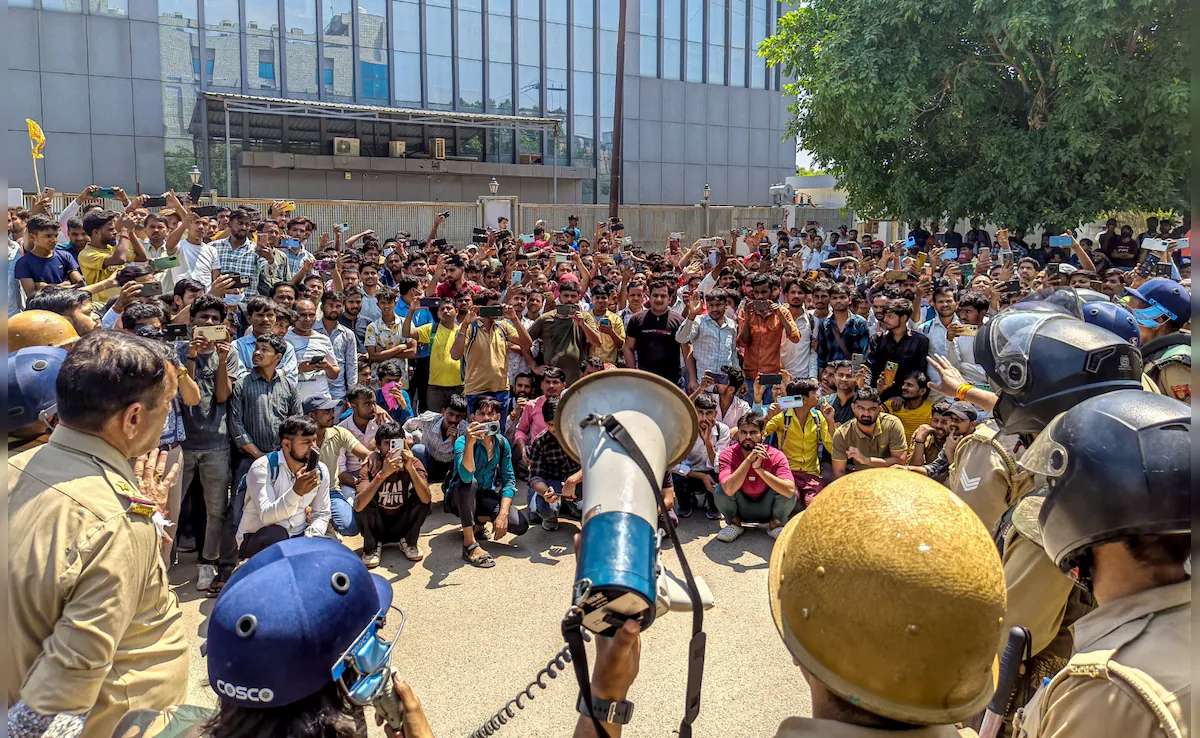
On 2nd April, contract workers of the Honda Company in Manesar, Haryana began protesting and soon they were joined in large numbers by workers in other companies in the industrial belt of Manesar-Gurgaon. Workers of Munjal Showa, Satyam Auto, Roop Polymers, Modelama, RichaCo, Richa Global, Pricol, Forza, Sarita Handa, Syrma SGS etc. The social media amplified the news of these series of widespread protests. On 7th April, prohibitory orders were promulgated to prevent gatherings in Gurgaon and on 9th April, the Government of Haryana notified an enhanced minimum wage of Rs. 15,220/-.
This (paltry) increase in wages, further reinforced the instinctive understanding of workers at large that only protests and strikes could yield the results that representations and applications had not achieved so far. Protests began in the garment factories of Noida, Uttar Pradesh demanding a minimum wage of Rs. 20,000/- Thousands of workers from Richa Global Export Company, Samvardhana Motherson International Ltd., Paramount Products Pvt. Ltd., Anubhav Apparels etc. gathered and with each passing day the administration reacted with even more vicious repression. On 12th April the District Magistrate of Gautam Buddha Nagar, Noida did also issue some general directions to industries, carefully skirting the basic issue of a raise in the minimum wages. It was finally the Government of Uttar Pradesh that once again enhanced the minimum wage from Rs. 11,313/- to Rs. 13,690/-
One important lesson to understand from these spontaneous strikes and agitations is that contractual workers today, even in the industrial sector, are battling highly exploitative and precarious conditions of work, literally at starvation wages. Today 60-90% of the industrial workforce in different industries is contractual, a large proportion of them migrant workers. They live in hovels, bereft of sanitation, their children get neither proper nutrition, nor schooling nor basic healthcare. The dark underbelly of “Viksit Bharat” and “the five trillion economy” has finally been revealed. The last straw was the unavailability or unaffordability of LPG gas cylinders that created an almost Covid-like situation of a panic return to the villages. With the new Code on Industrial Relations virtually abolishing permanent workers through the device of a fixed term contract increases the precarity of the workers. If one adds the growing crisis in agriculture, then there will be an increase in migration.
What were the demands? The first was a decent minimum wage – a fair wage – one that could really provide a decent human existence to a family. The basic minimum wage requires to be revised every five years. In practice Haryana had not revised its minimum wages in 11 years and Uttar Pradesh in 14 years. The new Code of Wages prescribe a national floor wage which is bound to suppress wages all over the country, which might well see capital deserting State Governments which notify higher wages.
The second was an 8-hour day and overtime at double the rate. Today in most industrial areas across the country and in security establishments, 12 hours has become the norm. Part of the reason is that the wages of 8 hours are simply insufficient for survival, but a 12 hour day effectively rules out unionization which would be the pre-requisite for a struggle for increased wages or reduced work hours.
But the response of the State and in particular the response of the State police of Haryana, NOIDA, Delhi NCR and various national investigative agencies – has been shocking and incredibly brutal. All across the media, videos and stills of “violence” of the workers have been exaggerated, hiding the misery that has forced the workers to revolt. Workers have been labelled “terrorists”, instigated by the “Pakistani Hand” and the spontaneous strikes and protests have been called “conspiracies” to destabilize the great Indian growth story. Hundreds of ordinary workers are missing and families are running from pillar to post trying to find them. The “conspiracy playbook” of misusing Whatsapp chats has resulted in independent trade unionists, students, labour researchers and social activists being named in ludicrous FIRs, being arrested and even tortured in the most gruesome ways. It has also been found that police personnel of UP were, in fact, posting provocative WhatsApp posts themselves, to evoke reactions which could later be criminalised.
Six members of the Inquilabi Mazdoor Kendra – Shyamveer, Ajit, Pintu Yadav, Harish, Raju and Aakash were arrested in Haryana on the night of 12th April on charges of being master minds of criminal conspiracy, inciting riots, arson and destruction of properties. They have been referred to as “outside elements” whereas all are well known local labour activists. Ajit and Pintu are terminated workers of the Belsonica company – a supplier to Maruti, Aakash is a workers’ representative of Munjal Showa and Shyamveer is a legal advisor to many unions. Two activists from the CITU – Jai Bhagwan and Vinod Kumar – were served notices for solidarity with the workers and placed under house arrest. 61 workers were arrested under FIRs filed by Modelma Exports and Richa Global Exports Pvt Ltd., 20 of them were women.
In NOIDA, four activists of Mazdoor Bigul were arrested on 11th April – Rupesh, Aakriti, Srishti and Manisha. The next day, in an unheard-off swoop, two lawyers who were trying to get them bail – Prateek Kumar and Mohammed Tanveer Ali were literally abducted from the Surajpur Court premises and illegally detained. This enraged the workers even more. On 13th April poet Katyayani, biographer of Bhagat Singh – Satyam Verma and journalist Sanjay Shrivastava – all well known and long-standing progressive activists were arrested in Lucknow.
Finally on the night of 13th April, 2026, ironically on the anniversary of Jallianwala Bagh, the Labour Minister of Uttar Pradesh – Anil Rajbhar said investigation was going on as to whether there was a larger conspiracy to generate unrest by Pakistan linked elements!! Chief Minister Yogi meanwhile declared that this was an attempt to revive Naxalism (which had been eliminated in Bastar on 31st March 2026 by Home Minister Amit Shah.) The same night an interim hike from Rs. 11,313/- to Rs. 13,690/- was made in the minimum wages. By this time more than 300 workers had been arrested in NOIDA under 7 FIRs.
On 14th April, hundreds of domestic workers protested outside Cleo County – luxury residential apartments in Noida – demanding wage increases and were covered widely by the alternative press. On 15th April 40 women gig workers demonstrated outside the Urban Company training centre in Sector 60, NOIDA.
On 18th April, the police arrested Aditya Anand, a B. Tech from Jamshedpur, from Tiruchirapalli railway station in Tamil Nadu and claimed the next day that” he had confessed” to “his role in the conspiracy” in the Noida protest. They also alleged that two X accounts – @Proudindiannavi and @Mir_Ilyas_INC – were being operated from Pakistan to instigate violence during the protest.
The brutality of repression has been unprecedented. Scores of workers have suffered grievous injuries in lathicharges in Manesar- Gurgaon and NOIDA. At one point the police of twelve districts and 6 companies of para military force were brought and stationed at NOIDA. Lawyers and activists have held press conferences about the treatment of labour activists in custody including stripping, torture and electrocution to force confessions out of them.
What do we as a nation learnt from these past months? Will the workers stop their protests? Clearly not. The agitations have spread to Bhiwadi, Neemrana, Kahrani, Khushkheda, Tapukara in Rajasthan; and to Pantnagar in Uttarakhand. The condition of the working class can no longer sustain them.
The answer is not to implement the new Labour Codes which do away with so many hard won rights including unionization and therefore collective bargaining. But to roll them back. The government must implement anew the abolition of exploitative arrangements of contractualization; implement not just a minimum wage but a living wage that accurately reflects real living standards in different parts of the country. The answer lies in listening to the workers, and their representatives – activists and union leaders; not to pretend they are Pakistani or terrorist -linked conspirators.
And let us never forget this May Day, the martyrs of Haymarket Square who went to the gallows for a 8 hour day in Chicago in 1886. Do the workers of India not deserve a working day of 8 hours and a living wage even today in 2026?