Beyond the Ballot: The Constitution's Last Defenders in the face of Authoritarianism
By PUCL Bulletin Editorial Board
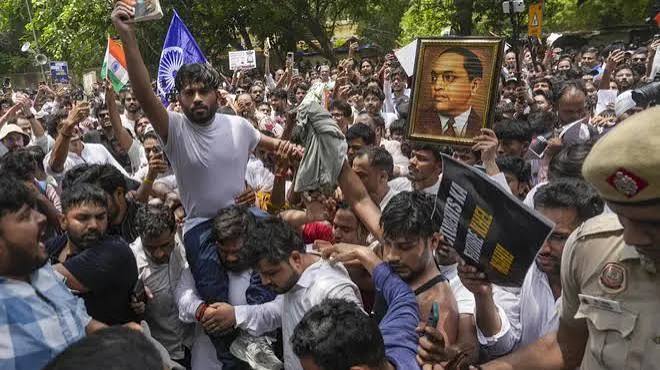
The current moment, marked as it is by youth protests led by the Cockroach Janata Party , NSUI and other youth groups are an important effort at challenging the hubris of the union government. The youth are making their frustration clear both with regard to the shocking disregard of their concerns by the BJP as well as the complete failure of the legacy media to be anything other than a mouthpiece of the Union government. The protests which have entered the fourth day are a significant challenge to the narrative of the Union Government that the only faultline in Indian politics which matters is the Hindu- Muslim divide. Instead the youth are saying that the issues which matter relate to the future of the youth including the ability to conduct examinations fairly and transparently and the generation of employment. This eruption of youth protests has caught the BJP by surprise, occupied as it was by its unconstitutional efforts at converting India into a country without an opposition. These protests have gained support from farmers groups and need to be supported by all constitutionally minded people as they challenge the narrative of the Modi government, that we are living in amrit kaal.
Ever since the BJP suffered a shock in 2024 through a reduction of its parliamentary strength, it has intensified its efforts to ensure that 2024 will be an aberration in its path to unchallenged electoral dominance. In particular the institutional capture of the Election Commission of India has been instrumental. The very decision of the ECI to do a Special Intensive Review of the electoral rolls and in the process disenfranchise millions of Indian citizens from minority, Adivasi and Dalit backgrounds speaks to the attempt at altering the nature of political democracy in India. The delimitation of electoral constituencies in Assam and the continuing efforts at introducing delimitation nationwide is another such effort at institutionalizing the electoral dominance of the BJP.
The efforts by the BJP to provoke splits in opposition parties is another unconstitutional means to ensure BJP’s parliamentary dominance. The efforts at changing the character of India’s electoral democracy come on the back of an effort to shut out all other forms of opposition. The relentless targeting of all protests as ‘anti-national’, the arrest of those who dissent, the capture of the media and the ongoing institutional capture of all wings of the state including the judiciary speak to the heavy handed authoritarianism of the state.
The context of this attempt to silence all forms of opposition is the spectacular failure of the government across all fields. In foreign policy, the government which liked to characterize itself as a Vishwaguru finds itself on the sidelines of every major international conflict, while Pakistan ends up being the mediator. When the Prime Minister liked to boast of his close ties to Donald Trump, Trump himself showed no compunctions in repeatedly insulting and humiliating India and Indians. Right from the unfair tariffs against India to the murder of Indian sailors to the handcuffed deportation of Indian migrants – the US has perfected a politics of cruelty working completely outside the framework of international law. The response of the Prime Minister to the spectacle of repeated humiliations from Donald Trump has been an embarrassing silence not worthy of the leader of a country which likes to call itself the world’s largest democracy.
When it comes to the economy, the failures are manifold. The call for austerity by the Prime Minister including the calls to cut fuel use and avoid travel indicate the seriousness of the crisis. These measures are being proposed amid the rapid downward slide in the value of Indian rupee against US dollar. The stresses and strains in the economy have not been accompanied by any measures to fortify the most vulnerable from economic shocks. On the contrary the government has gone out of its way to further strip the poorest of their economic entitlements. With the repeal of the MGNREGA and the enactment of the VB G RAM G Act, the cushion which India had provided in the form of employment as a right has been repealed, leaving the poor even more vulnerable during harsh economic times.
Cutting across ideology, what is increasingly apparent is the total incompetence of the government. This incompetence which has put the future of millions of young Indians at stake is today being exposed by the young themselves. Under this government, examination leaks in the NEET exam as well as serious discrepancies in the online evaluation of answer scripts by the CBSE have put the education system under scrutiny.
Typifying the seriousness with which these scams are being exposed is the work of seventeen year old 12th standard student Sarthak Sidhant from Ranchi. Sarthak was one of the 17 lakh students that have been affected by the On Screen Marking system released by the Central Board of Secondary Education. He used his research skills to make out a case that the CBSE failure to run the examination system competently was a result of a decision to favour a company Coempt Eduteck which had a past history of using software which failed massively. In Sarthak’s analysis, the CBSE Request for Proposals (RFP) were so structured as to favour one company by diluting tender requirements. As Sarthak put it, ‘This is a story of how a massive public institution deliberately played with students’ futures by rewriting its own rulebook.’
To give just one example of what Sarthak unearthed, the board in a previous RFP had explicitly stated that a service provider would be instantly disqualified if a confidential inquiry or past record revealed an history of “abandoning work,” “not properly completing contractual obligations,” or “financial failures/weaknesses in any institution.” However in the new RFP, ‘these clauses were completely wiped out’, directly benefiting Coempt Eduteck which in its previous corporate avatar as Globarena Technologies was responsible for the Telangana Intermediate exam fiasco which resulted in the failing of over 3.8 lakh students due to missing marks and other systemic discrepancies leading to the suicide of 23 students. As Sarthak put it, ‘For the board, a track record of poor performance didn’t matter anymore; as if ‘they had kept this clause, Coempt’s catastrophic operational history under the name Globarena in Telangana would have been a massive legal hurdle for their qualification.’
The emergence of the Cockroach Janata Party speaks to the levels of youth anger against the failures of the current government. The party which was born out of satire, and rapidly became an online sensation has made a transition into an offline presence organising protests in Delhi, Bangalore, Pune, Lucknow and other cities demanding the resignation of the Education Minister, Dharmendra Pradhan for ruining the future of tens of thousands of students of this country. As of 23 June 2026 the CJP marked the fourth day of continuous protests in Delhi demanding the resignation of the Education Minister, Dharmendra Pradhan. The protestors have strongly articulated that the ‘Hindu-Muslim’ issue is a bogey used to distract from the many failures of the government with respect to the youth. They have also strongly criticised the legacy media which they see as a tool to amplify the propaganda of the government while ignoring the concerns of the youth.
The resonance the CJP has had speaks to a high level of youth dissatisfaction and anger against the ruling party. At a moment when the levers of institutional control are even stronger with the union government, the continued protests on the streets by not only youth but also labourers, farmers, adivasis and civil society speaks to a wellspring of dissatisfaction vis a vis the performance of the Union Government by many sections of society. There is a disconnect between the mood on the streets and the election results. No matter how many elections the BJP wins, (using fair means and foul) the protests continue.
What is common to the range of protests which confront an unethical government drunk on its own power is its rooting in the Constitution. The protestors are reminding the government that however mighty it might think itself to be, it is still governed by the Constitution and the Constitution guarantees all citizens the right to peacefully express their opinion.
The expression of a free opinion through public assemblies is increasingly important in an authoritarian country in which the Union Government is using all means to prevent the expression of such opinion right from police intimidation, arrests and FIRs. It is a tribute to the protesters that they fearlessly express their opinion in spite of knowing that the act of protest could even invite a future of long incarceration under draconian laws such as the UAPA. It is a painful reality that after almost six years, peaceful anti-CAA protesters are still in jail including Sharjeel Imam and Umar Khalid.
In this climate which is hostile to protests, the current round of protests have loosened the grip of fear. One instance is the opinion expressed by CJP founder Abhijeet Dipke who spoke in the rally at Jantar Mantar of how his mother cried more on his return than when he had left for the US, as she feared his arrest on coming back to India. As he poignantly put it ‘This is not just the fear of my mother, this is the fear of the parents of any youngster who speaks on politics…. How long will we live in fear? Tell them, we are not scared.’
Abhijeet’s invocation of the importance of fearlessness reminds us of another era altogether. Jawaharlal Nehru noted that the time India spent under British colonial rule was a time of fear-‘pervasive, oppressing, strangling fear; fear of the army, the police, the widespread secret service; fear of the official class; fear of laws meant to suppress and of prison.’ As Nehru puts it, it was Gandhi who challenged ‘this all pervading fear’, with his ‘quiet and determined voice’. Slowly, the efforts of Gandhi bore fruit and ‘that black pall of fear was lifted from the people’s shoulders, not wholly of course, but to an amazing degree’.
The ‘black pall of fear’ is also reminiscent of the period of emergency from 1975-77 during which institutions which are meant to be independent such as the media and the judiciary abdicated their constitutional responsibilities and ceded full authority to the executive. The emergency saw the full use of draconian laws such as MISA under which thousands were detained and fear throttled the free expression of opinion in India.
The contemporary period of an ‘undeclared emergency’ much like the colonial period and the period of emergency is shrouded by the black pall of fear. It is in this dark time that one has to challenge an increasingly unaccountable government by fearlessly asserting the right to speech and assembly.
We hope that in the time going forward, all those who care about the Constitution of India can take forward the vision encoded in the Preamble of a society based on justice with liberty, equality, fraternity and dignity.