A Stolen Mandate: Weaponising the SIR to steal the West Bengal Elections, 2026
By PUCL Bulletin Editorial Board
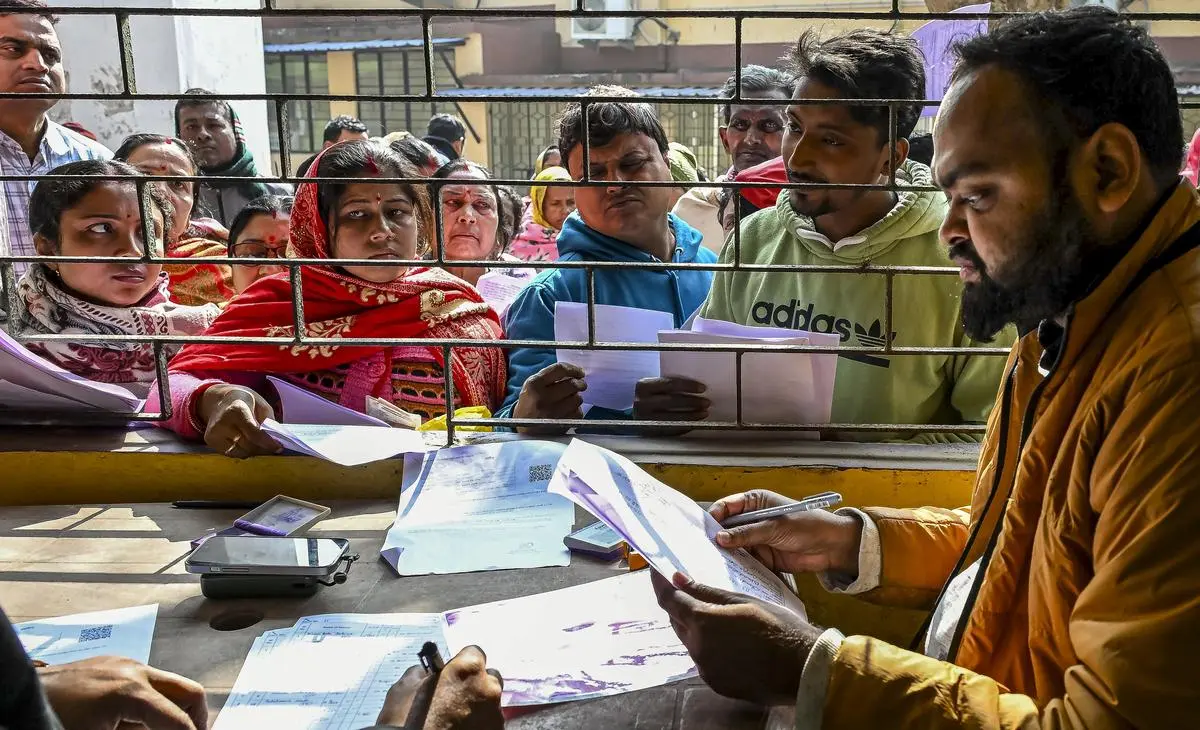
The 2026 West Bengal Assembly elections produced a seismic political outcome: the Bharatiya Janata Party swept to power with 207 seats, ending the Trinamool Congress’s 15-year reign. But the result arrived in the shadow of an unprecedented exercise in mass disenfranchisement, namely the Special Intensive Revision (SIR) of electoral rolls. Before a single vote was cast, approximately 91 lakh names had been struck from voter lists, with 27 lakh voters disenfranchised without even being given the opportunity to be heard, as is required by the law. The data is damning in its patterns, the process was riddled with arbitrariness, and from the viewpoint of a democracy committed to the defence of the right of all electors to vote, the elections should never have proceeded.
The SIR: A process invented to exclude
Both the Phase I & II of SIR, have clearly shown that around 7.69 crore voters’ names have been deleted from voter rolls. The SIR process is outside the existing constitutional and legal frameworks, as there is no such thing as SIR in Indian electoral law, namely the Representation of People’s Act, Registration of Electors Rules or the ECI’s own Manual of Electoral Rolls 2023. It requires voters to be mapped to the 2002-2004 electoral rolls, mandated it for all voters (yes, even existing voters on the voter rolls!) to submit an Enumeration Form, and restricted the submission of documents as proof to a list of 11 documents, which are less likely to be found in the homes of marginalised communities. We can safely say that the SIR was designed to disenfranchise the working poor, Dalits, Adivasis, religious minorities, transgender persons and most of all, women.
Its implementation in West Bengal however, revealed a more sinister design. The document rules were themselves a moving target. The ECI initially excluded Madhyamik (Class X) admit cards from the list of admissible documents, a highly consequential decision in a state where many rural and older voters lack passports or birth certificates. This was contested and partially reversed following judicial pressure, but not before many affected voters had already missed their hearing windows. Meanwhile, OBC certificates issued by the West Bengal government after 2010, affecting a significant number of backward-class voters were rejected as valid identity proof following a Calcutta High Court order, adding another layer of exclusion.
The unconstitutional category called logical discrepancy
New rules and processes were invented, involving the use of opaque technologies such as new AI-driven softwares to arbitrarily flag voters as suspect in a category called ‘logical discrepancies’. 1.16 crore voters were issued notices under this category, even though their mapping had been completed, and they had submitted their Enumeration Forms. The specific triggers for the “logical discrepancy” tag were extraordinary in their crudeness: the software flagged instances where more than six individuals had listed the same parent in their enumeration forms, or where the age difference between a voter and their registered parent was less than 15 years or more than 50 years.
These rules completely failed to account for the social realities of rural Bengali families, particularly Muslim families with older generations, where joint families with many children listing the same grandfather or grandmother as a family head are common. They failed to account for the absence of any standard transliteration of Bengali (and especially Urdu or Arabic) names into English, so the same person’s name could appear as “Mohammed,” “Mohammad,” “Muhammed,” or “Md”. Even Bengali Hindu names are spelt differently in Bengali, than in English, which led to discrepancies found between people’s documents. As former CEC Quraishi noted, “If software is being used to delete voters on the basis of these minor discrepancies, then it is a weapon against citizens’ rights and not fit for purpose.”
Even when the Chief Electoral Officer-West Bengal published the final electoral rolls after the SIR, around 60.06 lakh voters were marked as ‘Under Adjudication’. This part of the process has also not been outlined in any law, guideline or protocol issued by the ECI. A process of ‘adjudication’ was undertaken which found 32.68 lakh out of the 60.06 lakh people as eligible voters as on 25th March, 2026, but 27.16 lakh voters were still left as ‘Under Adjudication’.
With less than 2 weeks before polling, to decide these 27.16 lakh cases, 19 Appellate Tribunals were set up. However, these Tribunals could only approve 1,607 and more than 27 lakh people had their appeals pending, and were not allowed to vote in the Assembly Elections! We must remember, that these 27 lakh people were not excluded because they were found ineligible. It was because the system failed to account for procedures, sufficient time and resources to determine the validity of their appeals. In addition, there were appeals that were for exclusion of names, all in all, 34 lakh appeals were pending before the voter rolls were frozen.
Who were targeted?
The geographic distribution of these deletions is where the political targeting becomes statistically irrefutable. Murshidabad, where nearly 67% of the population is Muslim, recorded the highest deletions in the state: 4.55 lakh names were struck off. It was followed by North 24 Parganas (3.25 lakh), Malda (2.39 lakh), South 24 Parganas (2.22 lakh), and Purba Bardhaman (2.09 lakh). Together, these five districts accounted for over 53 per cent of all deletions in West Bengal. All are districts with substantial Muslim populations and were historically Trinamool Congress strongholds. Crucially, these 5 districts total 133 Assembly seats in the 294 seat West Bengal state Assembly.
Overall, estimates across civil society organisations and independent researchers suggest that 65% of the 27 lakh voters deleted in the adjudication phase are Muslim, even though Muslims constitute approximately 27% of West Bengal’s total population. One-third of all adjudication cases originated from just two Muslim-dominated districts: Murshidabad and Malda.
The constituency-level evidence is even more disturbing. In Nandigram, the high-profile seat held by BJP’s Suvendu Adhikari, an analysis by the SABAR Institute found that Muslims make up roughly 25% of the population, yet they accounted for over 95% of the names deleted from the supplementary electoral lists. The analysis found that across 7 of the supplementary lists in Nandigram, the share of Muslims deleted ranged from 60.9 per cent to 98.7 per cent. In Bhabanipur, where Mamata Banerjee contested against BJP’s Suvendu Adhikari, Muslims constitute approximately 20% of the electorate but accounted for approximately 50% of voters placed under adjudication.
This was not a coincidence. Senior BJP leaders such as Suvendu Adhikari had openly predicted, even before the SIR began, that around 1.2 crore “infiltrators” would be removed from voter rolls. They named no particular community, but the rhetoric around “Bangladeshi infiltrators” and Rohingyas left no ambiguity. The data confirms what the rhetoric foreshadowed: Muslim voters were targeted for deletion at rates grossly disproportionate to their population share, in constituencies that determined the political balance of the Assembly.
Of the 112 constituencies where Muslim voters made up between 20 and 30 % of the electorate, the TMC had won 106 in the previous election. By systematically erasing Muslim voters from these seats, the SIR functionally undermined the TMC’s core electoral base before a single ballot was printed.
The suspicion that the results of the election were clearly preordained becomes evident, when we compare the number of deleted voters with the victory margins of political parties. Out of the 207 seats that BJP won, in more than half, 105 to be precise, the number of deleted voters far exceeded BJP’s victory margin. We can only thus conclude that it was no accident, to proceed with conducting an election when the integrity of the voter roll is questionable. The SIR and a compromised Election Commission of India manufactured the victory of the BJP, effectively undermining the people’s mandate. By no means was it a free, fair and independent election.
Universal Adult Franchise – the cornerstone of parliamentary democracy
The right to vote is not a discretionary privilege, it is a constitutional right enshrined in Article 326 and even protected under international law, including Article 25 of the International Covenant on Civil and Political Rights (ICCPR), to which India is a signatory. Article 25 of the ICCPR guarantees every citizen the right to vote and to be elected “at genuine periodic elections which shall be by universal and equal suffrage.”
When 27 lakh citizens who had been registered voters – who had voted in previous elections including the 2024 Lok Sabha elections, who had the required documents and had even completed the process of mapping as required by the SIR – were stripped of their voting rights in the final weeks before polling, that right ceased to be universal. It became conditional on surviving an administrative purging process that was chaotic, rushed, and procedurally arbitrary on one hand and specifically targetted on the other.
The Courts that stood aside
The scale of what happened in West Bengal has no modern parallel in Indian electoral history. When petitioners came before the Supreme Court asking to vote while their appeals were pending, the court redirected them to appellate tribunals. But those tribunals could not restore names in time for polling. In fact, Justice Joymalya Bagchi made a remark saying that such ‘appellate processes may take time’, but the court could not allow the interim inclusion of such voters for the upcoming elections. If processes required time, then why is it that the Supreme Court allowed for the elections to proceed?
Gaurav Mukherjee argued powerfully in an article in the Scroll that the West Bengal SIR should be “understood as a constitutional failure, not merely an electoral controversy.” He wrote that the Supreme Court had placed “the risk of institutional delay on voters rather than on the state,” and that “the state should not be allowed to disrupt’ the existing voter rolls ‘through a rushed exclusion process and then invoke finality as a shield.” In a constitutional democracy, courts must not merely keep elections moving; they must keep the electorate open.
A stolen election
The BJP’s historic capture of 206–207 seats in the 2026 West Bengal Assembly elections was achieved against a backdrop in which the electoral rolls had been purged of millions of voters drawn disproportionately from communities that historically voted against it. That is not an incidental fact. It is the central political fact of this election.
The margins in many constituencies were narrow enough that the removal of thousands of Muslim voters, with no legitimate grounds for deletion, determined the outcome. In Nandigram in 2021, Adhikari won by a margin of under 2,000 votes despite the constituency having a nearly 30 per cent Muslim population that traditionally voted TMC. After SIR 2026, over 95 per cent of deleted names in that constituency were Muslim. The connection between targeted deletion and electoral outcome is not inferential — it is based on simple arithmetic.
Al Jazeera’s analysis concluded that the BJP’s victory “triggered profound questions over the integrity of the electoral process itself,” noting that the election took place “after an extraordinarily sweeping and deeply controversial Special Intensive Revision of electoral rolls.” The verdict, it observed, had “transformed India’s political map”, but the transformation was built on a foundation of structural disenfranchisement.
Many have argued that the victory of the BJP must be attributed to several other factors such as anti-incumbency and the voters’ frustration with TMC’s corruption and policies. Some like Pratap Bhanu Mehta have gone so far as to say that the results are a reflection of “unprecedented national electoral prowess of the BJP and the ideological supremacy of Hindutva”. However, from the human rights perspective, it is imperative to underline that such debate and dialogue about what the ‘people’s mandate’ is, would have been relevant only if the integrity of the voter roll been preserved.
The human rights standard for rejecting an election outcome is not simply that some voters were inconvenienced. It is that the foundational conditions for a free, fair and independent election, namely universal suffrage, equal treatment and due process, were systematically violated in ways that materially affected the result.
The West Bengal Assembly elections in 2026 meets this standard of violating the basic conditions of a free and fair election. 27 lakh citizens were stripped of their votes after an arbitrary algorithmic process, without individual reasoned orders, in a compressed timeline that made meaningful appeal impossible. The geographic clustering of deletions aligned precisely with Trinamool Congress strongholds and Muslim-majority constituencies.
Amongst international organizations, the `Hindus for Human Rights’ formally condemned the SIR process as one involving “voter disenfranchisement, intimidation, and threats to free and fair elections.” The Progressive International published an alert calling the deletion of 9.1 million voters “an assault on democratic rights.” International observers and constitutional scholars alike have characterised what happened as a structural distortion of the electoral process.
Why the Election Results Must Be Challenged
An election whose starting conditions are corrupted by the mass, discriminatory erasure of legitimate voters cannot produce a legitimate mandate. The results of the 2026 West Bengal Assembly elections must be challenged through every available judicial and international mechanism, not because any particular party deserves power, but because no election conducted under these conditions can claim the moral or democratic authority that representative government requires. When the state uses the machinery of electoral administration to silence the voices of its most vulnerable citizens, the results it produces are not a verdict of the people but rather the verdict of a government which chooses its own voters. All right thinking citizens need to be concerned as to whether SIR has become a tool for the BJP to choose its own voters.
Or as Brecht would have put it,
Would it not be simpler
If the government simply dissolved the people
And elected another?