A Glimpse of India’s First Gen Z Uprising
By Kavita Srivastava
`Ring the bells that still can ring
Forget the perfect offering
There is a crack, a crack in everything
That’s how the light gets in
Ring the bells that still can ring
Forget the perfect offering
There is a crack, a crack in everything
That’s how the light gets in
That’s how the light gets in
That’s how the light gets in’
The chorus of the song Anthem, by Leonard Cohen, sums up the upbeat moment on Delhi streets, where students stand fearlessly a day after the massive police violence, defying the Modi Government, with only one demand – Narendra Modi, Kursi Chhodo (resign).
On 20th July, 2026, the Delhi police brutally lathi charged young men and women, participating in the march to the parliament called by the Cockroach Janata Party. There were more than 1,00,000 young people participating in it. The police for the first time used pellet guns to target young people. So far, there have been four documented instances of pellet injuries. The police also thrashed them on their heads, hands, shoulders, legs, ribs. There are also instances of the serious sexual violence committed by the police, like tearing of the clothes of girls, shoving lathis into their genitalia and thrashing young women with lathis, untill their bled. The police also dealt with the young students in an inhumane manner, dragging the injured and those resisting police action along the streets.
However neither the brutal violence faced by the students nor the lodging of criminal cases against the protestors by the Delhi police was enough to deter them from showing up on the following day.
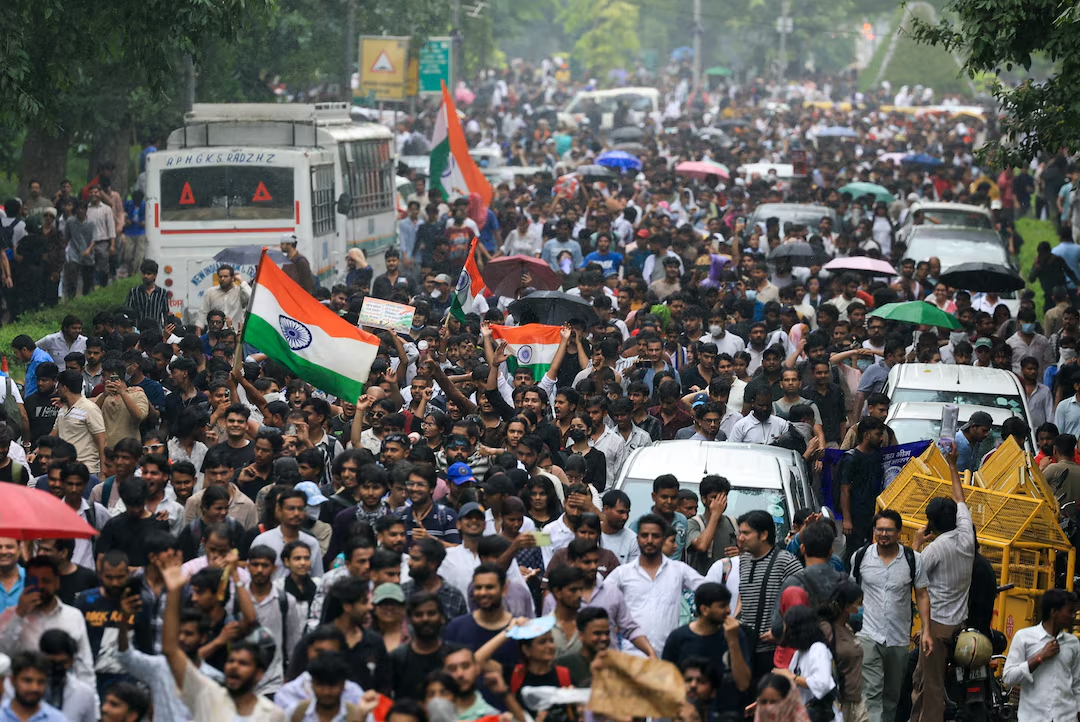
Lutyens Delhi seems to be now fully occupied by students and young people, with a resolve that they will leave only after Narendra Modi resigns. From the streets of Delhi it is loud and clear that the Modi Government has to go.
The CJP stage is no longer the centre of action. The movement now has its own steam, and is growing larger every day. Protests erupted in more than 60 cities on 20 July 2026. And many more protests continued to happen on the following days as well.
It appears as if the young people will continue to hold fort, day in and day out, demanding not just resignation of Dharmendra Pradhan and Prime Minister Modi but also legal action against the perpetrators of police brutality and justice for the victims.
This article is not about the CJP and the merits of its demands but rather seeks to look at the platform that has emerged out of this movement and the radio silence of the state.
The making of a Gen Z protest group, called the Cockroach Janta Party.
The CJP was borne out of a satirical post of communication strategist Abhijeet Dibke, an Ambedkarite. In response to the Chief Justice of India Surya Kant’s remark demeaning the youth of the country as parasites and cockroaches, Dipke asked, “What if all the cockroaches came together?” It resonated with the youth, and CJP’s Instagram handle got more than 22 million followers in less than a week.
With no organisational backing, a call was made by Dipke to stage a dharna in Delhi on the 6 June 2026, against the NEET examination leak and demanding the resignation of the education minister Dharmendra Pradhan. Within a couple of weeks, three more young professionals joined Dipke as spokespersons, just before the protest. Environmentalist and innovator Sonam Wangchuk had also joined the movement briefly that day and said that it was an opportunity to ask deeper questions of the education system and he was there to guide them.
Surprisingly the dharna was allowed at the Jantar Mantar, with hundreds of youth participating in it. From day one, the youth that gathered at the CJP platform, explicitly rejected the Hindutva narrative of polarising Hindus and Muslims and secondly, rejected the mainstream media, who were literally hooted out of the place. The protestors seemed to have a one point goal – to hold someone accountable for the systematic breakdown of the education system.
The day-long Delhi peaceful protest had ended abruptly, but was followed by peaceful protests in several cities with the CJP leadership at the helm of it.
The Indefinite Sit in and Fast
The CJP finally came back to Delhi on 20 June 2026, where an indefinite sit-in was announced with the demand for the resignation of Dharmendra Pradhan and compensation to the families, who lost their children due to the paper leak scam. This gathered a large number of student groups including from all the denominations of the left parties and ideologies. They all put up their banners and posters and sang revolutionary songs and performed plays and stayed twenty four hours at the dharna along with ordinary students and citizens.
It is important to emphasise that the protest using tools, which consisted of speeches, revolutionary songs, slogans and poster making became a talking point in Delhi. Young people who called themselves Gen Z, took ownership of it as they all felt that it was their time to discuss the issue of education and their future on the streets and not leave it to a Government which did not care.
The dharna initially may not have witnessed huge crowds, but was enriched with the spirit of brotherhood. Muslim families brought in food every day, a modest chai wala supplied tea to all the protestors, old women cooked and brought food in small quantities. Families of more than twenty children who had taken their lives due to the NEET paper leak, came to the protest. They saw hope for the future of other children. With the mainstream media pushed out again, YouTubers and webportals became the messengers. Known for its tactics of distorting and demonising protests and expressions, the public decided not to allow them into the protest. Although the CJP leadership announced that it is a non-party political movement, they welcomed all parties to participate in it.
Police intimidation and the pushing of boundaries by the protestors
Throughout the month, the police in every way denied necessities to the protestors like electricity supply for the night, water in the public toilets, and raided the homes of Muslim and working class volunteers in particular, who were supplying food or participating in the protest. The police would often deny people entry arbitrarily. Students were particularly incensed by the police action, destroying an impromptu library set up by one of the student groups of Delhi University.
The extent of surveillance seen at Jantar Mantar showed the state’s complete disregard of people’s privacy as well as their dignity and liberty. Towers of the height of 15 feet were erected inside the protest site, with two men in shifts sitting behind the cameras and capturing all the activity happening at the protest site. This intensive surveillance was enabled by purchases from the Spanish company Herta, which has been blacklisted by European nations because of privacy concerns. However Delhi Police was one of the proud purchasers of this technology!
The use of camera footage for facial recognition purposes, in order to book people in crimes, is the most dangerous part of this surveillance technology. In the Delhi riots of 2020, a large number of people were arrested, matching faces, with faded aadhar or voter ID pictures, and prosecuted on suspicion of participating in violence, when the person may not have had no role. This round the clock surveillance has been challenged to the Delhi High Court, via a civil writ petition on grounds of violation of privacy rights and the dignity of the individuals.
The Satyagraha phase of the movement
The epitome of a satyagraha is when the body becomes a tool to fight the system. The difficult phase of the dharna started with an indefinite hunger strike, with several young students also taking the decision of fasting, which included nine youth protestors with six of them from AISA. Of the six, three from AISA, namely Neha Bora, Aameen, Manish as well as Hamad from Punjab were going strong for 23 days. At the helm was the senior activist Sonam Wangchuk, environmentalist and leader of the Ladakh movement for statehood and schedule six status, who also decided to participate in the protest and sit on a fast unto death.
Wangchuk gradually became the face of the dharna. He is known for his long fasts, including the 40 day fast in 2024. When Wangchuk was protesting for Ladakh’s autonomy in 2025, he was arrested under the National Security Act and arbitrarily confined for almost six months before being released.
The dharna also started growing larger with masses coming to the dharna, to lend support and solidarity to those on fast. No response from the government further mobilised the young people.
The Government instead of listening to them, and initiating a communication with the CJP leadership, abducted Sonam Wangchuk from the stage, now popularly called Operation White Chadar. On the early morning of 18 July 2026, more than forty cops, dressed up as civilians, curtained off a resting Sonam from the crowds using white bedsheets. They later roughed him up, literally dragged him to the ambulance and abducted him.
The people tried to stop the police, but the policemen were relentless and pushed the public and took him away. The police tried taking away the other protestors who were fasting too, but by then, students and youth protestors had made a human chain and protected the three AISA protestors and Hamad.
The Government plan misfired; they thought the dharna would end or fizzle out, instead the crowd swelled up. By 18 July 2026, the number of young protestors reached more than 10 thousand. In fact, people came to the dharna and did not return home.
The CJP’s Call for a March to the Parliament on 20 July 2026
I had come to the CJP protest over three days between 16th and the 19th of July. It was very heartening to see how disciplined the crowd was. Since the police had barricaded both sides of the Jantar Mantar, huge crowds had to accommodate themselves within a limited space. A continuous stream of political party leaders, coming in solidarity with the CJP and those fasting, seemed to be the trend. Celebrities, satirists and other artists, also came to the protest site.
A Delhi Police notice issued on the evening of 19th July stated that neither a permission for a march had been granted to the CJP nor they had sought such permission. Section 163, BNSS (erstwhile section 144) had been imposed in the area, therefore, assembly of more than five or more people was prohibited, except at the designated protest site in Jantar Mantar, that too with prior permission. The police claimed that this was being done for public safety, security and in order to protect the vital Government installations. The notice made clear that any act of violation of these orders would result in being prosecuted under section 223 BNS (erstwhile section 188 of the IPC). Both provisions deal with the offense of “disobedience to an order duly promulgated by a public servant”. At the end the Delhi police tried to appeal to the citizens, to not participate in any unauthorised gathering or March and cooperate in maintaining public peace, safety and security. This notice was roundly rejected by all the protestors.
On the 19 July itself, the crowds, outside the barricades, seemed more than the numbers inside. It took me more than forty minutes to get inside the dharna space. Crowds were raising slogans against the Modi government. The mood had changed and there were continuously demands for the resignation of Modi along with Dharmendra Pradhan. The demand for the resignation of Modi seemed louder than that of Dharmendra Pradhan. There was a continuous flow of people, so that space could be made for others to come in. Music and sloganeering was in the air all the time. It was an important night. Katl ki raat, a decisive night, where something big was being expected. No one slept that night, as crowds of young people had already filled up Tolstoy Marg and were already near the barricade on the junction with Parliament Street. It was still not midnight.
Young men and women kept pouring on all roads leading to the Jantar Mantar. Despite several trains from various parts of India being cancelled and diverted, people found their way to the roads, leading to Jantar Mantar. The crowds ended up on eight of the radial roads. I saw three of the roads, namely Janpath, Tolstoy Marg and Parliament street which were filled to their capacity with people. There were people who had also filled up on Jantar Mantar road, Raisina Road, Ashok Road, central Park, above Palika Bazar, CP, Madras cafe area and many more roads, leading to Jantar Mantar.
Walking in the morning through Janpath and Tolstoy Marg was something I have never experienced before. People walking in a disciplined way, almost in rows. Both sides of the road had people moving, some towards Jantar Mantar and others returning from it, trying to access other areas. The slogans were mainly, Jai Bhim, Inquilab Zindabad, Vande Mataram, and against the PM and against the Modi Government. Jai Bhim and anti Modi slogans were raised more frequently than others. The slogans demonstrated a strong social justice awareness amongst the marchers.
We walked to the Parliament street barricade, which had already been broken down and people were moving towards the Parliament. The road towards Parliament House past the Parliament Street police station, was full of thousands of people. Wherever one turned their eyes, one could only see people. Early in the morning itself, students had upturned several barricades. The thousands of people near the Parliament Street police station barricade, was being led by the Member of Parliament Chandrashekhar Azad. Young women in huge numbers were walking confidently and safely.
The police were massed in large numbers. This included both the police in Khakhi uniform as well as the riot police, called the Rapid Action Force. News was coming in that the police, on all the roads, where people had gathered, were off and on using their batons to hit on the legs and push the people back. Some got injuries, most of which were not serious, but some did get hit badly. Fellow marchers called the ambulance who took the people who got injured to closeby hospitals.
There were not many conversations around anyone’s fast. Some were complaining that the protest was very chaotic and mismanaged as they did not know where to go and hence were asking for the leaders of the CJP. However two of the spokespersons were in a meeting with the Health Minister, JP Nadda where they were intentionally confined for more than two hours.
Many protestors sat down on the side walks and railings and the fallen barricades. Several police vehicles, including the water canons, the tear gas shelling machines were all around all as signs of intimidation, but the marchers hardly noticed it. There was a celebratory mood, a junoon, a passion that they will change the present, and make a new India. Many of the protesters had copies of the Constitution in their hands, several were carrying placards with Modi’s caricature, many carried blue flags as well as the India flag. All kept walking with a purpose.
Everything seemed peaceful. I tried to access other roads, walked into the protest area of the Jantar Mantar to meet all those who were on fast, and enquired about whether they had broken it. Almost all had broken the fast, except Hamad, who said he was curious about the outcome of the CJP delegation that had gone to meet the Health Minister JP Nadda. He said he wanted to break his fast, with some happy news of the possibility of Dharmendra Pradhan’s resignation.
The stage had some doctors who were providing first aid to the injured. The mood here too was upbeat. I also went outside on the Kerala House side where huge crowds blocked almost every little bit of the road. People had come in from side roads and the circle and were demanding that they be led to the Parliament. As it was a march to the Parliament.
I came back to Parliament Street where there were more than 40,000 to 50,000 students. People were getting restless, with the police stopping them and suddenly, we heard loud noises as if bombs were going off. They were tear gas shells being blown in the air, and with the white ammonia gas enveloping the area, students started retreating back, towards Tolstoy marg. But it was only for a few minutes that the students paused and then came back hooting at the police. This time the police retreated briefly and then came back violently, as if at war with the students. They started catching students and beating them mercilessly.
Sometimes the beating was on the legs, the hips but it was worrying that the police were also hitting students on the head. It almost caused a stampede, but the students did not give up. A batch from deeper within Tolstoy Marg rushed to challenge the police asserting that the police could not drive them out with their lathis and tear gas shells and merciless beatings. The police force almost seemed to double, which is when a group of policemen came to me and said that I should leave from where I was standing. I pleaded with them to not hit me or the students, but the police did not seem to be in a mood to listen.
I moved into the Parliament Street end. Students were being fired on with tear gas shells and being beaten by police men and women. Students were running everywhere and falling on the streets. A stream of chappals and shoes seemed to be left behind as boys were running. The police in riot gear were chasing and hitting them. And pushing them to move towards Connaught Circus. But the students started pushing back, refusing to be driven away. We ourselves were drowned frequently in an envelope of ammonia gas.
At times I had to take shelter behind a tree to avoid being pushed down by the running crowds. Then I rested against the boundary wall of a closeby hotel. The students were being driven back and forth. The Central Park – Connaught Circus end was completely filled with people, who refused to be pushed out. We suddenly heard stones being thrown. The young men and women who had retreated back, told us that the police had got into the park on one side and were hurling stones on the Parliament Street side.
I stationed myself with another activist, against the boundary wall of a hotel on Parliament street and gradually it became the space for lots of young men and women who requested that we stay with them till the end. They were frightened. Most of them had not asked their parents before coming for the protest. When I asked them as to why they defied their parents, they said “if not now then when”. Each one who had run and come away, to seek refuge by our side, had an injury or had been badly hit on the legs or whilst jumping off the barricade, hurt themselves.
One student said that he was running, despite his legs having given way. He had been injured at the protest site, when the riot police ran into the tent and started hitting people to leave the tent. They literally trampled on the team of doctors who were trying to treat a patient on the stage. He said that girls who tried to run and jump off the stage were trampled by others. He with his long legs ran over the barricade but when he was trying to jump, the police hit him hard on his legs, he felt that he would fall. He said he had come despite his parents’ denial of permission to participate. He declined any medical help. When the situation calmed down a bit he hobbled away to find some transport, which seemed nowhere in sight.
Leaning against the wall of the hotel, we were able to observe the endless pushing of students by the police, towards Connaught Circus. The police’s brief was to empty out Jantar Mantar and adjoining areas at any cost. In the backdrop of the loud sirens, shelling blasts and white fumes enveloping the people, despite the deep humiliation suffered by Gen Z and Gen Alpha who too had gathered in large numbers, the people forcefully asserted their presence. It was clear that no amount of repression could get them to take back their demands and leave the movement they had built. More than 50,000 people had passed through Parliament street driven through Tolstoy Marg by the merciless beating of the police.
When we were walking back, we saw a huge crowd of students that refused to move from the Tolstoy Marg, with their backs to the monument, outside the protest area. We walked up to the point and saw an empty protest site. When I moved to take a picture, women police pounced on me trying to push me back.
The police were announcing that the crowds must leave or they would be arrested. The young people refused. They kept shouting Jai Bhim slogans and kept their morale high. And the announcements seemed to reach no one. Then almost next to us, they lobbed a tear gas shell, we moved fast and took rescue near the wall of the church. One young girl ran a bit and sat down on the chair and said she was in acute pain. She had been beaten by lathis and perhaps also hit by a stone. Her face was swollen and lips in particular were hurt. Somehow we motivated her to come with us.
She walked a few steps and again sat down, crying this time. We again motivated her and got her friend to take her anyhow. The area was still unsafe. Close to the Parliament Street police station, we ran into another girl who was crying. She had taken admission in one of the Delhi University colleges and stayed in a rented room, but was from Patiala. Despite her parents’ denial of permission to come to Jantar Mantar, she took the train and came straight to Jantar Mantar. She was sobbing and traumatised with what she had witnessed.
Police Violence and Brutality
She kept saying that she saw too many women being lathi charged and who bled from the head. She also was sexually assaulted by the police and was unable to recover from that assault. She shared that the police had tried to pull her shirt and tear it, but she ran away. We really motivated her to have courage and not give up. And she exchanged her numbers with us.
We moved further and we were informed by one activist that a large number of people had been detained at the Parliament Police Station. We went in and found other women’s activists and a former member of Parliament. It was shocking to hear the stories of violence.
One SFI member, also a PHD scholar, told us that five men were taken into a room. First they were asked about being Hindu, he said yes he was born Hindu. The policeman Mohit who took them to one room, which was like a torture chamber, asked them a question regarding Kunal Kamra’s couplet, which he had made on the CJP stage, saying that they talk about Sita’s husband and work for Nita’s husband. He asked them whether they were angry with Kamra for that statement and whether it was making a laughing stock of Hindu gods. They said that it was for the courts to decide on whether it was right or wrong, so then they said, why are you men not outraged. The Muslims decapitate those who talk against their Allah, must you not express anger about it. Since they did not agree with this statement, each of them were beaten with batons and then made to sit on their haunches, with their palms spread out and were beaten again. They could also hear cries of help coming from another room where the police were beating people.
Similarly another boy who introduced himself as CJP Ludhiana was shirtless and he said that his shirt had been torn by the police. He had got a thrashing because he was asked whether he was Hindu or Muslim and he said I am Hindustani. When they insisted he reveal whether his identity was Hindu or Muslim, he was first threatened that his pants would be pulled down and his genitals would be checked. He was then beaten with the wooden baton. The marks on his body clearly showed how bad the beating was.
We met one girl who was detained at the police station from the protest site, after she was beaten badly on the breasts, her clothes torn by the policemen, and the assault by lathis had almost broken her elbow. She was also bleeding near the elbow, and when she was screaming at the police, they dragged her into the thana. Luckily one boy gave her a T shirt from the bag and she could cover herself. Despite bleeding badly, they took her separately and beat her in the police station along with two of her companions, instead of giving her medical help.
We also met one boy who was hit by a baton at the protest site where the nail from the baton went into his forehead, causing serious injuries and bleeding. He was taken away and detained in the police station where he was beaten black and blue and we could see lathi marks on his back.
Both these students, despite bleeding badly, were not taken for a medical examination. Instead, when they protested, the thana first aid box was given to them. They had to bandage the wounds of each other, without any help from the medical staff.
Of the 35 detainees, 26, of the detainees had been released by various lawyers, these nine got released without any paperwork, due to the intervention of a former MP and some of us activists. Since students did not wish for the police to get their medical examination done. We got them out and realised that some of them had not eaten from the previous night. We took them for a meal and tried to convince them to come to RML for a check up, but they refused and said they would rather leave and go home.
Most of the people injured did not go to public hospitals, instead reached private hospitals. However there were more than 250 people who were being treated at the three public hospitals. Some reports state that about 100 people reached Lady Hardinge Medical college and about 200 people reached the Ram Manohar Lohia hospital, although that figure needs verification as many of the injured were turned away as the RAF was at the RML and stopped the people from getting medical access. Despite this, a hundred injured must have accessed the services, and 35 at Safdarganj Hospital. The injuries include Stun Baton shocks, pellets, fractures, head and limb surgeries, eye injuries including blindness among others.
Before we reached home, we started receiving calls from other detainees. I got a call from one detainee at the Chhatrasal Stadium. He had come from Maharashtra. More than 60 people who were leaving the protest-site at the Raisina road end, were picked up by the police opposite Central Secretariat Metro, when they were trying to run away from the police lathis and violence. They were herded into a bus and before they knew it, they were taken to the Burari police station, where their details were taken and sent to the Chhatrasal Stadium for the night.
With the intervention of lawyers, the girls were released, but the male students and youth were detained. When we spoke at the Burhari Thana, we were told that they were planning to release the boys, but got a message from the Joint CP that since the dharna had restarted they would delay their release. A list of 47 detainees was sent to me, with five from outstation. We contacted lawyers, who rushed there in the night, but were not allowed to meet the boys. But by the next day, lawyers managed to access them. They were taken to the Model town police station and released on personal bonds.
Late into the night, teams of lawyers who were contacted by activists and detainees were moved into various police stations. The three days after the march, these were the developments.
On day 1, there were 35 detainees at the Parliament Police station, and day 2 there was one, he was brought on the 20th but not released, till lawyers went searching as he was put in the missing list. Detainees at the Mandir Marg police station on day 1 were 11 and 6 on day two, about 25 to 30 detainees at Kapashera police station on day one, Mukherjee Nagar, 60 on day one.
On day 2 at least 26 people were brought into Nizamuddin police station and day 3, it was 60 who were sent to Badarpur police station and about 10 were kept in the Nizamuddin police station, these were mostly were picked from the Nizamuddin area, What was worrying was that most of the people who were picked up were locals from areas, outside the Railway Station and the Bus station of Sarai Kale Khan, these were not protestors, but people getting on with their work.
On day four, about 50 detainees were brought into the Nizamuddin police station, as of 2 am of the 23 July 2026 again from nearby areas. A group of twenty protestors, were returning home and were picked up by the Lodi road police station. In a first, it was brought to our knowledge that the police were checking all the apps installed on the phone and trying to make enquiries.
Several people were released without bonds and many were also released on personal bonds.
Summarising Police Violation
Clearly, it can be stated that there was unprovoked violence by the Delhi police and RAF on the peaceful protestors not sparing children and minors, women, and the old. The use of excessive police force seemed as if the Indian state was out to make war on its own people. It was shocking to see that not a single policeman of any rank wore name tags. The violence did not consist of methods to manage the crowd but to seriously injure and humiliate the protestors. The extent of the sexual violence brazenly attacking women’s bodies left women shattered. It was surprising to see that despite the huge placement of water canons they were not touched.
Excessive use of tear gas shells was observed. It was shocking to see that non-state actors including the RSS and Gaurakshaks with plastic batons were being allowed to beat up the protestors. The absolute shocker was the use of pellet guns which in the past were used in “insurgency” areas in Kashmir and Manipur. A large number of people were arbitrarily detained and subjected to violence inside the police stations. Many a times for not claiming we were Hindu or agreeing to the anti-Muslim narrative. The denial of medical access by the RAF outside the RML simply to reduce the numbers of injured was again observed for the first time. When the injured and the assaulted tried to lodge ZERO FIRs against the police, they were denied. One such instance was brought to our notice.
As I close it is important to note that youth protests have sprouted across the country, with young students remaining undeterred, and asking for change. New reinforcements are being brought in by the CRPF in the name of crowd management. However, this nationwide protest with Delhi as the epicentre, seems like a hopeful moment of change.
The demands from our side would include
- The resignation of the Delhi police commissioner, who led the violence on peaceful protestors
- Compensation for all injuries and traumas incurred by the protestors.
- Resignation of the Education Minister Dharmendra Pradan
- Compensation to the NEET students who took their lives.
- Demanding from NHRC action on police violence.