PUCL condemns the UP Police’s invocation of National Security Act against the arrestees of the NOIDA wage hike struggle as illegal and unconstitutional
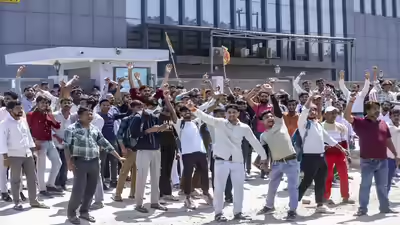
Background of the workers struggle in NCR Delhi region in April, 2026
It is important to understand that the protest of the workers in NOIDA for a hike in wages was not in isolation. The workers strikes in the Delhi NCR region precipitated with a phenomenal increase in food and fuel inflation, with cooking gas prices skyrocketing, due to the West Asia conflict. This led to several factory workers in the Delhi NCR region protesting for hiked wages. It started with multiple factory workers in Manesar, Haryana going on strike for increased wages on 2nd April and spread like wildfire to several units in the Manesar Industrial area, with more than 7000 protesting workers who stopped work and demanded the implementation of the Haryana State Minimum Wage Committee which had proposed Rs. 23,196 on December 29th 2025. On the 9th the CM of Haryana, announced Rs 15,220 for unskilled workers, as the increased wage, from Rs. 11,274 which was fixed in 2015. The workers continued with the struggle, demanding a further hike along with other demands, which resulted in the Haryana police use force on the protestors and arrested 6 activists of the Inquilabi Mazdoor Kendra, Shyam Bir, Raju, Harish, Ajit, Pintu and Akash along with more than 55 workers against two FIRs. The 61 arrestees are in jail since the 10th of April onwards, with attempt to murder cases.
Very soon the demand for the hike of wages, spread to the NOIDA industrial sectors from 9th April itself and it started from the Richa global textiles and spread to other factories and more than 10,000 workers were on the street on the 9th and 10th, April. UP Police used repressive tactics and some violence followed, which needed to be enquired into, as there was evidence to show that the provocation was not the workers. The police then picked up thousands of workers and activists, who were providing support to the workers. Several FIRs got lodged, and even today seven activists and approximately 60 workers are still behind bars. On the 14th of April, the CM UP announced a meagre increase in wage from Rs. 11,313 for unskilled workers, to Rs. 13,690, which left the workers dissatisfied.
The workers agitation did not stop with NOIDA, it spread to Faridabad, Bhiwadi, Rajasthan also in the NCR region, demanding minimum wages and spread to Neemrana, Kushkhera and Tapukara in Rajasthan with Industrial workers raising only one demand of hike in wages. The workers’ struggle for minimum wages was not simply restricted to the Delhi NCR, it spread to Uttarakhand, Punjab, Gujarat, Chhattisgarh and right down to the south in TN. The economic stress is being faced by the workers nationwide.
The PUCL condemns the invocation of the National Security Act (NSA) by the Gautam Buddh Nagar Police Commissionerate of UP Police. It is shocking that the well-known public intellectual and journalist Satyam Verma and amateur theatre artist Aakriti have been arrested under NSA. They have been detained under the NSA – which is a preventive detention law – in the light of the burgeoning workers protests in Noida. It is sad that a genuine struggle for hike in wages to ensure mere survival of workers and their families, has been converted into a law-and-order problem, with physical torture and a witch hunt for activists and workers. Sadly, through all this abuse of power and violence, the real issues of food inflation and housing costs has been marginalised.
The police in its statement issued by the media cell of the Gautam Buddh Nagar Police Commissionerate on 13th May, 2026, said that NSA was being used against the two people, “…….. for their role in the violent protest, arson, and spreading disorder during the labour movement was found to be significant’, adding that the two attempted to disrupt public order by instigating people in different areas under the jurisdiction of Police Commissionerate Gautam Buddh Nagar.
What contradicts the police narrative is that of the seven activists arrested in NOIDA, Aakriti along with other activists Manisha, Srishti and Roopesh were detained and arrested on 11th, April itself (along with several hundreds of striking workers) and were in Judicial custody on the 13th of April, when violence broke out. They were under arrest in FIR number: 163/2026, dated 12/04/2026 under provisions of the BNS relating to rioting, criminal intimidation and causing hurt as well as intimidation of public officers. Later these four were re-arrested under FIR 164/2026, dated, 14th April 2026, under BNS provisions related to rioting, causing hurt, criminal intimidation as well as provisions of the Criminal Law Amendment Act, 1932 related to intimidation and provisions related to public defacement in the Public Property Defacement Act, 1984 and were once again arrested under a third FIR, 165/ 2026, dated 15/04/2026, under provisions related to attempt to murder, causing hurt, rioting, criminal intimidation and provisions related to public defacement in the Public Property Defacement Act, 1984.
In a striking parallel, Lucknow based public intellectual Satyam Verma, never came to Noida, nor was he involved at any level with the workers strike. Neither was he a member of any of the WhatsApp groups which had mostly workers. He was taken into police detention only on 17th of April. It is important to note that on the 13th of April, he was all day with the UP police, as they had raided the Jan Chetna office in Lucknow, where he worked. Could he have prompted the violence while he was in police custody all day? This is a question that the UP police has to answer.
Even though neither of them were involved in “…violent protest, arson, instigation of the workers strike or spreading disorder…”, as stated by the statement of the UP police, yet they have been booked under NSA. The police see them as the chief architects of the so called violent movement; ostensibly out of fear of further protests being instigated by them, they are ‘preventively detained’ to ensure that they don’t act in a manner which is ‘prejudicial’ to the ‘security of India.’
According to the news reports, the UP police has also stated that they will be invoking NSA on two more people, Rupesh, who was in judicial custody on the 13th April and Aditya Anand, who was only arrested on 18th April from the railway station of Tiruchirappalli, TN. The police also arrested Himanshu, an University student studying in Delhi on the same day.
It should be pointed out that Aditya Anand’s issued a video appeal asking the workers to use restraint while striking peacefully for their hike in wages and not be tempted to use any form violence. This video advocating peaceful, non-violent protest, went viral, which got the police to name him as one of the masterminds.
The PUCL supports the Delhi NCR workers struggle for a hike in wages, as the current statutory minimum wages fall far below a genuine need based standard and fails to ensure dignity, health, education and a decent living for workers and their families, as guaranteed by the Constitution.
The PUCL is also of the opinion that for the constitutional advocacy of labour rights, criminalising the protest and the invocation of NSA is not statutorily or constitutionally permissible.
In the present case, workers all over the country, particularly migrant workers, are struggling between hunger and survival. This is due to the phenomenal increase in cooking gas prices due to the war in west Asia, costing Rs. 300 to Rs 400 per kg in the market.
Instead of understanding what precipitated the protest and focussing on the spike in household expense faced by the workers or addressing the issue of minimum wages, frozen since 2016 when it was Rs. 8000 (with 0.5 % occasional incremental increase), and making it Rs. 11,313, at the time of the strike, for an unskilled worker (March-April, 2026), the government refused to listen to the voices of the workers who were engaged in a battle for survival. What the government ought to have done is to engage the workers in a dialogue to find a solution; instead, the workers were arrested under various sections of the BNS and other local laws.
The PUCL since its inception has held the position that preventive detention laws are unconstitutional and therefore should be repealed. To use them against the struggle of labour for wage hike, is not only repressive but also blatantly unconstitutional. The right to speech and the right to assembly are constitutional rights and the state cannot ignore how deep rooted these rights are in Indian constitutional traditions and invoke the NSA.
The NSA is a draconian law which gives the power to detain to the Central and State Government if the government is satisfied that the detention in required to prevent a person from ‘acting in any manner prejudicial to the maintenance of supplies and services essential to the community’. This hits directly at the freedom of speech, association and assembly when it comes to the constitutional advocacy of labour rights. The NSA has therefore no place in a constitutional democracy and should be repealed.
We demand that:
- All the activists and workers arrested in the Delhi NCR, in the cases registered in NOIDA and Manesar (Gurgaon) Industrial regions be released forthwith.
- The NSA invoked to detain Aakriti and Satyam must be immediately revoked and they should be released forthwith.
- NSA must not be invoked any further on any of the activists.
- The UP Police must be held accountable and criminally prosecuted for abuse of law and unleashing violence against activists and others who were only supporting worker’s rights as also the motivated invocation of NSA against Aakriti and Satyam Verma.
- A High Level judicial enquiry should be instituted to examine the condition of survival and wages of the workers in the NCR region. The enquiry should also cover the hundreds of illegal arrests and torture that the arrested workers and labour rights activists were subjected to by the Gautam Buddh Commissionerate of the UP police, and also the abuse of power by the Gurgaon (Haryana) police.
- The Central Government must set up a national level committee to examine the situation of workers and the minimum wages of workers, with special emphasis on migrant workers, across states. The root causes of the economic stress that the workers are undergoing must be understood and proper remedial measures undertaken. The Government must consider the demand of the central trade unions who have demanded that the minimum wage be at least Rs. 30,000 per month, which they have based on the 15th Indian Labour Conference formula and the SC verdict in `Workmen Vs Reptakos Brett & Co. Ltd’ (1992), for adjustment of inflation in the wage structure and providing a decent standard of living to the worker in India.
- Repeal the National Security Act, 1980.
Kavita Srivastava, President
Dr. V. Suresh, General Secretary
People’s Union for Civil Liberties