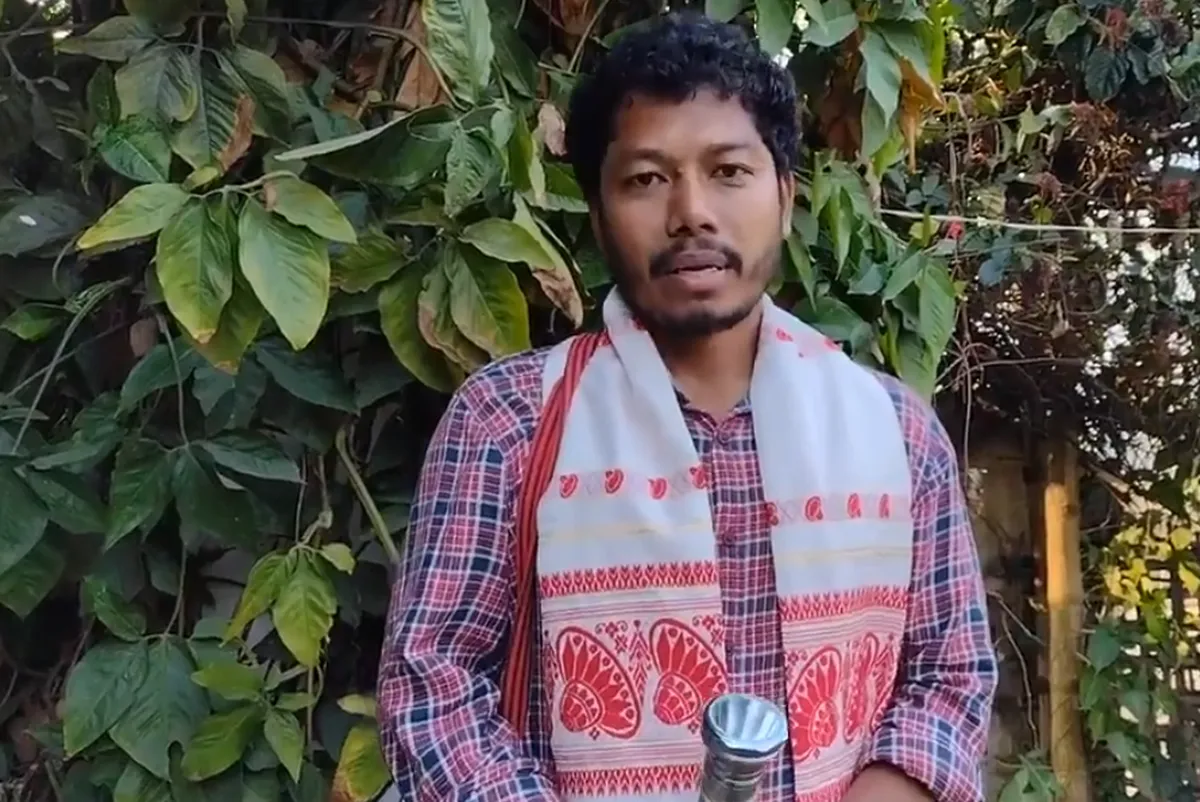
Condemn the Vindictive Use of NSA Against Pranab Doley – Release Him Immediately! Stop the criminalisation of Adivasi and Indigenous defenders in Kaziranga forthwith!
Tags: Kaziranga, Pranab Doley, NSA
Related Issue: Human Rights Defenders, Environment rights, Right to Freedom of Expression,
We, the undersigned people’s movements, organisations, trade unions, democratic rights groups and concerned citizens, strongly condemn the invocation of National Security Act against Pranab Doley, Indigenous rights activist from Assam and Convener, Greater Kaziranga Land and Human Rights Protection Committee, one day after the Golaghat Sessions Court granted bail to him, in the false, retaliatory and vindictive case launched against him and other Adivasi and Indigenous defenders by the Assam police.
We demand the immediate revocation of the NSA detention order passed against Pranab Doley, and that he and all other activists arrested in connection with the ongoing land struggle in Kaziranga, be released from jail immediately.
We firmly believe that the arrest and criminalization of Pranab Doley and other Adivasi and Indigenous defenders in the criminal case filed by the Assam police, is nothing but an attempt to punish and vilify the activists for exercising their constitutional right to protest, and to silence their voices; We demand that the criminal case filed against them be unconditionally withdrawn.
We collectively urge the state to put an end to the criminalisation of communities defending their land, livelihoods and environment, and to respect and protect their right to autonomy over their lands and as guaranteed under the Indian Constitution.
Pranab Doley, convenor of the Greater Kaziranga Land and Human Rights Protection Committee (GKLHRPC), was arrested on 12th July 2026 in connection with a case filed by the Assam police at Bokakhat Police Station under Sections 61(2), 191(2), 191(3), 190, 329(3), 324(2), 324(3), 221, 132, 121(1), 121(2), 351(3), 74, 326(g) and 62 of the Bharatiya Nyaya Sanhita (BNS), in retaliation to a protest held on 28th June 2026 against the proposed Hyatt luxury resort project at Inglay Pathar near the Kaziranga National Park and Tiger Reserve. Four other activists – Amit Nag, Brijit Kutum, Bhaskar Saikia and Rajib Pegu – were also arrested in connection to the same case, while several others have been falsely implicated and face the threat of arrest.
The Sessions Court at Golaghat granted bail to Pranab and the above four activists who were languishing in Golaghat district jail, by its orders dated 29th July 2026. A day later, the Assam Government invoked Section 3(2) of the National Security Act (NSA) by its order dated 30th July 2026 against Pranab Doley, clearly with a view to defeat his bail granted by the Sessions Court and to continue his unjust incarceration. The NSA permits preventive detention without trial or formal charges for up to 12 months.
The NSA detention order was served on Pranab’s family only on 31st July 2026 in the afternoon, while the bail formalities were being completed pursuant to the signed bail order copy being made available the same morning, with a view to get Pranab released on bail. This action of the government to use the draconian NSA against Pranab to prevent his release is highly condemnable; a blatant attempt to circumvent the process of law. Infact, while granting bail, the Additional Sessions Judge in the order questioned the manner in which the criminal law had been deployed against the movement. The court observed that the dispute arose from deep anxieties over environmental degradation and its impact on the socio-cultural life of local Tea workers and their families (from the Adivasi community). It noted the absence of video evidence supporting several police allegations and emphasised that criminal law cannot become an instrument for suppressing community concerns where ecological preservation and indigenous survival are at stake.
Questioning the state action against the activists, the bail order goes on to state – “It is also germane to mention here that in cases involving marginalized groups like the Tea Tribes, structural inequalities prevent local communities from negotiating on equal terms with corporate or state entities. In such a scenario, treating the activists or community leaders as ‘external disruptive element’ will not yield any fruitful result in the long run and hence, including the social activists and community leaders in the dialogue process would ensure fairness and balance in the power dynamics for a sustainable solution.”
The Real Issue : Land, Livelihoods and Kaziranga
Pranab’s arrest and subsequent incarceration under NSA is directly linked to the land and environmental struggles in which he has been involved. Pranab and GKLHRPC have stood with the local communities in raising questions of land rights, displacement, ecological destruction and the future of communities living around one of India’s most ecologically sensitive landscapes. For several years, Indigenous and Adivasi communities around Kaziranga have opposed the transfer of their lands for commercial and tourism projects, including Hyatt’s proposed luxury resort at Inglay Pathar/ Hathikuli (‘frequented by elephants’). Inglay Pathar, the proposed site of the hotel project, is situated near the Kohora (Central) Range of Kaziranga National Park. It serves as an important habitat and movement corridor for elephants and is locally revered as a ‘playground for elephants’.
Documents examined by The Reporters’ Collective show that around 30 bighas were allotted to the Assam Tourism Development Corporation (ATDC) and subsequently handed over for the luxury resort project. Affected families have disputed the government’s claim that this is merely government land and have approached the Gauhati High Court with records supporting their claims. On 1st June 2026, the High Court issued notices to the Assam Government and ATDC on a petition filed by 20 evicted families.
The present struggle must also be understood within the much wider conflicts over land unfolding across Assam. Indigenous, Adivasi, peasant, forest-dwelling and other marginalised communities have been resisting displacement, land grab and forest diversion for luxury tourism, power projects, townships, commercial and extractive mining, logistics infrastructure and other large corporate projects, that threaten the environment, forests, land and natural resources and the rights of Adivasi and Indigenous peoples. The question being raised by these movements is fundamental: who decides the future of Assam’s land, forests and commons, and whose idea of “development” will prevail?
Pranab Doley, along with other Adivasi and Indigenous defenders, has been raising precisely these democratic questions. To portray such activity as a threat to “national security” turns the meaning of national security on its head.
The NSA Order : Raising Even More Serious Questions
According to the communication informing grounds of detention under NSA provided on 31st July 2026, the Assam Government lists out protests that Pranab Doley has ostensibly been part of and the protests cases filed against him; it cites alleged road blockades and damage to public property, Pranab’s foreign travel in the last decade and alleged “suspicious foreign transactions” among the grounds for preventive detention. The Sessions Court in Pranab’s bail order had already observed, while considering the question of foreign travel and funding, that any legitimate concerns could be investigated through documents without requiring Pranab’s continued incarceration. The grounds cited in the order only go on to expose the vindictive and arbitrary nature of state action against Pranab for being a socially and politically active citizen and defender of rights, rather than being in any manner prejudicial to the security of the state or maintenance of public order as alleged.
The NSA is a draconian law conferring extraordinary powers upon the executive. It’s use against a land-rights activist immediately after he receives bail raises profound constitutional questions. If the government possesses evidence of an offence, it must place that evidence before the court and allow Pranab the full protection of his rights guaranteed under law. Preventive detention cannot become an alternative available to governments whenever ordinary criminal proceedings fail to keep an activist behind bars. The timing therefore cannot be ignored: the court grants bail on 29th July 2026; the government invokes the NSA on 30th July 2026.
This is not merely the matter of targeting one activist. It strikes at the independence of the judicial process itself. Bail granted by a competent court cannot be rendered meaningless simply because the executive dislikes the outcome. Moreover, this sets a dangerous precedent where judicial orders granting bail to citizens can be subverted by the state, by abusing the process of law and employing extraordinary and preventive detention laws. If allowed, such vindictive state action would pose a serious threat on the right to bail of an accused, which is an important legal safeguard linked to the valuable right of personal liberty protected under Article 21 of the Constitution.
The present action carries disturbing echoes of what the Assam Government did to peasant leader and anti-corruption activist Akhil Gogoi in 2017. Akhil Gogoi, then a leader of the Krishak Mukti Sangram Samiti (KMSS), had been arrested amid movements over farmers’ issues, dams, corruption and citizenship. After his arrest in September 2017, the Assam authorities invoked the NSA against him. On 21st December 2017, the Gauhati High Court quashed his preventive detention, finding the detention order legally vitiated, including because his constitutional right under Article 22(5) to make representations against his detention had not been properly communicated to him.
The parallel should alarm every democratic citizen. Then, as now, an activist associated with powerful people’s struggles was portrayed as a threat warranting extraordinary preventive detention. Then, as now, the state used a law intended for exceptional threats to national security and public order against political dissent against the policies of the government. Although the Gauhati High Court ultimately intervened in Akhil Gogoi’s case and struck down the NSA detention, the Assam Government has failed to learn from that episode. Instead, nearly nine years later, it appears determined to repeat it.
Defending Land and Environment is Not a Threat to National Security
There is an increasingly disturbing pattern across India in which those resisting land acquisition, displacement, environmentally destructive projects and corporate takeover of natural resources are subjected to criminal cases, prolonged incarceration and prosecution under extraordinary laws. Governments cannot be permitted to convert dissent and disagreement over development policy into questions of national security.
Adivasi and Indigenous communities asserting their rights over land and for protection of the environment and natural resources, are not enemies of the nation. Farmers defending agricultural land are not threats to national security. Environmental defenders questioning projects near Kaziranga are not threats to public order. Peaceful dissent, democratic mobilisation and solidarity with affected communities are constitutional rights, not crimes. These rights are essential in a democracy and fundamental to an active citizenry.
Indeed, what threatens democracy is precisely the opposite – the use of extraordinary state power to prevent citizens from exercise their legitimate right to raise questions on decisions concerning their own lands and their collective futures. The right to freedom of speech and expression and right to assemble peacefully are fundamental rights provided under Article 19(a) and Article 19(b) of the Indian Constitution. At a time when the world, and in particular our country, faces higher vulnerability and risk of disasters, environmental and climate crises, raising the concerns of this destructive model of development have become all the more important in public debate and for affected communities. The State is obligated under Article 48A of the Constitution to protect and improve the environment and to safeguard the forests and wildlife of the country. A corollary fundamental duty is vested upon citizens under Article 51(a)(g) of the Constitution. The misuse and abuse of law to silence those exercising their rights and performing their duties under the Constitution by raising such legitimate concerns is a threat to intergenerational equity, sustainability and social justice.
The United Nations Declaration on Human Rights Defenders, adopted by the General Assembly of the United Nations on 9th December 1998, states that“everyone has the right, individually and in association with others, to promote and to strive for the protection and realisation of human rights and fundamental freedoms at the national and international levels; (article 1). And that “the State shall take all necessary measures to ensure the protection by the competent authorities of everyone, individually and in association with others, against any violence, threats, retaliation, de facto or de jure adverse discrimination, pressure or any other arbitrary action as a consequence of his or her legitimate exercise of the rights referred to in the present Declaration” (Article 12.2).
Pranab Doley and the other Adivasi and Indigenous defenders are today facing reprisals for exercising these valuable rights to protect and realise human rights. Following the arrests of Pranab Doley, Amit Nag, Brijit Kutum, Bhaskar Saikia and Rajib Pegu, on 17th July 2026, several UN experts – Working Group on the issues of human rights and transnational corporations and other business enterprises, the Special Rapporteur on the rights of Indigenous Peoples, the Special Rapporteur on the rights to freedom of peaceful assembly and of association and the Special Rapporteur on the situation of human rights defenders – in their statement, also communicated to the government, expressed concern over their arrest and detention which could undermine the legitimate work of those defending Indigenous Peoples’ rights in the context of business activities, and called for their immediate release.
The vindictive and arbitrary action initiated in this case against the Adivasi and Indigenous defenders for exercising their legitimate rights as human rights defenders, must be taken back immediately.
Hence, we collectively demand:
- Immediate revocation of the NSA detention order against Pranab Doley and his immediate release.
- Withdrawal of the instant case filed against activists and community members, including Pranab Doley, Amit Nag, Brijit Kutum, Bhaskar Saikia, Rajib Pegu and all other named in the case and opposing Hyatt’s proposed luxury hotel project at Inglay Pathar near Kaziranga National Park, and an immediate stop to further arrests in the case, in particular of Geeta Gowala, Minali Gowala, Srimoti Kishan and other community members who are facing an imminent threat of arrest.
- Release of all activists and community members imprisoned in connection with the land struggles in Assam, including Adit Chandra Rabha who is currently in jail following his opposition to a proposed Satellite Township project at Barduar, and withdraw all such fabricated and politically motivated cases.
- Immediate end to the use of preventive detention and extraordinary laws to suppress democratic movements, environmental defenders and Indigenous and land-rights activists.
- Independent investigation into the allegations of police excesses, procedural violations and the criminalisation of communities opposing the Kaziranga luxury resort project and strict criminal action against the erring officers.
- Full disclosure and transparent review of land allotments and the proposed tourism and infrastructure projects around Kaziranga, with meaningful participation of affected communities and full protection of their constitutional and legal rights.
- Protection of Indigenous, Adivasi, peasant and forest-dwelling communities across Assam from forced displacement and corporate appropriation of their lands, forests and commons.
The Assam Government must understand that a judicial order granting liberty cannot be subverted in this fashion with preventive detention. The Constitution cannot be suspended whenever citizens challenge the government’s model of development.
We call upon all citizens and civil society groups across India to stand with Pranab Doley and the communities of Kaziranga.
Revoke the NSA against Pranab Doley!
Release Pranab Doley and all imprisoned land-rights activists!
Withdraw the false case filed against the Kaziranga activists!
Stop the criminalisation of people’s movements!
Defending Jal–Jangal–Zameen is not a crime!
Signed by :
- Adivasi Adhikar Manch, Udaipur
- Adivasi Samajonnati Seva Sanstha, Saphale, Maharashtra
- Adivasi Sangharsh Morcha
- All India Feminist Alliance (ALIFA)
- All India Forum of Forest Movements
- All India Inquilabi Youth and Students Alliance (ALIYSA)
- All India Kisan Sabha
- All India Lawyers Association for Justice (AILAJ)
- Anhad, Delhi
- Association for Protection of Civil Rights (APCR)
- Awaken India Movement
- Bandi Adhikar Andolan
- Banglar Manabadhikar Suraksha Mancha (MASUM)
- Basti Suraksha Manch
- Bhumi Adhikar Andolan
- Campaign Against Fabricated Cases, Odisha
- Campaign to Defend Nature and People (CDNP)
- Campaign for Survival with Dignity, Odisha
- Centre for Financial Accountability (CFA)
- Chennai Wetlands Action Collective
- Civil Society Women’s Organisation, Meghalaya
- Chasi Mulia Sangha, Odisha
- Chasi Mulia Suraksha Samiti, Kandhamal
- Chhatisgarh Bachao Andolan
- Climate Front India
- Climate Front Jammu
- Climate Front Telangana
- Community Network Against Protected Areas (CNAPA)
- Dabla Khanan Virodhi Sangharsh Samiti, Neem-ka-than, Sikar
- DARSHAN, Ahmedabad
- Delhi Solidarity Group
- Desheeya Manavika Vedi
- Dibang Resistance, Arunachal Pradesh
- Food Sovereignty Alliance
- Forum Against Oppression of Women
- Fridays for Future, India
- Friends of the Earth – India
- Growthwatch
- Human Rights Defenders Alert – India
- Indian Social Action Forum – INSAF
- Indian Solidarity Committee (INSOCO)
- Indigenous Research and Advocacy (IRAP) Arunachal Pradesh
- J&K Gujjar Bakerwal Youth Welfare Condeo
- J &K RTI Movement
- Jagrit Adivasi Dalit Sangathan (JADS)
- Janmukti Sangharsh Vahini, Jharkhand
- Jharkhand Janadhikar Mahasabha
- Joint Action against Custodial Torture, Tamil Nadu
- Jungle Zameen Jan Andolan, Rajasthan
- Justice in Mining Network
- Kalpavriksh
- Karavali Karnataka Janabhivriddhi Vedike
- Kashtakari Sangathana, Dahanu, Maharashtra
- Kerala Sarvodaya Mandalam
- Khandual Mali Sthayi Suraksha Samiti, Kalahandi
- Krantikari Kisan Union, Punjab
- Jodhpura Sangharsh Samiti, Kotpuli
- Let India Breathe
- Lokshakti Abhiyan, Odisha
- Maa Mati Mali Surakshya Manch (Kalahandi & Rayagada)
- Manthan Adhyayan Kendra
- Mazdoor Kisan Shakti Sangathan, Rajasthan
- Muse Foundation
- Nagarahole Jamma Paale Hakku Sthapana Samiti
- National Alliance for Climate and Ecological Justice (NACEJ)
- National Alliance for Justice, Accountability and Rights (NAJAR)
- National Alliance of People’s Movements (NAPM)
- National Federation of Small-scale Fishworkers
- New Trade Union Initiative (NTUI)
- Niyamgiri Suraksha Samiti
- North East Human Rights (NEHR)
- Okhamandal Paryavaran Jan Sangharsh Samiti, Okha, Gujarat
- Paryavaran Suraksha Samiti, Gujarat
- People’s Commission on Shrinking Democratic Spaces
- People for Himalaya
- People’s Union for Civil Liberties (PUCL)
- People’s Watch
- Programme Against Custodial Torture and Impunity (PACTI)
- Public Inquiry Committee and People’s Commission
- Rajasthan Adivasi Adhikar Manch
- Rajasthan Asangathith Mazdoor Union
- RTIFED
- SAMATA
- Sarvahara Jan Andolan
- Saurashtra Dalit Sangathan, Junagadh
- Save Dol ka badh Andolan
- Save Kavesar Lake Citizens Movement
- Save Mollem Campaign, Goa
- Shoshit Jan Andolan
- Sikkim Indigenous Lepcha Tribal Association
- South Asia Just Transition Alliance (SAJTA) India
- Students and Youth Collective, Ahmedabad
- Sustha Samaj Bikash Chakra, Guwahati
- Telangana Domestic Workers Union
- There is No Earth B
- Vettiver Collective, Chennai
- Vikalp Sangam
- Woodpeckers Initiative
- Youth Climate Centre
- Youth for Himalaya
& Others