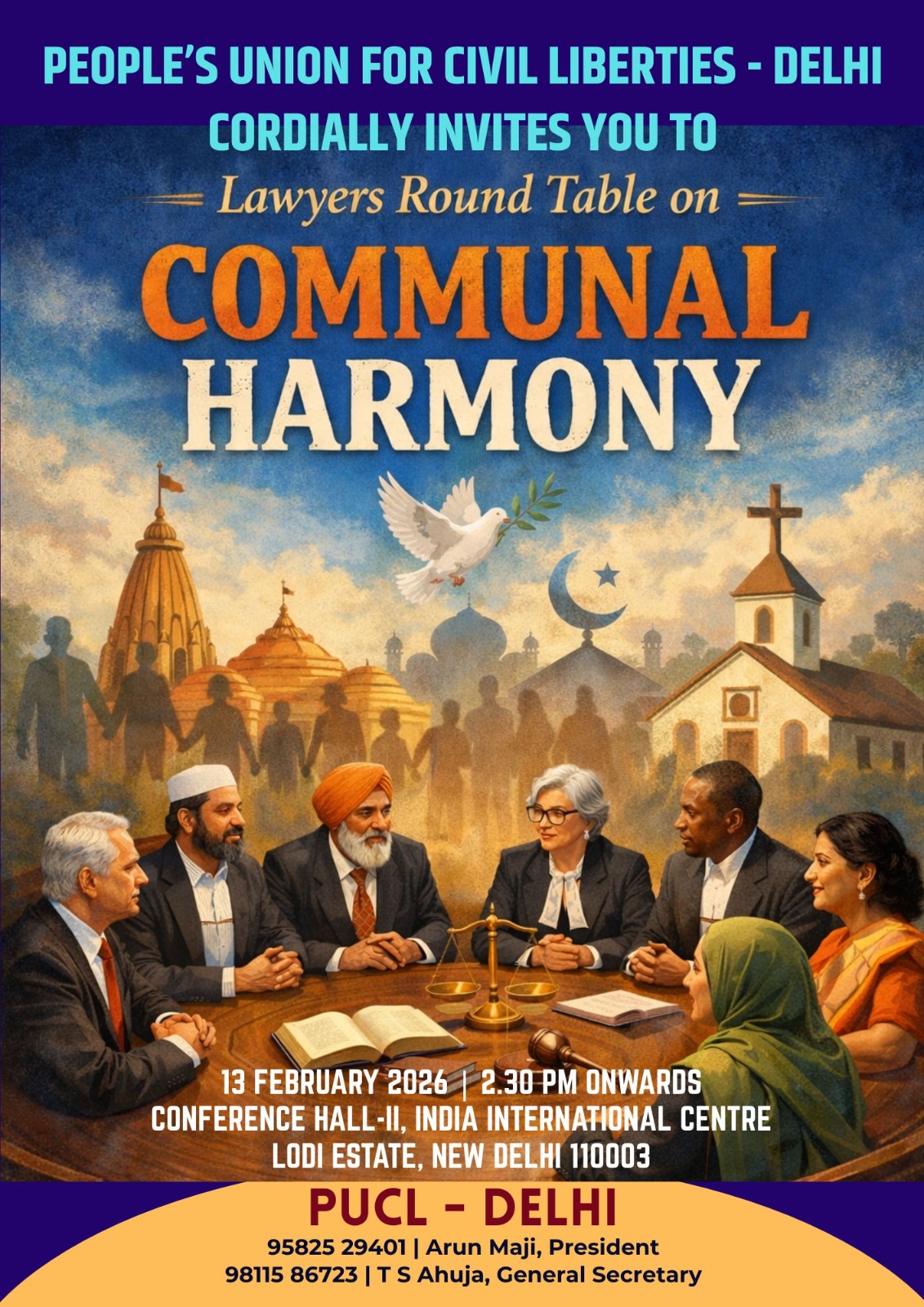
PUCL Delhi: Lawyers Round Table on Communal Harmony
Relevant State Delhi
At a time when constitutional values are increasingly strained by rising communal polarisation, hate speech, and targeted violence, the People’s Union for Civil Liberties (PUCL) Delhi convened a Lawyers’ Roundtable on 13 February 2026 to deliberate on the role of the legal fraternity in safeguarding India’s secular and democratic framework.
The Roundtable brought together former judges, senior advocates, independent practitioners, law students, and representatives of lawyers’ collectives to reflect upon both ideological and institutional responses required to address hate crimes and communal division. The deliberations were firmly anchored in a shared commitment to constitutional morality, the rule of law, and the urgent necessity of translating constitutional promises into lived realities.
Approximately 90 participants attended the meeting, nearly 90 per cent of whom were practising lawyers. The gathering witnessed participation not only from Delhi but also from members of the Bar across regions, including Jalaun, Bareilly, Dehradun (Uttarakhand), and Allahabad—reflecting a wide and committed engagement with the issues at hand.
Opening Remarks:
The meeting commenced with Mr. T.S. Ahuja, speaking on behalf of the Executive Committee of PUCL Delhi, who presented the concept paper framing the discussion. He outlined the central theme: the responsibility of lawyers in promoting communal harmony and combating hate crimes and hate speech.
Mr. Ahuja started the discussion within PUCL Delhi’s longstanding engagement in defending civil liberties and intervening in matters involving state excesses, discrimination, and constitutional violations. He emphasised that lawyers are not merely courtroom actors but constitutional functionaries entrusted with upholding justice beyond litigation. In the present climate, he noted, neutrality in the face of injustice effectively amounts to abdication. The legal community must therefore respond collectively, institutionally, and ethically to the growing normalisation of divisive rhetoric and communal targeting.
He also informed participants that PUCL Delhi has initiated outreach programmes aimed at educating young people across university campuses on combating hate speech and hate crimes, and defending constitutional values. This initiative forms part of a broader effort to strengthen constitutional awareness and civic responsibility among youth.
Keynote Address: (Retd.) Chief Justice Rajiv Shakdher (Himachal High Court):
Justice Rajiv Shakdher delivered the keynote address, setting the tone for the deliberations. Referring to recent judicial developments, including the case concerning Deepak, he reflected on the increasing invocation of stringent anti-conversion laws.
He underscored that Articles 25 to 28 of the Constitution of India guarantee freedom of conscience and the right to freely profess, practise, and propagate religion. However, he expressed concern that contemporary legislative trends appear to criminalise propagation if accompanied by alleged inducement, in some instances prescribing severe punishments, including life imprisonment. Such measures, he cautioned, raise serious constitutional questions.
Justice Shakdher emphasised that constitutional ideals must not remain confined to judicial pronouncements. They must be carried to the grassroots. The Constitution, he remarked, is not self-executing; its vitality depends upon citizens and institutions who internalise and defend it. The broader the social participation in this endeavour, the stronger its impact.
Address by (Retd.) Chief Justice Iqbal Ahmed Ansari (Patna High Court)
Justice Iqbal Ahmed Ansari expanded the discussion by emphasising that combating communalism requires, at the very least, a broad understanding of the foundational principles of major religions practised in India. Genuine engagement, he suggested, demands intellectual humility and interfaith literacy.
Invoking the ideas that “My Allah is also the creator of everyone else” and “kan kan mein bas hain Ram,” he highlighted the shared spiritual universality embedded within India’s religious traditions. He observed that Hinduism, historically grounded in pluralism, has accommodated believers of diverse philosophies—including those who worship Ram, those who worship Ravan, and those who profess no belief at all.
Justice Ansari stressed that India is a constitutional democracy, not a theocratic state. In a democracy, power is not royal prerogative; it is structured and limited by law. No arbitrariness can be sanctioned under the Constitution. He posed a critical normative question: whether society chooses to be guided by the Constitution, with its guarantees of equality and non-discrimination, or by hierarchical codes inconsistent with constitutional morality.
He also cautioned against incendiary public statements that generate fear and social panic, noting that such rhetoric corrodes democratic institutions and deepens communal fault lines.
The Roundtable was chaired by Senior Advocate Sanjay Parekh, who reflected on PUCL’s recent intervention before the Supreme Court on hate speech—an initiative that remains ongoing. He emphasised that the struggle against hate must extend beyond the courtroom and involve introspection within and among ourselves. Drawing upon the teachings of Gandhi and Ramakrishna Paramhans, he underscored the need for ethical self- examination in public life. He also stressed the importance of verifying inflammatory claims through authentic religious texts and proposed the formation of a multidisciplinary advisory body comprising historians, academicians, and subject-matter experts.
Discussion Initiated by Senior Advocate Sanjay Hegde
Senior Advocate Sanjay Hegde initiated the broader discussion by calling for a reaffirmation of “Project India,” grounded in constitutional nationalism rather than sectarian or exclusionary identity politics. India, he noted, is a conglomeration of multiple identities, languages, and nationalities bound together by a constitutional compact.
Recalling observations by Fali S. Nariman regarding the Constituent Assembly, he emphasised that despite being largely composed of orthodox Hindus and presided over by Dr. Rajendra Prasad, the Assembly consciously adopted equality and secularism as foundational commitments—reflecting lessons drawn from the global experience of fascism.
He observed that constitutions are living documents that must be defended in spirit as well as in text. He described the defence of constitutional values as dependent upon a triad: the street (sadak), society (samaj), and the Supreme Court.
Critiquing what he termed “jugaad jurisprudence,” he warned against legal reasoning driven by expediency rather than constitutional ethos. Referring to the Ayodhya judgment and subsequent litigation trends under the Places of Worship Act, he expressed concern over judicial observations that may open floodgates for destabilising claims.
He further noted with alarm that certain district bar associations have witnessed overt rejection of secular constitutional values. As officers of the court and creatures of the Constitution, lawyers, he stressed, are duty-bound to act in accordance with justice and constitutional morality.
Open Discussion and Key Proposals
The floor was opened to law students, young practitioners, and representatives of lawyers’ organisations. Senior Advocate Ashok Panda, a founding member of PUCL, along with Advocate Arun Maji, President of PUCL Delhi, proposed that ahead of forthcoming elections—including the West Bengal elections—a formal charter be addressed to political parties urging explicit commitments in their manifestos to combat communalism, hate speech, and hate crimes.
Veteran advocates Som Dutt Sharma and Poonam Kaushik expressed unequivocal support for PUCL Delhi’s initiative. Advocate N D Pancholi former president of PUCL Delhi presented the stellar work being undertaken by PUCL Delhi in spreading the idea of communal harmony in the atmosphere of hate.
Participants also volunteered to contribute to the proposed legal cell. Mobilising informed opinion within the legal fraternity was identified as a critical agenda.
Key Agendas
- Engagement with Educational Institutions Systematic outreach to college campuses to promote constitutional literacy and counter communal narratives.
- Use of Technology and Data Documentation Creation of structured databases for documenting hate speech and hate crimes to strengthen evidence-based advocacy and litigation.
- Establishment of a Coordinated Legal Cell
Proposed functions include:
- Collection and documentation of hate speech material
- Fact-checking and dissemination of accurate religious information
- Strategic case selection
15 young Advocates and law students volunteered to be members of the PUCL Delhi legal cell, Advocate Harsh Kumar Gautam was appointed Convenor.
A multidisciplinary advisory group comprising historians, academicians, and subject experts was also proposed.
Three-Level Strategy
- Ideational Intervention: Engagement in educational spaces to nurture constitutional values and interfaith understanding.
- Legal and Institutional Intervention: Creation of coordinated mechanisms for legal assistance, strategic litigation, documentation, and mobilisation within the Bar.
- Institutionalisation: Spreading the message of communal harmony: combating hate crimes and hate speech amongst the legal fraternity in Delhi and for the same holding meetings and forming legal cells in different district courts, High Court and Supreme Court.
Conclusion
The Roundtable concluded with a collective resolve to institutionalise these initiatives. The deliberations reaffirmed that communal harmony, equality, and secularism are not optional aspirations but constitutional mandates. The legal fraternity, as a central pillar of democratic governance, bears a distinct responsibility to defend these values—through advocacy, education, mobilisation, and sustained collective action.