Marking Political Prisoner Day on September 13, 2026 - PUCL-Karnataka
Relevant State
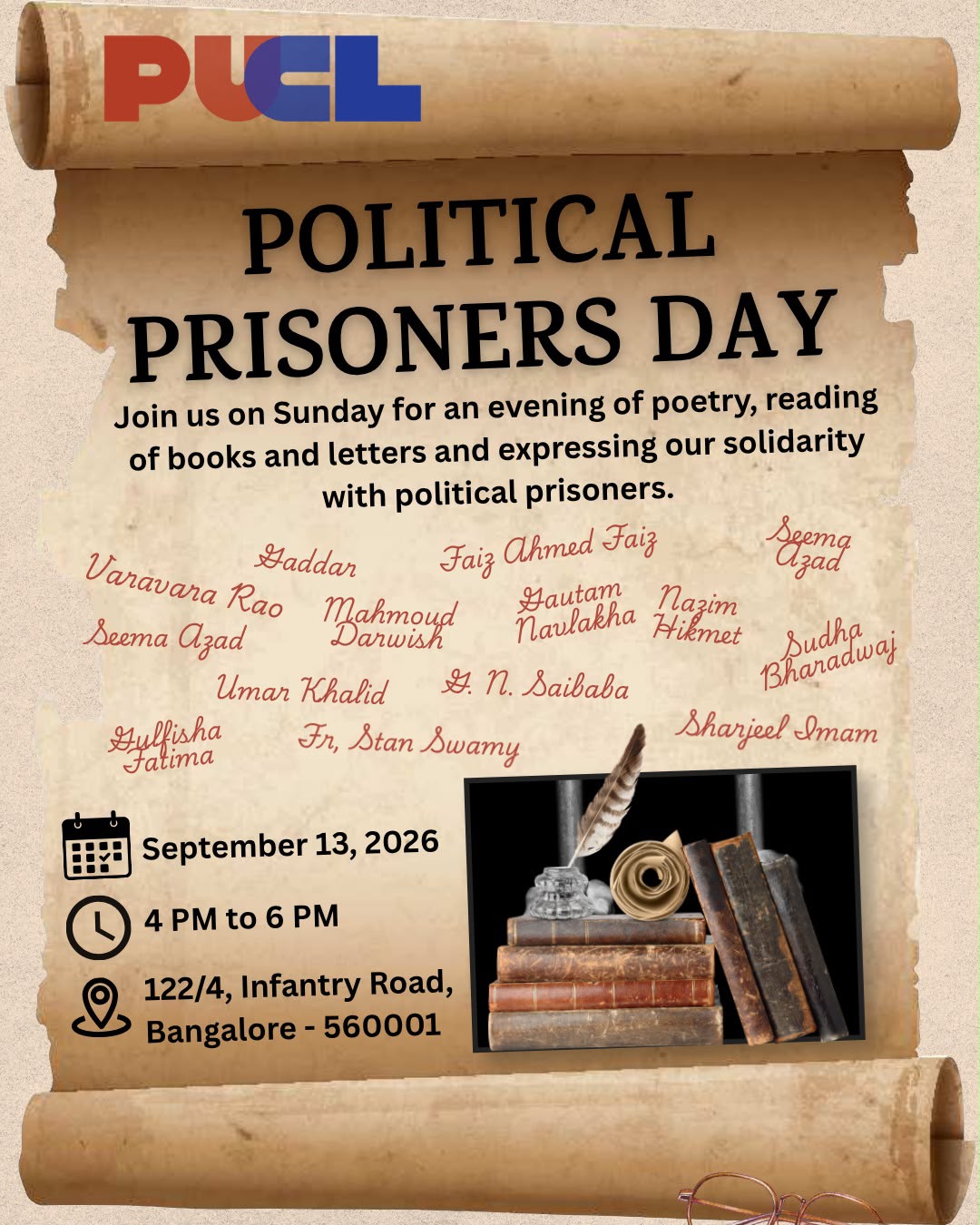
The PUCL-K marked political prisoner day on September 13, 2026 by organizing a reading of the literary works of political prisoners. September 13 is the day that Jatin Das died, when on the 61st day of his hunger strike. If we think of Indian history, three moments when the political prisoner formed a significant part of the narrative of state oppression was the colonial period , the period of the emergency and the contemporary period of the undeclared emergency. The session included readings from a range of texts drawing attention to the significance of the political prisoner.
In the colonial period the iconic prisoner was of course Bhagat Singh whose ‘Jail Note Book’, was a tribute to a voracious reader who read widely in politics, history and literature. The other significant figure is Jawaharlal Nehru who wrote three volumes while in jail for nine years. Thus the ‘Discovery of India, ‘An autobiography’ as well as ‘Glimpses of world history’, were written in the nine years Nehru spent in jail.
To reproduce below some of the extracts which were read from Nehru’s writings.
The higher valleys and mountains of Kashmir fascinated me so much that I resolved to come back again soon… Instead of going up mountains or crossing the seas I have to satisfy my wanderlust by coming to prison. But still I plan for that is a joy which no one can deny me even in prison, and besides what else can one do in prison? And I dream of the day when I shall wander about the Himalayas and cross them to reach that lake and mountain of my desire. But meanwhile the sands of life run on and youth passes into middle age and that will give place to something worse, and sometimes I think that I may grow too old to reach Kailas and Mansarovar. But the journey is always worth the making even though the end may not be in sight…
In the barracks in which I was kept there must have been about fifty persons. We were all crowded together, our beds being almost three or four feet from each other. Fortunately almost everybody in that barrack was known to me, and there were many friends. But the utter lack of privacy, all day and night, became more and more difficult to endure. Always the same crowd looking on, the same petty annoyances and irritations, and no escape from them to a quiet nook. We bathed in public and washed our clothes in public and ran round and round the barrack for exercise, and talked and argued till we had largely exhausted each others capacity for intelligent conversation. It was the dull side of family life, magnified a hundred fold with few of its graces and compensations, and all this among people of all kinds and tastes…
In the second half of 1928 and in 1929 there was frequent talk of my arrest…the warnings produced a feeling of uncertainty in me and I felt I was always on the verge of it. I did not mind this particularly as I knew that, whatever the future held for me, it could not be a settled life of routine. The sooner I got used to uncertainty and sudden changes and visits to prison the better. And I think that on the whole I succeeded in getting used to the idea hand whenever arrest came I took it more casually than I might otherwise have done. So rumours of arrest were not without compensation; they gave a certain excitement and bite to my daily existence. Every day of freedom was something precious, a day gained…
My main occupation however was reading and writing. I could not have all the books I wanted, as there were restrictions and a censorship and the censors were not always very competent for the job…the only books the British officials heartily recommended were religious books or novels. It is wonderful how dear to the heart of the British government is the subject of religion and how impartially it encourages all brands of it
So I occupied myself with my books, going from one type of reading to another, but usually sticking to ‘heavy’ books. Novels made one feel mentally slack and I did not read many of them. Sometimes I would weary of too much reading and then I would take to writing. My historical series of letters to my daughter kept me occupied right through my two year term and they helped me very greatly to keep mentally fit. To some extent I lived through the past I was writing about and almost forgot about my goal surroundings. (An autobiography)
The greatest gift for an individual or a nation, so we had been told in our ancient books was Abhay(fearlessness), not merely bodily courage but the absence of fear from the mind…But the dominant impulse in India under British rule was that of fear- pervasive, oppressing, strangling fear; fear of the army, the police, the widespread secret service; fear of the official class; fear of laws meant to suppress and of prison; fear of the landlord’s agent; fear of the moneylender; fear of unemployment and starvation, which were always on the threshold. It was against this all pervading fear that Gandhi’s quiet and determined voice was raised: be not afraid. Was it as simple as that? Not quite. And yet fear builds in phantoms, which are more fearsome than reality itself, and reality, when calmly analysed and its consequences willingly accepted, loses much of its terror.
So suddenly , as it were the black pall of fear was lifted from the peoples shoulders, not wholly of course , but to an amazing degree. As fear is a close companion to falsehood, so truth follows fearlessness…. (Discovery of India)
The above extracts communicated quite powerfully what it meant to be a political activist in the time of the British Raj. You lived under the threat of imprisonment and imprisonment was an experience you were bound to have. The experience of the colonial prison mirrors quite closely the experience of imprisonment during the contemporary period.
The other book from which extracts were read was ‘Umar Khalid and his world’. While Nehru spent nine years in jail, Umar has spent six years. While Nehru’s imprisonment was post conviction, Umar is in jail without even the trial process being completed.
Below is the extract from Umar’s letter on getting to know that his bail had been rejected by the Supreme Court.
The first few days after a judgment comes are always difficult to cope with. In fact, the day I was denied bail by the Supreme Court, I was transported back to 2022 when my bail was rejected the first time in the trial court. The suddenness of the news hit me in the gut in the same way. But after spending more than five years here, after my bail has been rejected five times by three different courts, Ive almost gotten used to bouncing back from the feeling of helplessness. The weather does add to the gloom…But after 3pm, whe the time to return to the lock up approaches again- that is when the mind space starts to go downhill. My mind starts spiraling into a bottomless darkness and I begin to wonder whether I will ever be able to step out as a free man…
Once a prisoner who had been watering a tree in our barrack for a few weeks got bail. The next day, after he left, three others took up the mantle to keep the tree watered in the hope that they too would be released. You see hope remains a stubborn thing even in captivity I am planning to get back to my reading, even though the recovery from the bail application derailed me a bit. There’s a list of books I already have in mind, which I must get cracking on. The wait for freedom seems longer than ever at this time. So I must do what I can to keep myself going, especially in an environment where doubt has been made to turn into certainity in public perception, regarding the allegations against m. The operative word in mainstream media’s discourse for me is no more “anti-national”; its “terrorist”.
There is pain in this seemingly endless wait, indeed but there is also a beauty to this pain. I am content where I am, inspite of what Im being subjected to, because there is a beauty in knowing that this is not about me alone. My incarceration is not merely to target me as an individual; it is to teach my fellow comrades a lesson that anyone who dares to ask uncomfortable questions .. will be forcibly silenced… Ours is a battle for a vision- of a time in our society when some will not be more equal than others. This conviction is what makes this pain bearable…
The other books which were displayed were ‘Colours of the cage’ by Arun Ferreira, ‘The cell and the soul’, by Anand Teltumbde, ‘From phansi yard’ by Sudha Bharadwaj, Varavara Rao: A life in poetry, by Meena Kandaswamy and ‘Unsilenced’, by Seema Azad. There were also extracts from Kannada poems which were read out.
The meeting concluded with a reading from Turkish poet, Nazim Hikmet, titled, ‘On living’.
I
Living is no laughing matter:
you must live with great seriousness
like a squirrel, for example—
I mean without looking for something beyond and above living,
I mean living must be your whole occupation.
Living is no laughing matter:
you must take it seriously,
so much so and to such a degree
that, for example, your hands tied behind your back,
your back to the wall,
or else in a laboratory
in your white coat and safety glasses,
you can die for people—
even for people whose faces you’ve never seen,
even though you know living
is the most real, the most beautiful thing.
I mean, you must take living so seriously
that even at seventy, for example, you’ll plant olive trees—
and not for your children, either,
but because although you fear death you don’t believe it,
because living, I mean, weighs heavier.
II
Let’s say you’re seriously ill, need surgery—
which is to say we might not get
from the white table.
Even though it’s impossible not to feel sad
about going a little too soon,
we’ll still laugh at the jokes being told,
we’ll look out the window to see it’s raining,
or still wait anxiously
for the latest newscast…
Let’s say we’re at the front—
for something worth fighting for, say.
There, in the first offensive, on that very day,
we might fall on our face, dead.
We’ll know this with a curious anger,
but we’ll still worry ourselves to death
about the outcome of the war, which could last years.
Let’s say we’re in prison
and close to fifty,
and we have eighteen more years, say,
before the iron doors will open.
We’ll still live with the outside,
with its people and animals, struggle and wind—
I mean with the outside beyond the walls.
I mean, however and wherever we are,
we must live as if we will never die.
III
This earth will grow cold,
a star among stars
and one of the smallest,
a gilded mote on blue velvet—
I mean this, our great earth.
This earth will grow cold one day,
not like a block of ice
or a dead cloud even
but like an empty walnut it will roll along
in pitch-black space…
You must grieve for this right now
—you have to feel this sorrow now—
for the world must be loved this much
if you’re going to say “I lived”…