A tale of two protests
By Arvind Narrain
(Originally published in Deccan Herald)
What Delhi in the last few days has demonstrated is that the heart of a democracy is the people reclaiming their right to occupy the streets in defence of the Constitution. Other cities including Bangalore, have also followed suit. These protests have alchemised the people into ‘we, the people of India’.
Hannah Arendt has argued that ‘the pursuit of happiness’ in the US Declaration of Independence, is not only about the right to pursue one’s individual well-being, but also about the right to collectively organise and agitate for a better society. Likewise, it is this dream of a better India, which the protesters have brought alive and by doing so, breathed life into the Constitution.
But whenever ‘we, the people of India’ have attempted to restore life to Indian democracy, the state has brutally pushed back. The most recent and shocking development is the denotification of Jantar Mantar as a designated protest site in Delhi.
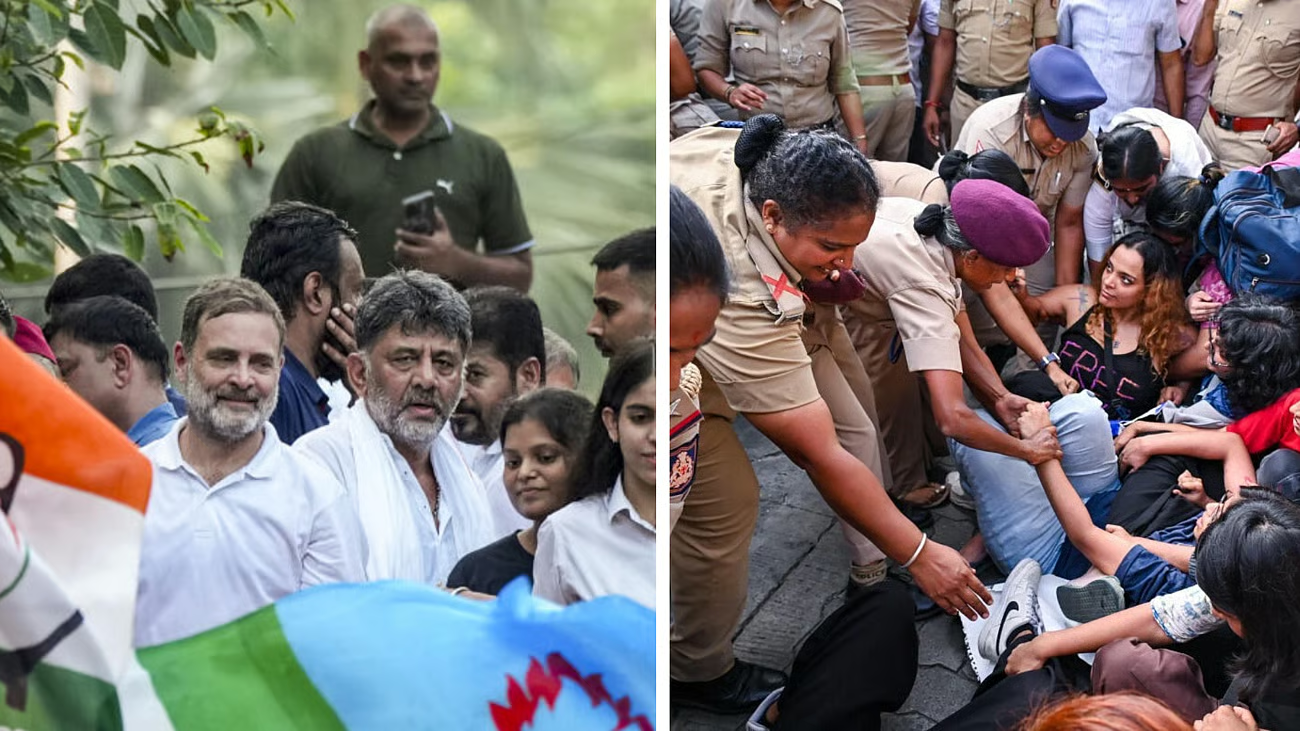
When the Constitution seemed to be on its last legs in the courts, it was ‘we, the people’ who through their public spirited protests revived the promise of the Constitution. What has been an unmissable sight is the Leader of the Opposition, Rahul Gandhi, marching on in defiance of arbitrary restrictions, and protesting outside Prime Minister Modi’s residence and inside Akashvani Bhavan. On October 12, he along with other opposition leaders and thousands of citizens again defied restrictions and marched to the Supreme Court to file a petition challenging constitutionality of the SIR process.
However in a tale of two cities, the Congress Party that reclaimed the streets in Delhi, refused the people the right to occupy the streets in Bengaluru on the same day. When hundreds of people sought to march to the office of the Chief Electoral Officer to present a memorandum, they were dragged, pushed and forcibly detained. Those brutally attacked included students, senior citizens, lawyers, ordinary people and even journalists. Police officers were also seen beating young people, pulling the clothes off women protestors and dragging people into buses.
What accounted for this brutal treatment of the protesters, which was completely at odds with what its leader Rahul Gandhi was doing in Delhi? What is more, the Chief Minister of Karnataka was on a protest march in Delhi, the same day his police officers were brutally assaulting protesters in Bangalore.
In Bengaluru, when the BJP government was in power, protests were restricted to Freedom Park by the Police Order of 2021. Ever since the Congress government came to power, the Campaign for the Right to Protest has demanding a revocation of the stifling 2021 Licensing Order which restricts protests to Freedom park. In fact on Gandhi Jayanti in 2023 after the Congress government came to power, activists staged a protest under Gandhi’s statue demanding the revocation of the police Licensing Order, asking, ‘Would Gandhi have been told to lead the Dandi march within the four walls of Freedom Park? Cases were filed against activists who dared to protest and the unconstitutional restrictions continued to be in place.
On October 12th, 2026 the Bangalore Police justified their heavy-handed and unlawful actions with a social media post saying that protestors gathered without permission or prior intimation. Respect for the Constitution demands that the constitutional right to assembly cannot be restricted to Freedom Park.
The actions of the Bengaluru police follow a nation-wide pattern of curbing protests where the state has succeeded in creating a “permission regime”, mandating location and duration, and even seeking to control the posters and slogans used at protests. The State treats protests not as a right of the people but rather as a threat to the state.
Gandhiji was prescient in seeing that ‘the state represents violence in a concentrated and organized form’ and that ‘the State is a soulless machine’, which could ‘never be weaned from violence to which it owes its very existence.’
The lesson of Delhi and Bengaluru is that a State addicted to violence, cannot easily be weaned off it.
As a starting point, the Karnataka chief minister must follow through on his commitment that there will be ‘no double standards’ and withdraw the 2021 licensing order which restricts protests to Freedom Park. ‘We the people of India’ India’ can and must bring the right to peaceful assembly alive again in our country, for it is the very soul of our Constitution.