PUCL condemns the brutal clampdown on peaceful protest in Delhi and across the country, the assault on MP John Brittas and student leaders, and the mass detention of thousands
A Government at War with its Own Citizens
“Organised, non-violent protest marches were a key weapon in the struggle for Independence, and the right to peaceful protest is now recognised as a fundamental right in the Constitution.”
— Supreme Court, Anita Thakur v. Govt. of J&K (2016)
PUCL strongly condemns the calculated and violent suppression by the Central Government of the peaceful protests held on 10th and 11th October 2026 by students, young people and citizens — including the Cockroach Janata Party (CJP), AISA, SFI, AISF, Left parties and many other groups — demanding the resignation of Chief Election Commissioner Gyanesh Kumar and the roll-back of the Special Intensive Revision (SIR) of electoral rolls. Citizens asking questions about the integrity of the voters’ list were met not with answers, but with lathis, police vans and detention camps.
Delhi: A Besieged Capital
Several days before even a single protester had assembled, the Union Government had turned New Delhi into a city under undeclared curfew. Prohibitory orders under Section 163 BNSS were clamped; on the Union Home Secretary’s approval, mobile internet was suspended for 24 hours across a 4-km radius of the Janpath–Kartavya Path crossing; over 40,000 police personnel were deployed and scores of detention centres readied. The capital was blanketed with facial recognition systems, drones, body cameras and rooftop spotters — mass biometric surveillance turned on citizens whose only ‘offence’ was to show up. Metro stations were shut, including GTB Nagar and Vishwavidyalaya serving Delhi University students; the Solicitor General’s own admission before the Supreme Court was that 45 of 303 metro stations were closed. Additionally, New Delhi and Nizamuddin railway stations were closed without any traffic advisories being issued. All this in defiance of the Supreme Court’s order of 9th October 2026, which had termed the closure notifications “overreaching” and directed that there be no outright prohibition on metro and rail services.
Mass detention in Delhi
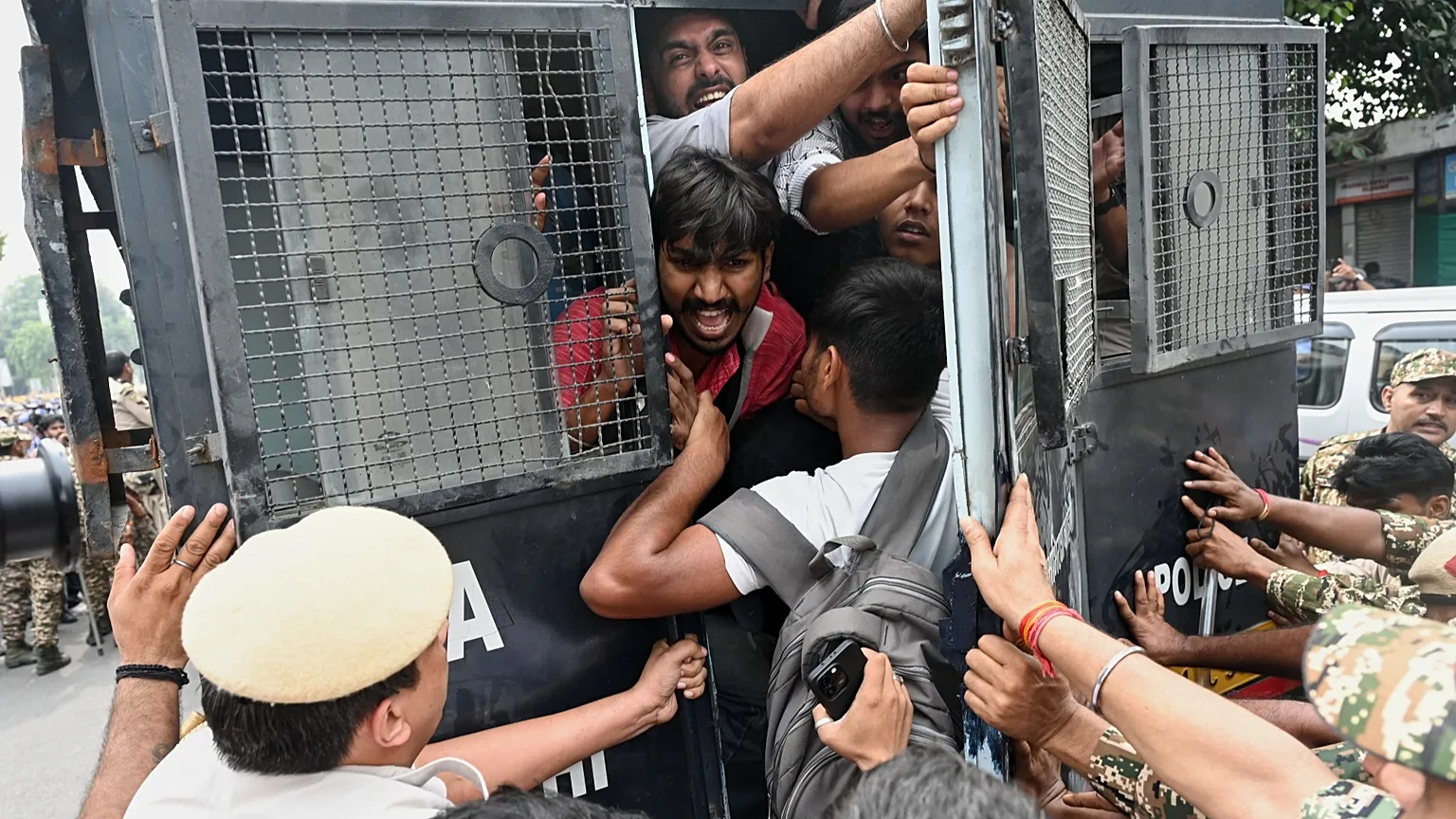
Nearly 7,000 people were reportedly detained in Delhi on 10th October. Lawyers marching from the Supreme Court to Jantar Mantar were picked up in their black coats from outside Gate C of the Supreme Court, including Senior Advocate P.V. Dinesh; women lawyers were manhandled by women police personnel without name tags and suffered injuries. Economist Jean Drèze, Yogendra Yadav, Left leaders including former CM of Keralam, Pinarayi Vijayan, Paranjoy Guha Thakurta, and scores of others were detained. Of concern is that police detained and beat up children and minors also.
Most police officers deliberately wore no name tags or rank insignia — a clear sign that the police came prepared to act with impunity. Worse, as on 20th July 2026, videos show men in civilian clothes, armed with lathis — some studded with nails — moving freely alongside the police and attacking protesters, including young women. No action was taken against them in July; none has been taken now.
This is not policing; it is state-sponsored vigilantism.
Not even a Member of Parliament is spared
On 11th October, when students and Left organisations resumed the protest, Rajya Sabha MP from Keralam, Dr. John Brittas was forcibly lifted and detained near Connaught Place by central security personnel. He has stated that he was pushed under a seat in the vehicle, his face pressed down, and beaten even after he told them he was an MP. He was then dumped by the roadside, visibly injured, and has been admitted to Ram Manohar Lohia Hospital for scans of chest injuries. SFI national president Adarsh M. Saji was seen bleeding from the forehead after being dragged away; SFI Delhi secretary Sooraj Elamon and AISF leader Dinesh were also reportedly assaulted; CPI General Secretary D. Raja and Annie Raja were detained. Instead of acting against those who beat them, the Delhi Police has registered 20 FIRs against the protesters.
A nationwide dragnet: pulled off trains, locked in homes
The crackdown began days before the protest and far from Delhi. On the night of 8th October, at least 14 students from Pune, including two young women, were pulled off the Goa Express at Itarsi and detained under Section 172 BNSS; about 10 students were taken off a train at Bhopal and held at Barkatullah University; others were stopped at Gwalior. At least 30 young people were removed from trains in Madhya Pradesh, and at least five Delhi-bound trains were cancelled. The families of the two women had to move the Madhya Pradesh High Court in habeas corpus to find them. Across Delhi, Uttar Pradesh — Allahabad (Prayagraj), Lucknow, Ghaziabad, Saharanpur, Sultanpur — Rajasthan, West Bengal, Chandigarh and especially the northern States, activists, student leaders and opposition workers were detained or placed under house arrest, with police posted at their doors. In Gujarat, Crime Branch personnel in plain clothes went from house to house in Ahmedabad asking students and professors “Are you going to Delhi?”, extracted signed undertakings not to protest, detained activist Ashwin Vaghela and his associates overnight, and placed SFI leader and village sarpanch Satyesha Leuva under house arrest; on 10th October nearly 100 students, academics, journalists and activists were detained in Ahmedabad merely for attempting to gather.
Mumbai: hundreds detained at the very ground of ‘Quit India’
On 10th October, around 700 people were detained in Mumbai for holding solidarity protests on the same demands — about 200 at August Kranti Maidan, the very ground from which Mahatma Gandhi gave the call to ‘Quit India’ in 1942. Among them were Tushar Gandhi, the Mahatma’s great-grandson, held for nearly eight hours; actor Imran Khan; activist Feeroz Mithiborwala, picked up from his home; members of Hum Bharat Ke Log, the CPI(M) and the Vanchit Bahujan Aghadi at Hutatma Chowk. A senior citizen with a pacemaker alleged she was pulled and pushed by a constable. The Mumbai Police justified the detentions on the ground that no permission had been taken, and is registering FIRs. While most of those detained were later released, what is objectionable is the act of detaining them in the first place.
The crackdown didn’t stop with 10th; even today, Sunday, 11th October, 2026, when protestors gathered in Shivaji Park, Mumbai, another 700 people were arrested/ detained by the Mumbai police. Undeterred by the fear tactics of the police, protestors have announced that they cannot be silenced and will not stop their democratic protests.
PUCL would like to stress that peaceful citizens do not need the State’s permission to exercise a fundamental right.
Central governments Denial called out by the Supreme Court
Assembling in an urgent hearing on Sunday, 11 October, the Supreme Court found a prima facie case of contempt for violation of its 9th October order, issued notice on the habeas corpus petition concerning the illegal detention of about 7,000 people, and directed that there shall be no illegal detention of peaceful, unarmed assemblies; that internet services function unhindered; that barricades be reviewed; that lawyers, journalists and professionals not be hindered in any manner; and that a Section 163 BNSS notice board put up within the Supreme Court’s own precincts be taken down forthwith. That such a direction was needed at all shows how far the executive has gone. Yet the Solicitor General denied that anyone was illegally detained — even as the assaults of 11th October unfolded on live television.
In his 1922 statement before the court at Ahmedabad, Mahatma Gandhi said that “affection cannot be manufactured or regulated by the law” and that one should be free to give “the fullest expression” to disaffection so long as one does not incite violence. A government that answers peaceful questions about the voters’ list with internet blackouts, mass detention and beatings in police vans indicates that they don’t care for democratic values embedded in the Constitution.
We would like to point out that when a State acts with such sense of impunity and immunity, under the very nose of the Supreme Court, it begins to behave like a rogue state.
PUCL demands:
1. Immediate release of all those still detained or under house arrest in Delhi, Mumbai, Gujarat, Madhya Pradesh, Uttar Pradesh and elsewhere, withdrawal of all FIRs against peaceful protesters, and disclosure of every order — Section 163 BNSS, internet suspension, metro and rail closures — with its legal grounds.
2. Registration of FIRs and prosecution of the personnel who assaulted Dr. John Brittas MP, the student leaders and the lawyers, and of the civilian-clothed men who attacked protesters on 20 July and 10 October; a time-bound judicial inquiry fixing responsibility on the entire chain of command, including the political executive.
3. A halt to the use of facial recognition and other mass surveillance against peaceful protesters, disclosure of its legal basis, and destruction of all data so collected with verification being provided to the Supreme Court.
4. Strict enforcement of mandatory name tags and rank insignia on all police and central force personnel on protest duty, and of all statutory safeguards on arrest and detention.
5. An end to the use of internet shutdowns, cancellation of trains, metro and transport closures and blanket prohibitory orders as instruments to crush dissent, and full compliance with the Supreme Court’s orders of 9 and 11 October 2026.
We urge the Supreme Court and the High Courts, the sentinels on the qui vive of our fundamental rights, to hold the Central Government and its forces accountable when the matter is heard on 13 October.
PUCL salutes the courage of the young people who, for every hundred detained, came forward in their thousands.
Their right to speak, assemble and dissent under Articles 19(1)(a) and (b) and 21 is not a gift of the State — and it will not be surrendered.
Kavita Srivastava, President
Dr. V. Suresh, General Secretary
People’s Union for Civil Liberties