A Generation is Shifting the Tide
By PUCL Bulletin Editorial Board
A new chapter in Indian history is in the making as lakhs of students and youth have been hitting the streets across the country over the past few weeks since 6th June, 2026 demanding the resignation of Union Education Minister, Dharmendra Pradhan by taking accountability for NEET entrance examination scam which led to the suicide of 20+ youngsters across India. Following the call for protests by the Cockroach Janta Party, a movement that began online as satire and has grown into one of the most organic student and youth mobilisations in years, visuals from these protests capture slogans and placards reflecting the discontent of an entire generation: not only with the NEET paper leak or the CBSE scandal, but with the BJP-led administration itself.
The young people demanded accountability from the Union government for a near total breakdown on the education system in India marked by numerous entrance exam frauds, paper leakages and worse in the last decade. The deafening silence of PM Modi who refused to respond to the anguished voices of youth whose futures have been literally destroyed by a failed education system, accompanied by the strident stand of the BJP Ministers that they are not “weak” like the UPA and will not cow down to popular protest pushed the youngsters to finally announce a march to Parliament from Jantar Mantar, the place they had been protesting non-stop from 6th June, 2026. Their frustration and rage against a state that refuses to be held accountable boiled over, visible in the echoes in youth protests across the country – in Mumbai, Patna, Ahmedabad, Bangaluru, Chennai and in almost 60 cities and towns across India.
One thing is certain: the mood has changed. The silence that fear demands has been broken; the might of a state unwilling to answer for its failures is now being met with an entire new generation questioning the Modi government and using humour as a powerful tool through reels, memes and videos. It is not an exaggeration to say that the conviction of those who fought against the British imperialists and dreamt of a free India articulated in the Constitution is visible again today in the eyes of twenty-year-olds who have never faced a lathi before and are not backing down from one now.
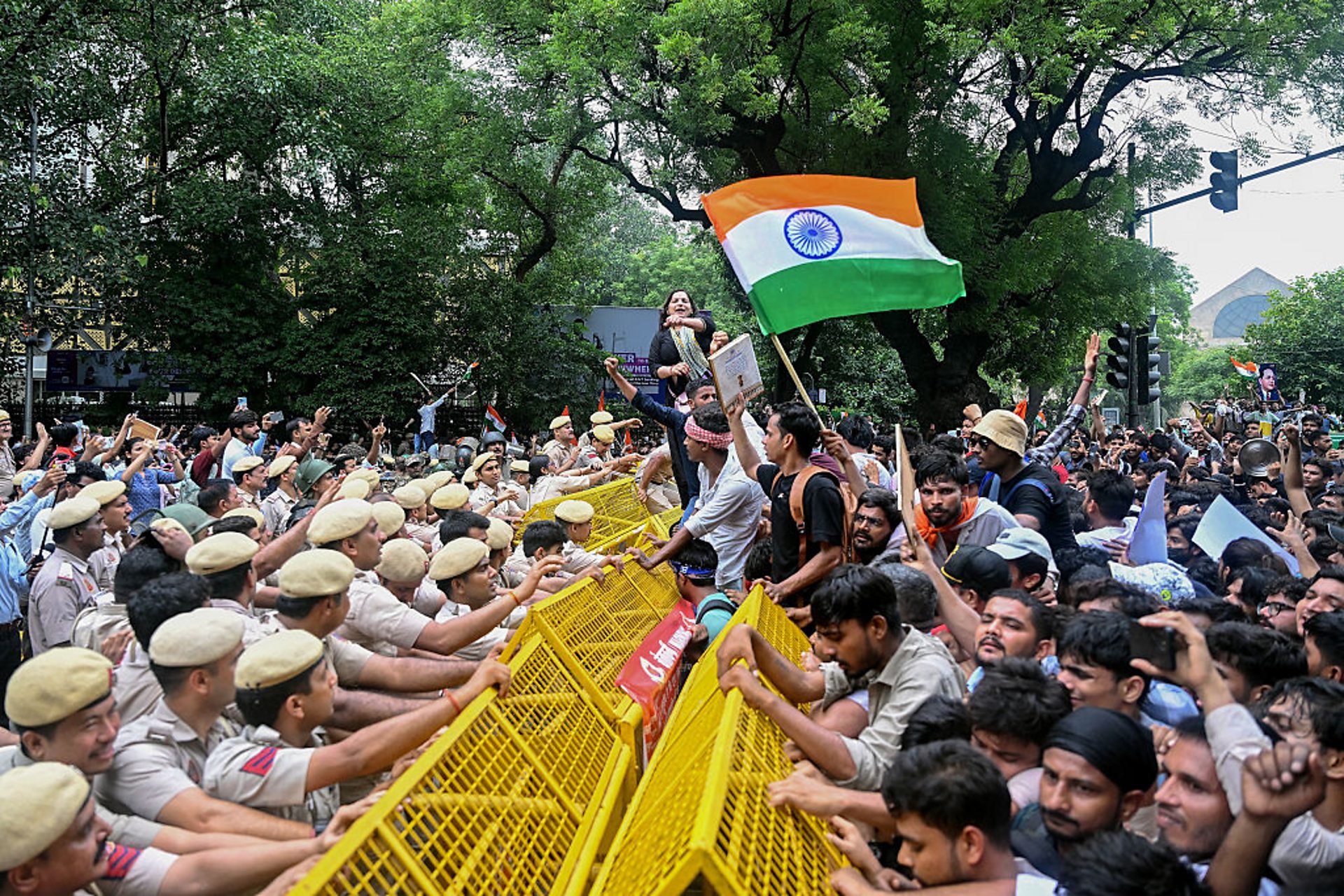
On 20 July, thousands marched from Jantar Mantar toward Parliament in Delhi, in one of the capital’s largest street mobilisations in over a decade. Young people had travelled in from neighbouring states to join. What followed was the entire country watching the Delhi Police respond to a peaceful march with force: tear gas, lathi-charges, and detentions that tried to stop the march before it reached Parliament.
Despite being violently beaten with lathis and in spite of arrests and FIRs, the youth have made it clear: they cannot be deterred and they will fight on. A perfect example of this fearlessness is a young woman who returned to the Jantar Mantar protest site in Delhi on 21st July, 2026 wearing a bicycle helmet, holding a placard and told the media, “We need to have protection in case Delhi police beat us up again. We are not scared of them and we won’t run away, no matter what they do. We’ll stay here till they listen.”
Their fearlessness, their rage, their frustration, and their powerful and fluent use of humour and memes is shifting the tide before our very eyes. Their irony and humour is deflating the time tested toolkit of labelling protesters as anti-nationals or Pakistani or being foreign funded! One young man in Jantar Mantar distributing food to the protesters mockingly said, “This is a funded protest. The samosas are funded by Pakistan and the tea by Nepal!” Another example is how they have tackled the allegations of being anti-Hindu. When a protester was asked by a media channel what his name was, he replied saying “Mohammed Deepak”! Another instance is a video from the Jantar Mantar protests of a Muslim man dancing along with others to Hindu devotional songs. Their sharp and powerful use of humour has played a significant role in amplifying their criticism of a government that refuses accountability. A placard held by a young pregnant woman in a protest in Bangalore read, “Pregnancy cravings: Accountability!” Another placard at one of the protests read, “Modiji, blink twice if the teleprompter won’t let you take questions.”
The protests have taken apart a key element of the BJP’s ideology, namely the relentless focus on promoting communal division for electoral gains. The protest sites have been models of fraternity in action with persons from every religious group participating. The protesters have relentlessly mocked the ‘Hindu-Muslim’, ‘Mandir-Masjid’ politics of the BJP asserting that the BJP is only distracting from the real issues of the youth, namely education and employment.
Reports from the ground describe protesters bleeding from lathi blows, and others treated for breathlessness, burning skin, and dizziness after exposure to tear gas. Parliament Street and Connaught Place bore the marks the next morning, blood stains on roads, overturned barricades, sandals and scarves left behind in the scramble. Protesters and rights groups have raised serious questions about the proportionality of the force used, about internet restrictions around the protest site, and about police personnel operating without visible identification, all of which sit uneasily against the basic legal protections which ensure that the right to peaceful assembly can be exercised by citizens.
The crackdown was not confined to Delhi. Solidarity protests broke out in cities and towns across the country, many met with the same pattern of detention. In Mumbai alone, police filed cases against more than fifty protesters across multiple stations after gatherings at Dadar, Shivaji Park and Chaityabhoomi. Students in Varanasi, Patna, Allahabad and other cities in Gujarat, Telangana, Karnataka and beyond took to the streets in response to the police action itself, the crackdown becoming its own reason to march.
It is worth remembering that while the call to protest began with a demand for Dharmendra Pradhan’s resignation, the crowds at Jantar Mantar have not stopped there. Many now are openly demanding the resignation of Prime Minister Narendra Modi as well. From communal politics to the deepening nexus between state and corporate power, from unemployment to a broken system of examination governance, this generation is not asking for a reshuffle. It is asking for change.
Much of the mainstream coverage has lingered on the injuries suffered by police personnel while offering only glancing attention to the grievances driving the protest or the scale of the mobilisation, many times underplaying these numbers! A generation’s demand to be heard on the question of their very future, has too often been reduced in the retelling to a law-and-order story. This is what happens when journalism forgets its primary obligation: to speak the truth even when it is inconvenient, to question those in power rather than repeat their press notes, and to carry the voices of the people rather than talk over them.
A press that will not do this has failed to be the fourth pillar of democracy and has become something closer to a mouthpiece of the state, reporting the government’s version of events as the only version, and treating a generation’s grief and anger as a nuisance to be managed rather than a truth to be told. At the same time, the commendable efforts of independent news and media outlets, individuals with YouTube channels and other social media influencers have courageously brought the real stories of the protest to the world at large.
Undoubtedly, today the country’s youth have thrown a challenge to the might of the state. No matter how tightly the state controls the media and the police, an entire generation has escaped that control, travelling long distances to stand in the sun, assembling by the lakhs, and turning their own phones into a press the state cannot shut down. One thing that these protests have already achieved, is that they have forced several individuals who are usually silent into speaking out in solidarity with the youth: from parents of students to film celebrities and social media influencers.
The state’s response has been marked by an arrogance which shows in its unwillingness to be accountable for what happened on its watch. No resignation, no meaningful dialogue with the protestors, no independent inquiry on the police brutalities, no acknowledgment of the discontent expressed by protestors. From young children to college graduates, all these protestors have been saying is that, once you are elected into power, you are accountable to us!
After a month of silence, the Prime Minister chose to break his silence through an anodyne tweet, communicating the decision to ‘set up fast-track courts to ensure swift and stringent punishment for those involved in paper leaks.’ However the Prime Minister did not mention the protests happening just a few kilometres from parliament nor did he address the core demand of the protestors, the resignation of Dharmendra Pradhan, showing a stunning obtuseness to the anger of the youth. Neither did he address the core question of why such leaks are happening. Is it because of a few bad apples who can be dealt with through fast track courts or is it an institutional failure with the responsibility lying with the education minister, Dharmendra Pradhan?
Neither the Prime Minister nor the Home Minister addressed the burning question of who was to be accountable for the brutal injuries suffered by the youth including injuries on the head, limbs and pellet injuries. (For a first person account of the protest in Delhi with details on the nature of police violence see the following article by Kavita Srivastava in this issue.)
What was even more shocking was the peremptory and dismissive manner by which the Chief Justice of India responded to a request for urgent listing of a petition about the brutal attack by Delhi police on protesting students and youth in Delhi on 20th July, 2026. The Chief Justice remarked, “Don’t waste our time. We are not interested in videos, we don’t have time to watch.”
At this crucial juncture, we cannot forget that a range of protests across India continue to demand accountability and justice from the state. Adivasi communities across several states continue to resist displacement from their forests and land. Adivasis in Madhya Pradesh have been holding ‘chita’ and ‘faansi’ demonstrations to show that the Ken Betwa River Linking Project will threaten their very lives. Farmers in Punjab remain locked in their own long struggle for fair prices and dignity, farmers in Bidadi, Karnataka stage protests against the acquisition of their fields for a government township. Residents near Visakhapatnam have raised alarms over the environmental and social cost of new data centre projects pushed through with little consultation.
The tide is shifting, and the right to protest guaranteed, not granted, by the Constitution is being reclaimed as the ground on which any movement for change can stand. Lawyers have started speaking out in the Supreme Court as well as the high courts. Doctors in Safdarjung as well as AIMS have begun to express their disquiet at the forcible confinement of Sonam Wangchuk as well as the police violence on 20 June. The silence of the government has fed public anger with thousands coming to protest sites around the country in spite of the crackdown on June 20.
However, one cannot help but bear in mind the inhumane and cruel tactics of the current ruling regime. On 15th July, the powers of the Commissioner of Police, Delhi to detain under National Security Act, were extended from 19th July to 18th October. As Arundhati Roy wrote, “It is vulnerable young people up against a vicious, vindictive government that has shown itself to be merciless to those who oppose it. Revenge is surely being planned and will be visited on those it sees as the main instigators”.
This is the moment for the human rights movement to join this wave, lending its solidarity, its legal shield, and its long memory of what these battles cost and what they can win. This is the moment for education reformers and youth rights activists to walk alongside this generation, and treat the protests as catalysts in the larger aim to demand for structural reform in public education. There is hope in this, and there is strength in it too, proof that even now, people will stand up, to ensure that our rulers do not betray the promise the Constitution makes to ‘we the people’.