Implementation Failures of the Forest Rights Act: Insights from Padaliya, Gujarat
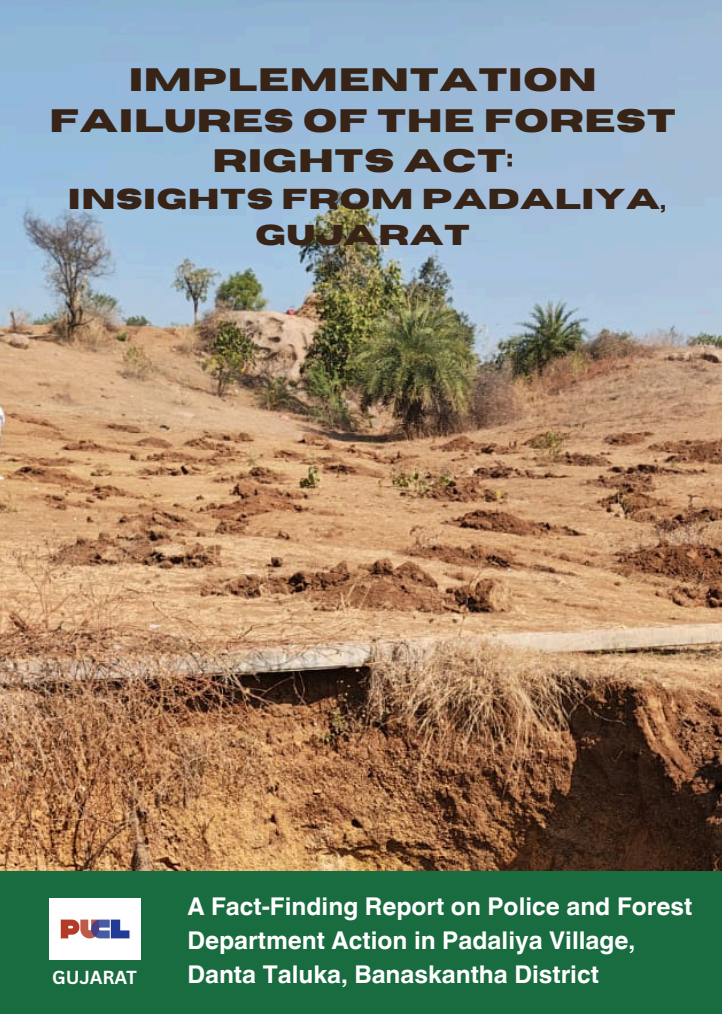
On 13 December 2025, a confrontation in Padaliya village in Gujarat’s Banaskantha district was reported as a violent clash between Adivasi residents and government officials. However, findings from this fact-finding inquiry show that the incident cannot be understood as a standalone law and order issue.
It emerged from a deeper failure in the implementation of the Forest Rights Act (FRA).
In 2023, the Gram Sabha of Padaliya identified 173 residents, including Shakariben Lalabhai, as forest rights claimants. But the verification process stalled due to administrative inaction, including the non-functioning of the Sub-Divisional Level Committee. As a result, villagers continued cultivating land without formal recognition of their rights.
Despite these pending claims, forest officials undertook land clearing and plantation activity in December 2025. Villagers objected, stating that the land was under FRA claims. On 13 December, officials returned with police and machinery, leading to a confrontation.
While police records describe an attack on officials, testimonies indicate that tensions escalated after the demolition of a hut and the destruction of an irrigation well belonging to Shakariben, a widow dependent on the land. The use of force to disperse villagers appears to have triggered the situation.
Following the incident, criminal cases were registered against 26 named individuals and around 500 unidentified persons, creating widespread fear. In contrast, a complaint filed by Shakariben alleging illegal eviction and destruction of property had not resulted in an FIR at the time of inquiry.
The evidence suggests that the Padaliya incident was the result of administrative delay, coercive action on disputed land, and failure to uphold protections under the Forest Rights Act, which prohibits eviction until claims are decided.
Rather than an isolated clash, Padaliya reflects a broader pattern where unresolved land rights and delayed governance create conditions for conflict.