“Are we not Indians?” The Development Politics of Uprooting Citizens and Shattering Lives at Chandola Lake
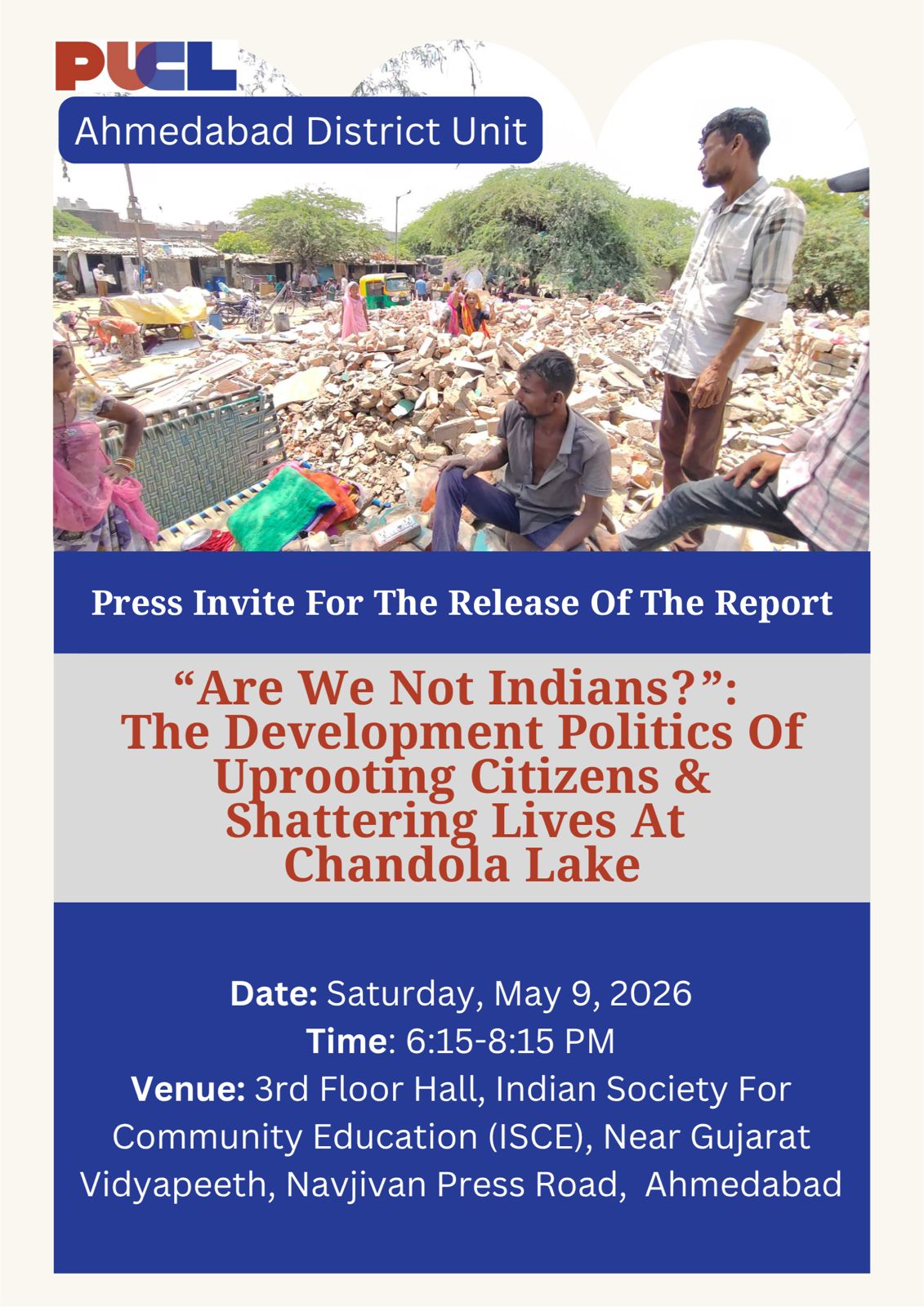
April 2025 saw one of the worst terrorist attacks in India in recent times, when terrorists killed 26 innocent civilians in Pahalgam. Its repercussions were felt by thousands of urban poor living in a residential area at a lake more than 1500 kilometres away, in Ahmedabad, India. These urban poor, most of whom belong to the Muslim community, had been living there for almost fifty years. Between April 27, 2025 and May 2, 2025, hundreds of people from the Chandola Talavna Chapra were publicly paraded, detained and had their houses demolished, on the pretext that the area was a hub of illegal activities and a threat to national security.
This report focuses on the demolition of around 12,500 residential, commercial and religious structures at Chandola Lake, Ahmedabad in April and May 2025. It also draws connections to the housing demolitions which have taken place in Gujarat during the year between May 2024 and May 2025. The Chandola Lake demolitions were not the only major demolitions in Gujarat during this time period. Such demolitions were also undertaken in Beyt Dwarka, Vadodara, Bhavnagar, Mehsana, Jamnagar and Rajkot. There appear to be three reasons that cut across these demolitions: (i) to ‘punish anti-social elements’; (ii) for development purposes such as road widening, lakefront development or riverbank expansion; and (iii) for ‘security purposes. At times it is a combination of these reasons. While the earlier demolitions were an attack on the urban poor, the current wave of demolitions has a religious undertone.
Mapping the demolitions shows that the urban poor of Gujarat face a triple vulnerability in terms of housing. Firstly, they belong in a perpetually flexible state of regulations. Their identity as slum-dwellers leaves them at the mercy of the state and the judiciary, which in recent years have been taking steps to remove the urban poor from their settlements. Secondly, their identity as Muslims makes them susceptible to state violence, being constantly looked at with suspicion, and as threats to national security. Thirdly, this spate of demolitions appears linked to the larger issue of development. Infrastructure development negatively impacts their rights to life and livelihood. This process is unjust and unfair, targeting the urban poor specifically, since demolitions are not undertaken for similar violations by real estate developers or the middle-class population.
The objectives of the report are:
- To document the circumstances of the forced evictions at Chandola Lake, Ahmedabad, creating an archive that centres the voices and rights of the displaced
- To provide an accurate, field-based understanding as grounds for our critique of state, media, and communal propaganda
- To situate the event within broader national-level patterns of anti-Muslim demolitions and urban authoritarianism
The aim of the report is to serve as a resource for activists, lawyers, journalists, and community organisers.
The report is divided into sections focused on the legal, discursive and social components of the Chandola Lake demolitions. The second section presents the methodology used to arrive at the report, drawing on primary and secondary sources. The third section provides a historical and legal context to the demolitions and deportations. This builds heavily on a report titled Unmaking Citizens: The Architecture of Rights Violations and Exclusion in India’s Citizenship Trials, which explores the history of citizenship law. It then highlights the laws that have been passed by the Ahmedabad Municipal Corporation with regards to informal housing in Ahmedabad. The fourth part of the report then presents the recent histories of demolitions between 2024 and 2025, before focusing on the Chandola Lake demolitions. This section details the timeline of the demolitions, their legal dimensions, mainstream media reporting on the issue and the human costs and differential impact it had on its residents.