PUCL condemns the attack by ABVP on students of Azim Premji University
Universities must protect the spirit of critical inquiry, not surrender to the blackmail of mob violence!
Government of Karnataka must unilaterally withdraw the prosecution which targets the students!
PUCL Karnataka strongly condemns the attack on students of Azim Premji University and the members of Spark Reading Circle by members of the Akhil Bharatiya Vidyarthi Parishad. Unfortunately, the response to lawless violence of the ABVP by feckless university administrations is to cave in and abandon the core mandate of a university which is to cultivate a fellowship of learning.
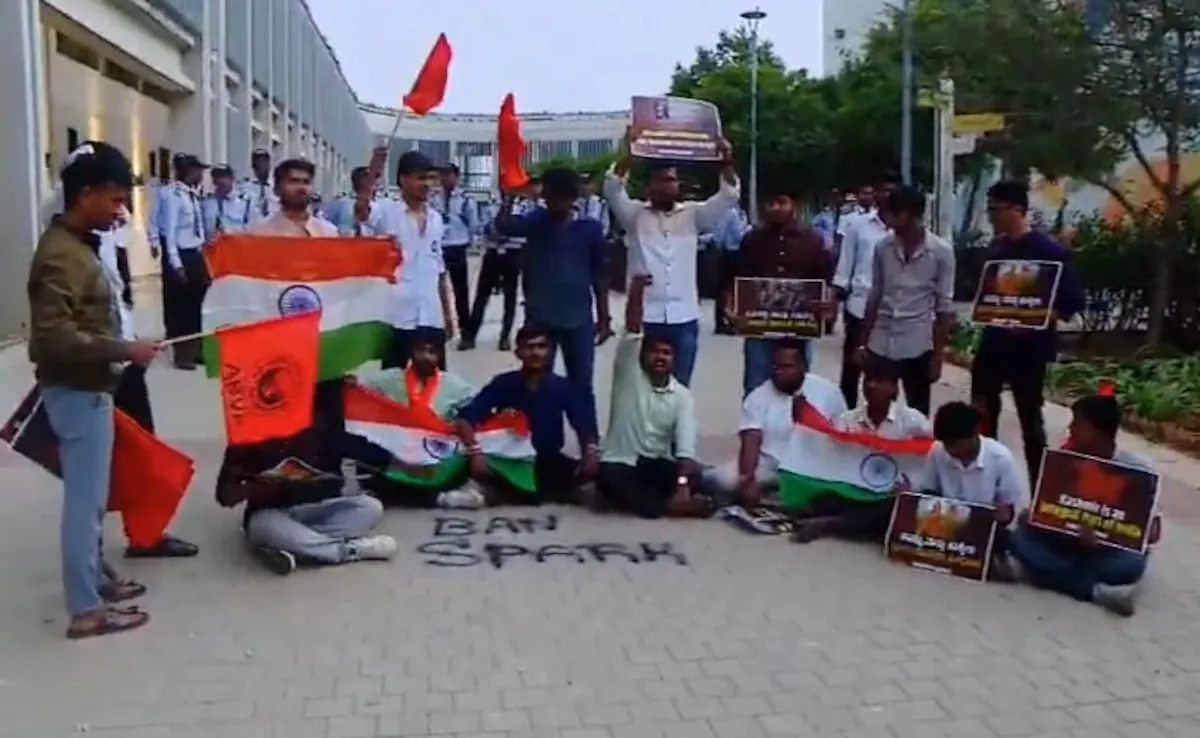
On 24th February 2026, ABVP goons illegally trespassed into Azim Premji University (APU) in Sarjapura, Bengaluru, apparently triggered by an Instagram post from the student group Spark Reading Circle APU announcing a discussion on the 1991 Kunan-Poshpora incident in Kashmir, which they labeled “anti-national”.
The ABVP members gathered outside the APU campus, raised slogans waved the Tricolour, then trespassed, assaulted security guards and a first-year BA student, issued death threats, vandalized property by smearing black paint on the signboard and wrote slogans like “ban SPARK” and “ban AISA”.
These actions of the ABVP members clearly amount to vigilantism. The Supreme Court decision in Tehseen Poonawalla v Union of India in fact addressing the nature of vigilantism held that,
“Such vigilantism, be it for whatever purpose or borne out of whatever cause, has the effect of undermining the legal and formal institutions of the State and altering the constitutional order. These extrajudicial attempts under the guise of protection of the law have to be nipped in the bud; lest it would lead to rise of anarchy and lawlessness which would plague and corrode the nation like an epidemic. The tumultuous dark clouds of vigilantism have the effect of shrouding the glorious ways of democracy and justice leading to tragic breakdown of the law and transgressing all forms of civility and humanity. Unless these incidents are controlled, the day is not far when such monstrosity in the name of self professed morality is likely to assume the shape of a huge cataclysm. It is in direct violation of the quintessential spirit of the Rule of law and of the exalted faiths of tolerance and humanity.”
The Sarjapur Police Station formally arrested 20 persons on February 25 following the registration of an FIR based on a complaint by security manager S Wilson. The case invokes BNS Section 191 (rioting), 189 (unlawful assembly), 351 (criminal intimidation), 115 (voluntarily causing hurt), 352 (intentional insult to provoke breach of peace), and 329 (criminal trespass). The injured security guards include Jagadeesh, Chandan Mahalik, Chitr Bahadur, Naresh, Sripathi, and Harish. The accused have already been granted bail.
Shockingly the APU Registrar Rishikesh BS’s response to this blatant attempt to police university spaces by lawless violence was to file a separate complaint against the Spark Reading Circle APU Instagram account for posting about an event on the Kunan-Poshpara “mass rape” allegedly by army personnel, accusing it of defaming the university, and instigating enmity. The university in their complaint emphasized that there was no faculty knowledge or permission for the event.
Based on this complaint, on February 24, Police registered a case against the office bearers of Spark Reading Circle APU under IT Act Sections 66E (privacy violation), Section 67 (obscene material), Bharatiya Nyay Sanhita Section 229 (false evidence) and Section 299 (outraging religious feelings). It is abundantly clear that the ingredients for these offences are in no way made out.
The complaint has been filed by Registrar. It is beyond comprehension how the Registrar claims to be aggrieved by a reading circle on Kunan Poshpara. The Police has failed to apply its mind to the facts which do not constitute any crime – forget the crime of outraging religious feelings and obscenity.
At this stage it is crucial to bring to attention what is the incident of Kunan Poshpara? The issue, in the opinion of the PUCL is a serious one and should be discussed. It has been documented by numerous fact finding bodies including Human Rights Watch and the Jammu and Kashmir Coalition of Civil Society (JKCCS). In Kashmir itself the infamous day is marked as Kashmiri Women’s Resistance Day. There is academic literature on the point including a book by Essar Batool titled, ‘Do you remember Kunan Poshpora?’ published by well-known feminist publisher Zubaan books.
As per the 2018 Report of Office of the United Nations High Commissioner for Human Rights titled “Situation of Human Rights in Kashmir: Developments in the Indian State of Jammu and Kashmir from June 2016 to April 2018, and General Human Rights Concerns in Azad Jammu and Kashmir and Gilgit-Baltistan” –
“According to survivors and a local administration official, on the night of 23 February 1991, soldiers from the 4 Rajputana Rifles regiment of the Indian Army gang-raped around 23 women of Kunan and Poshpora villages of Kupwara district. The Indian Army and Government of India have denied the allegations. In 1991, Wajahat Habibullah, who at the time was the divisional commissioner of the Kashmir region (a civil service position), filed a report with the state government addressing these allegations. In March 1991, former Chief Justice of Jammu and Kashmir High Court Mufti Bahauddin Farooqi led a fact-finding team that interviewed several survivors; he reportedly noted that “he had never seen a case in which normal investigative procedures were ignored as they were in this one”.The Jammu and Kashmir Police stopped its investigations by October 1991 after it declared the case was “untraceable”. In July 2013, Wajahat Habibullah accused the state authorities of deleting parts of the report where he had recommended a higher level investigation and a special order to ensure army cooperation”
Universities are spaces of intergenerational learning and reflection. The students by discussing Kunan Poshpara and abuse of AFSPA were centering the continued injustice to the survivors of sexual violence by the Armed Forces which took place 27 years ago and for which attempts to seek justice have been denied and blocked over the years by the authorities at different levels. The antagonism of the state points to how systematically there is culture of impunity and fear such that the mere expression of solidarity with survivors of such grave injustice has been responded with weaponizing of the law.
The action of the APU administration in which they take criminal action against their own students does grave injustice to the very mandate of APU. The APU website declares that ‘we care for the well-being of each individual in our community. We hope that learning can be a dynamic and creative process that will help all individuals discover their potential.’ One is hard put to discover any ethic of care in the decision to file an FIR targeting their own students! The Registrar, Mr Rishikesh needs to answer the question as to how he justifies the shocking decision to file FIR targeting his own students as aligned with the mandate of APU to ‘care for the well being of each individual’ in the APU community?
Leaving aside the specific APU mandate of care, the question of what does a university do in the context of the discussion of topics which may be unpalatable to the powers that be remains.. In the face of serious engagement by both civil society and academia, surely APU cannot take the morally and constitutionally indefensible position that discussion per se warrants the filing of an FIR against its own students!
The APU administration has failed to honour the constitutional mandate of Article 51-A(h), to develop the scientific temper, humanism and the spirit of inquiry and reform. The role of a university is to foster discussion even on difficult issues, not shut down speech. The fact that in this case the shutting down of speech was in response to the vigilante action on APU’s campus, makes APU complicit in silencing its own students and abandoning the mandate to foster a spirit of conversation.
By contrast the Karnataka Home Minister Dr G Parameshwara has not only condemned the violence but has also gone on to state that no one can interpret seminar topics unilaterally or take law into hands, affirming strict action!
The attack indicate the increasing fragility of the atmosphere of open discussions in university spaces. On 20th February, 2026, All India Students’ Federation, the student wing of CPI organized a study circle in Dr. Hari Singh Gour University (Sagar, Madhya Pradesh) aimed at promoting scientific temper and rational debate. However, the study circle was interrupted by a mob of 100 to 150 people allegedly from the ABVP and RSS, who assaulted the participants. There have been other such attacks at the Jawaharlal Nehru University, Banaras Hindu University, and Jadavpur University among others.
The ABVP attack on students in Azim Premji University is thus only the latest flashpoint in what is becoming a calculated strategy to intimidate the spirit of inquiry into silence. The strategy involves the use of violence by groups such as the ABVP acting as vigilante enforcers of a morality at odds with the Constitution. When mobs are emboldened and speech is silenced, the culture of a rich and vibrant associative democracy at the heart of which are universities erodes.
We urge the Government of Karnataka to unilaterally withdraw the prosecution which targets students and we call upon law enforcement authorities to conduct a prompt investigation, ensuring that those responsible for the attack at APU are held accountable under the law. Remembering injustices is an act of resistance and PUCL stands with the students of Sparks Reading Circle targeted through the FIR.
Arvind Narrain, President
Shujayathulla E, General Secretary
PUCL – Karnataka