PUCL Discussion Paper: India’s unconstitutional silence in the face of the illegal war against Iran is a betrayal of the idea of India
By PUCL National
Introduction
The PUCL is outraged by and strongly condemns the unprovoked and illegal bombing of Iran by the United States and Israel which commenced on February 28, 2026. As of 10 March, 2026 the bombing has spread death and devastation across Iran, with over 1300 civilian deaths, including over 200 children and destruction of Iran’s infrastructure in over 200 cities. The bombing also resulted in the targeted assassination of Iran’s Supreme leader, Ayatollah Ali Khamenei.
This unprovoked campaign of terror by Israel and the United States is a violation of international law. The heart of the UN Charter, Article 2(4), mandates that, ‘All Members shall refrain in their international relations from the threat or use of force against the territorial integrity or political independence of any state, or in any other manner inconsistent with the Purposes of the United Nations.’ This provision is meant to outlaw the crime of ‘aggression,’ which, according to the Nuremberg tribunal, is the ‘supreme international crime.’ It is only when nation states eschew force as a way of resolving disputes that the Preambular promise of the UN Charter, ‘to save succeeding generations from the scourge of war’ which has ‘twice, brought untold sorrow to mankind,’ can be fulfilled.
India under Modi has betrayed its constitution and its anti-colonial heritage and abdicated its leadership of the global south
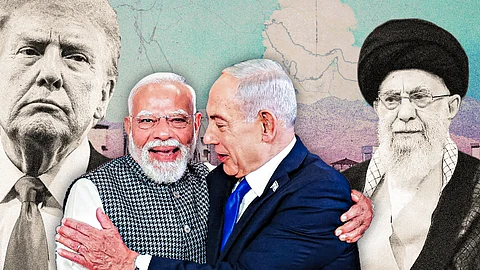
India has remained silent in the face of this illegal war and choose not to issue any condemnation of the illegal US- Israeli aggression. The Prime Minister, Narendra Modi in a particularly cynical decision, chose to visit Israel just 2 days before the bombing began on 28th February. This was when there was a warrant of arrest issued by the International Criminal Court (ICC) against the Prime Minister of Israel for crimes against humanity committed in Gaza. It is all the more shameful, that in his address to the Israeli Cabinet, he declared that ‘India stands with Israel firmly, with full conviction, from this moment and beyond.’ Is one to make that as far as Modi is concerned, the fact that there are credible accusations of genocide against Netanyahu is of no consequence? Are we to understand that the official position as repeatedly stated by the Ministry of External Affairs, that ‘India supports a two-state solution, towards the establishment of a sovereign, independent and viable State of Palestine’ has changed? Which then takes us to the point that as far as India today is concerned there are no values (leave alone constitutional values) which govern its foreign policy.
The immorality of the Indian position was exposed on the world stage when India chose to remain silent on 4th March, 2026, when an unarmed Iranian warship, the IRIS Dena was torpedoed by the United States when the ship was returning to Iran after the “Milan” biennial multilateral naval exercise which was hosted by India and was within Sri Lankan waters. What is shocking is that the IRIS Dena was part of a set of 3 warships from Iran which on India’s invitation participated in a multi-national naval even in Vishakhapatnam between 15th to 25th February, 2026. In fact during the event, Indian President Droupadi Murmu had participated in the meet.
When our country’s honoured guests, about 86 young Iranian naval officers were murdered, India till date, has failed to condemn the attack! Not only was India unable to protect its guests in what it sees as its backyard, but further did not even issue the mildest condemnation of the US action targeting a vessel which was not in the theatre of war and posed no military threat. This speaks to India abdication of leadership of the global south, and India’s betrayal of both its constitutional vision as well as the abandonment of its oft declared sovereignty over the Indian Ocean.
This abdication of leadership and the decision to cosy up to the United States is not only bereft of any values, but also has implications for the core constitutional principle of sovereignty. The decision to subordinate our interests to the demands of the United States regardless of our relationships with other nations, is an infringement of India’s freedom to act as a sovereign nation. The cat was out of the bag when the US Treasury Secretary Scott Bessent on Friday announced that Washington issued a temporary 30-day waiver to allow Indian refiners to buy Russian oil already on vessels. The question rightly being raised is does India need US permission to import Russian oil? Is this not an infringement of India’s sovereignty?
We have a proud heritage of defending our sovereignty which Modi is betraying. The current dispensation can take a lesson from the first Prime Minister, who did not hesitate to criticize the powerful when they acted outside the constraints of the rule of law. When moving the Objectives Resolution, Nehru fiercely defended Indian sovereignty and spoke out against even perceived attempts to dictate what India’s policy should be. As he put it, ‘The only way to influence India is through friendship and co-operation and goodwill. Any attempt at imposition, the slightest trace of patronage, is resented and will be resented.’
The current India US relationship seems to be one of a master and a vassal. While Nehru resented ‘imposition’, Modi silently acquiesces in whatever way Trump decides to slight and insult India.
Illegal war against Iran
The war in which Modi has silently acquiesced in has no justification in international law. Israel and the US have tried to give a series of shifting justifications for the attack ranging from the supposed nuclear threat posed by Iran to the threat posed by its missile programme to regime change.
Most tragically, on 28th February, 2026, the very day Israel and USA started bombing Iran the Omani Foreign Minister Badr bin Hamad Albusaidi announced a historic breakthrough in the talks between Iran and the USA regarding the issue of nuclear bomb and stockpiling of nuclear material. Even as he declared, “If the ultimate objective is to ensure forever that Iran cannot have a nuclear bomb, I think we have cracked that problem through these negotiations … the single most important achievement, I believe, is the agreement that nuclear material that will create a bomb”.
What is eerily apparent is that the USA and Israel felt threatened by the historic breakthrough which could have brought lasting peace to not just Iran but all of West Asia, and very cynically decided to bomb Iran on the very same day citing a reason which is exposed to be entirely fictitious.
The rationale for bombing Iran not only has no basis in any independently verifiable threat but also smacks of the hypocrisy of two nuclear-armed nations (USA and Israel) taking on the self-assumed role of policing nuclear ‘threats’ outside the framework of the Nuclear Non-Proliferation Treaty and asserting that they had the right to attack Iran.
PUCL believes in disarmament and does not support the dangerous trend towards militarisation around the world. However, disarmament is a global imperative for all nations in the world and the requirement of disarmament cannot be imposed on any one nation unilaterally. Iran’s missile programme falls very much within this logic of the sovereign equality of states. There is no legal justification for any other state, including and especially nuclear armed Israel or the US, to unilaterally demand that Iran’s missile capability be dismantled.
There is absolutely no legal, ethical or moral justification for the USA and Israel aiming to bring about regime change; this falls entirely outside the sphere of international law which is based on the understanding that the international order consist of sovereign states with different social, legal and political systems. If a powerful state goes to war to unilaterally demand that the internal governing mechanism of a state be changed, then it spells the end of international law as we know it. The targeted assassination of Iran’s Supreme Leader lays waste to the principle of sovereignty on which international law is based.
The justification for regime change offered by Trump was the shooting down of protesters against the regime. Trump said that he had “put Iran on notice“ and that if the regime shoots at demonstrators the U.S. will hit Iran “very hard.”
It is true that the protests which rocked Iran were met with brutal state repression and the mowing down of unarmed protesters in their thousands (some estimates put the toll as high as 35,000) on January 8 and 9th of 2026. Human Rights groups around the world have not forgotten the brutal repression by the Iranian regime of the protests which erupted in 2022 following the killing of Mahsa Amini resulting in 551 causalities. However the means to make the regime accountable for human rights abuses is not through the unilateral, arbitrary and immoral act of bombing Iran and launching an unprovoked war. This will only hurt the Iranian people and push the cause of human rights even further from their reach.
The Iranian regime must be made accountable for these unconscionable deaths as the Iranian state is bound to respect the human rights of its citizens under the UN Charter. However, it is utterly cynical of the US and Israel to use these deaths as a factor to legitimise a war which has already resulted in over 1300 civilian deaths, thousands of casualties and mass suffering through the attack on civilian and military infrastructure.
Global response to the illegal war against Iran
The UN Secretary General has stayed true to the mandate of the UN by reminding the Security Council on 28th February that Article 2(4) of the UN Charter states that all Member States “shall refrain in their international relations from the threat or use of force against the territorial integrity or political independence of any State,” and that international law and international humanitarian law must always be respected.
However, this basic fidelity to the UN Charter was lacking on the part of the Western powers. The leaders of France, Germany and the United Kingdom stated that they were ‘appalled by the indiscriminate and disproportionate missile attacks launched by Iran against countries in the region’ and went on state that they would enable ‘necessary and proportionate defensive action to destroy Iran’s capability to fire missiles and drones at their source’ and would ‘work together with the US and allies in the region on this matter.’ They had not a word of condemnation of the US or Israeli action as a fundamental violation of international law. These western nations are not only silently acquiescing but actively supporting the criminal actions of the USA and Israel.
Spain was the only western country to unequivocally state that ‘Spain’s position is the same as in Ukraine or Gaza. `No to the breakdown of international law that protects us all. No to resolving conflicts with bombs. No to war.’
Russia and China have condemned the US Israeli war against Iran as has Pakistan!
War is the`Supreme international crime’ and India’s silence is unconscionable
PUCL has always opposed the crime of aggressive war. As the judgment at Nuremberg put it, ‘To initiate a war of aggression, therefore, is not only an international crime; it is the supreme international crime differing only from other war crimes in that it contains within itself the accumulated evil of the whole.’
It is this supreme international crime which needs to be condemned without reservations, as ‘war’ implies a range of other violations. It is the fount of all violations. India under Modi has shown itself unable to condemn what is without doubt the ‘supreme international crime’. This is unconscionable and unacceptable!
There should be a constitutional compass to Indian foreign policy
Foreign policy as conducted by the Modi government has shown itself to be purely transactional and bereft of values. The values which should underpin our foreign policy must derive from our Constitution. The Directive Principles of State Policy, under Article 51(c) oblige India to ‘foster respect for international law’ and under 51(a) require the State to ‘promote international peace and security’, under 51(b), ‘to maintain just and honourable relations between nations’ and under 51(d) ‘encourage settlement of international disputes by arbitration’. If these values give a constitutional compass to our foreign policy, then the bombing of Iran and the assassination of her Supreme Leader should be condemned as a violation of Articles 51(a), (b), (c) and (d ). It is further the fundamental duty of every citizen and by implication every high constitutional functionary to ‘abide by the Constitution’ and ‘respect its ideal and institutions under Article 51-A (a), to ‘cherish and follow the noble ideals which inspired our national struggle for freedom’ under Article 51-A (b) and to ‘uphold and protect the sovereignty, unity and integrity of India’ under Article 51-A (c).
As early as in 1946 itself, even before we formally and officially gained independence on 15th August, 1947, the drafters of the Indian Constitution very much envisioned a contribution of a future independent India to global peace. The `Objectives Resolution’ – which later became the Preamble to the Constitution – adopted by the Constitutional Assembly on 22nd January, 1947, very clearly emphasised in sub point 8 that,’this ancient land attains its rightful and honoured place in the world and make its full and willing contribution to the promotion of world peace and the welfare of mankind.’
As Nehru said in the Constituent Assembly, in the famous ‘tryst with destiny speech that our ‘dreams are for India, but they are also for the world, for all the nations and peoples are too closely knit together today for any one of them to imagine that it can live apart. Peace has been said to be indivisible; so is freedom; so is prosperity now; and so also is disaster in this one world that can no longer be split into isolated fragments.’
The idea of India in the world was also articulated powerfully by Rabindranath Tagore who invoked the ideal of a people who were not ‘afraid’ and a context where ‘the world has not been broken up into fragments by narrow domestic walls.’
India’s foreign policy in the past has derived from these constitutional values of promoting peace, upholding the UN based international order and defending the sovereignty of nation states, in particular from the global south. In fact, India has had a proud history of opposing aggression by imperial powers drawing from the values of the Indian Constitution.
The idea of India draws upon the understanding that imperial wars are a threat to world peace
Going back to another historical parallel, one should remember the Suez Crisis of 1956. When Nasser nationalized the Suez Canal, Egypt was attacked by the trio of Israel, the U.K., and France. India’s response to this unprovoked attack was to assure Nasser of India’s full support and to call the actions of Britain and France a ‘reversion to a previous and unfortunate period of history when decisions were imposed by force of arms by Western powers on Asian countries… The whole purpose of the UN is undermined, and the freedom of nations is imperilled if armed might is to decide issues between nations.’ As Nehru put it, this was a ‘reversal of history,’ and ‘no country in Asia or Africa, which has recently achieved freedom, can possibly tolerate this reversal.’
After the brutal European colonisations of the 18th and 19th centuries the world saw the period of decolonisation beginning from the independence of India in 1947 going right up to the end of the apartheid regime in South Africa in 1992. Today we seem to be witnessing a period of recolonization. The brutal assault on Gaza, Lebanon, Syria and Iran by the Israeli regime with the support of the United States speaks to this stark new reality. The kidnapping of the President of Venezuela, Maduro on 3rd January, 2026 and the continuing brutal blockade on Cuba by the United States is again a manifestation of unchecked power asserted by the US which is unquestioned by many countries including by the government of India. All this is reminiscent of the period when the coloniser countries of the West exercised hegemonic control over the rest of the world.
India should recognise the current reality as nothing other than a form of neo-colonialism and respond accordingly. India has a historical legacy to guide our actions being part of the founding group of the Non-Aligned Movement. India’s foreign policy should also be anchored in the values of the Constitution as well as the significance of the UN Charter all of which are even more relevant today.
Unfortunately, the Modi government chooses to eschew the ideals which animated the birth of India and rather operate in a particularly amoral, cynical manner. India today prides itself on its transactional approach to foreign policy. This is a shameful limitation on our role on the international stage compared to the key role India has played earlier as leader of the Non-aligned movement.
It is in India’s self-interest to defend a rules based order
The defence of international law is not only a constitutional imperative but also in the self-interest of a middle power like India. As the Canadian Prime Minister Mark Carney put it, ‘the middle powers must act together, because if we’re not at the table, we’re on the menu.’ When middle powers only negotiate bilaterally with a hegemon, we negotiate from weakness. We accept what’s offered. We compete with each other to be the most accommodating. This is not sovereignty. It’s the performance of sovereignty while accepting subordination. In a world of great power rivalry, the countries in between have a choice – compete with each other for favour, or to combine to create a third path with impact.’
In a rapidly changing world where re-colonisation by the most powerful countries is the imperative, India must act in its self-interest. Cosying up to the hegemon is not in India’s self-interest. India should aim as Carney indicated for something larger. It should aim to bring together the middle powers and aim to constrain the hegemony of the most powerful. It cannot stay silent when President Trump has bombed eight countries in one year laying waste to the principle that the powerful are constrained by international law.
Conclusion
The US and Israel bombardment of Iran has a direct implication for the rest of the world. What is being done is the destruction of a world order governed by a whole body of international law. This wanton disregard for international law is also being seen in the continuing genocide in Gaza in which the world watches as Israel with US complicity continues its destruction of the very foundations of the collective life the Palestinian people. In Gaza alone, the US and Israel have killed more than 72,000 Palestinians till date, and have continued to deliberately impose a siege on the people of Gaza, manufacturing conditions for starvation, malnutrition and disease. At least 615 of the killings took place during airstrikes and murders during the ‘ceasefire’ between Israel and Hamas.
The impunity with which the genocide against Gaza and the current war are perpetrated is encouraging fascist and supremacist regimes around the world. The message that Modi’s visit to Israel (in February, 2026) sent out was that international law is of no consequence. Twinned with the abdication of a responsibility to protect international law is the willingness to shred the Indian Constitution. It is clear that the Modi regime would have no hesitation in displacing the constitutional principles of human rights, equality and justice by militarized nationalism and the suppression of dissent.
The invasion of Iran has no legal, moral or ethical justification and must be condemned in the strongest possible terms. This is the mandate of both international law as well as the Indian Constitution. If this armed aggression is not condemned by the world’s largest democracy, it becomes one more nail in the coffin of the international legal order. Each time such violations pass without condemnation, the principle of impunity by the powerful gets sanctified.
In this context of a willingness to tear down the rules based order by the powerful, India’s immoral and unacceptable silence highlights a dangerous backsliding from India’s historically pre-eminent position as a leader of the non-aligned nations. India had stood for an international rules based order based on resolving disputes through dialogue and discussion. India should have had a clear unequivocal condemnation of the unprovoked war against Iran drawing her position both from India’s anti-colonial heritage as well as her Constitution.
The Modi government must therefore condemn the bombing of Iran by US and Israel, the attack on the Iranian warship IRIS Dena in the Indian Ocean waters, and the continuing war against Iran, in the strongest terms and make a case that India stands in defence of the UN Charter and the right of all nations not to be subjected to wanton attacks.
The Modi government must also return to our constitutional imperative to promote peace and work towards building rapprochement between all parties and bring an end to this needless war. This is vital especially as there is the possibility of the war turning nuclear. This would be a devastating catastrophe which India must work towards preventing.
This is the heart of the idea of India sanctified in the Indian Constitution.
Picture Credit: Newslaundry